
How To Get Free Traffic to Your Blog

After months of analysis, testing and measuring, I’ve learned the easiest way to get traffic to a website is to simply create hundreds of pages. Yep, that’s the secret. I’m sure you were expecting something more groundbreaking, but the truth is rarely as exciting as our expectations.
Increase Your Opportunity Surface Area
If you publish a couple hundred blog posts, you’ll rank for keywords you hadn’t even thought of. Each one is an opportunity to be found, so all you have to do is increase your opportunity surface area.
That being said, search engine traffic, in every single one of my niches, has been uniformly the worst-converting traffic out of all the traffic sources I’ve measured. Search engine visitors to my blog typically stay the least amount of time, view the fewest pages, opt in the least often and have very little of what I call stickiness.
Their loyalty is measured in discounts, and they don’t stick around long enough to get to know me. It’s been my experience that you have to give people a reason to get to know you before they visit your website. And you do that by telling them a story. Not just any story, but your story.
I admit I do get tons of search engine traffic to my blog, but I’d hate to have to make a living just from that traffic alone.
Content marketing is an investment of time and effort that yields compounding returns. But your highest ROI will come from the relationships you build with readers that are genuinely invested in your personal brand.
Quality Wins…But Only in Large Quantities
Every SEO and content marketer will tell you that quality is the only thing that truly matters when it comes to content. And every single one of them is lying. With good reason though. Everyone that is anyone in digital marketing is aware that Google’s staff occasionally read their articles and social media posts.
So, they do their best to sound like they’re “on Google’s side,” promoting its best practices and advising their readers to be as wildly inefficient as possible in their efforts to rank on the platform. Instead of just embracing the reality that their entire industry is predicated on staying one step ahead of Google.
I don’t know about the marketing gurus, but Google has never once offered to pay me to kiss their ass. I get better results by entertaining my readers and telling blunt-force truths than performing unpaid PR for a company that wouldn’t care if I starved to death.
They want to give the impression that they don’t “over-optimize” their content in case someone from Google happens to read their advice, as well as convince any aspiring competitors that quantity doesn’t increase search rankings. Because it does.
Remember, Google ranks pages, not websites.
Remember, Google ranks pages, not websites. The more keyword-targeted pages you have on your website, the more individual opportunities you have to rank in search results and that means more traffic.
According to HubSpot, “The more content you have available on your site, the more opportunities you create for visitors to find it.”
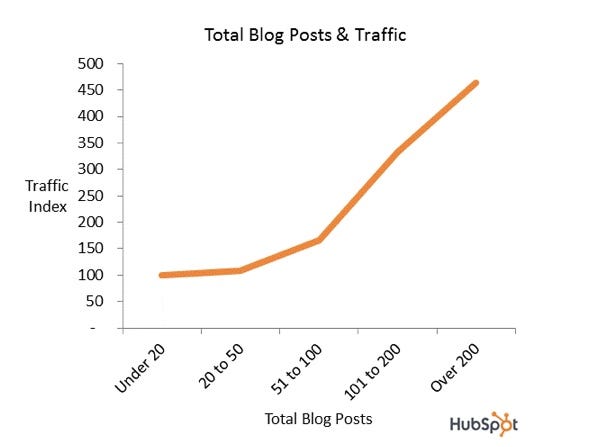
The raw number of pages on your website is directly correlated with the amount of inbound web traffic your site will draw. HubSpot’s report reveals the following statistics for both B2B & B2C companies:
- Companies with between 51 and 100 pages get 48% more traffic than those with only 1 to 50 pages on their site.
- Websites with 101 to 200 pages generate 2.5x more leads.
- Companies with more than 200 pages on their site get approximately 5 times as much inbound traffic as companies with 10 pages or less.
- Companies with 1,000+ web pages see 9.5x more traffic than companies with under 50 pages.
We all know subpar content doesn’t perform well, that horse has been beaten to death, resuscitated and bludgeoned twice more. The truth is, all other factors being equal, a site with more content will get more traffic than a smaller site of similar quality.
On-Site Search Engine Optimization
Internal linking plays a part in this. If you have more pages, you can create more internal links. Each page on your site has its own assigned PageRank, a metric used by Google to calculate the authority of individual web pages. By linking to other relevant pages, you can increase their rank in search results. Because each link is viewed by Google as an “endorsement” of the target page’s authority within that niche.
Whenever I publish a new article on my blog, I look for an older article relevant to the topic and link to it. Chances are, you’re already doing this on Medium in order to “revive” old stories that don’t get many monthly reads anymore. Each post becomes an opportunity to highlight another post that might interest the reader.
Your blog is no different. And all of those links you create to other posts/pages on your site help them climb the search rankings. While an internal link from your own site isn’t as beneficial as an external backlink from Forbes, it’s well worth the five minutes of effort.
Why Google Doesn’t Want You to Learn SEO
Google doesn’t want you to perform SEO. They want you to churn out endless high-quality content that fulfills their users’ needs, and then pay them for ads to bring traffic to that content. That is their business model. Learning all of the little tricks to rank your site organically costs them advertising dollars.
While one of their goals is indeed to improve the quality of search results, their main goal is to keep their investors happy. Which means they always need more advertisers paying them more money for less traffic. Their algorithm updates simultaneously serve to fulfill both of these goals.
This leads to an unsustainable clickonomy, where website owners have to continuously compete for shrinking market share. There’s a new competitor popping up every day, which means you need to publish more content faster and pay more for fewer clicks on PPC ads. It’s a race to the bottom.
Your goal then is to become the Wikipedia of your specific niche, covering every facet and frequently asked question in as much detail as possible. But also to provide them whatever they searched for as efficiently as you can, so that they don’t yawn and sprain their thumb from slamming the back button.
Content volume and frequency are key drivers of growth. More content, higher word counts, more often. Google favors those who keep their sites consistently updated with fresh content. Sounds a lot like Medium, right?
In its infinite wisdom, Google’s algorithm also postulates that a 2,000 word article, quality and other factors aside, is more authoritative than a more concisely-written 800 word article on the same topic. Even if the latter tells you what you need to know just as well with fewer words. The word of the day, readers, is more.
A Simple Trick to Monetize Your Humble Blog
Before I wrap this up, I’m going to give away another secret the marketing gurus won’t tell you. Once your site is ranking for a few keywords, you can get paid handsomely to publish content that other people write for you.
Here’s how it works. Say you have a website about fitness, and you do the work to get a Domain Authority of 40 (per Moz and Ahrefs). You reach out to digital marketing agencies and offer to publish guest blog posts with a link to one of their clients’ websites. For a fee.
Digital marketers spend all day looking for website owners that will do this, so you’re making their job easier. Depending on your niche and how well you’re ranked, you can ask for anywhere from $20–500 per link.
They’ll have one of their content creators (real ones, not OnlyFans “content creators”) write up a 2,000 word post, proofread it and find images for it, then send it to you. All you have to do is hit “publish.” Now you’re getting free content and earning an income for publishing that content. Rinse and repeat.
Every digital marketer claims they don’t buy backlinks, and, once again, every one of them is lying. All marketers buy backlinks. They have to in order to stay competitive.
You simply can’t scale the time-consuming task of searching for sites relevant to your client’s site, reaching out to them and hoping your email doesn’t get lost among the thousands of other people doing the same thing. Especially if you’re not going to pay them when everyone else will.
If your site isn’t already ranking well for some really competitive keywords, you’re probably not going to get rich by posting affiliate links and cluttering your website with annoying AdSense ads. Not unless you’re getting massive traffic that would be better monetized by simply selling a course or something to them directly.
However, if you reach out to a bunch of agencies and offer to help them out with a guest blog post, you can make hundreds, even thousands of dollars a month with almost no effort at all. That’s about as close to passive income as it gets.


