
Aging and Exercise
How to Get Started with Resistance Training If You Are Over 40
The older you get, the more important it becomes.
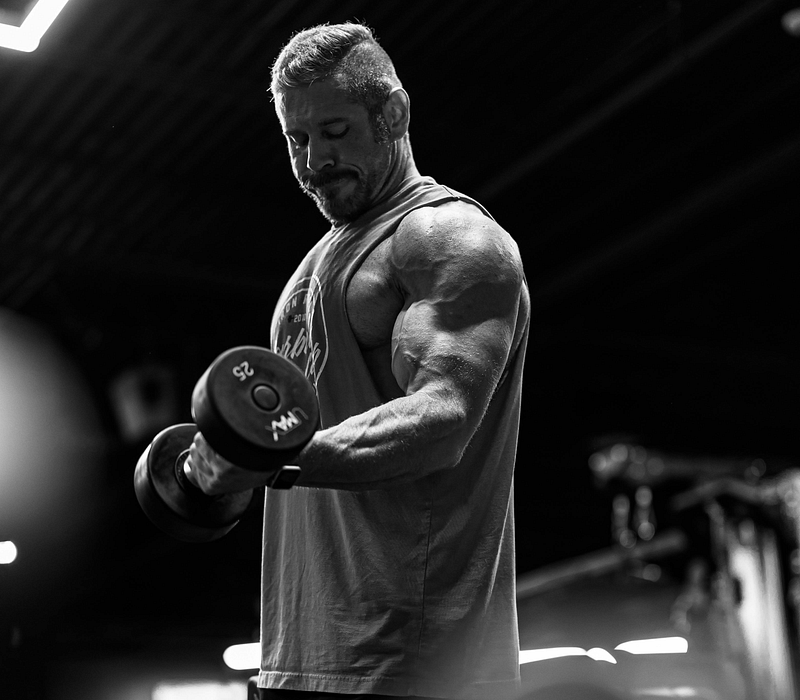
It seems incredible that I’ve been lifting weights for over 45 years now. I remember when I first started; I knew nothing and reliable information was hard to come by at that time. So, I made a lot of mistakes. But, over the years, I’ve done extensive research into all areas of health, fitness, and muscle-building principles, and I also gained a professional qualification in biomedical sciences.
Now, as an “older guy” myself, I understand well the difficulties experienced by people as the aging process makes it more and more of a challenge to stay in shape. So, it was with that in mind that I decided to write this article.
Several years ago, I was talking to a neighbor, and the topic of working out came up. He said he was too old to go to the gym (he was in his mid-50s), and I thought “You are too old not to”. Nowadays, I would say that, but at the time, I just kept my thoughts to myself.
The fact is that, after the age of 30, inactive people lose 3–5% of their muscle mass each decade. And, after age 60, this speeds up even more. So, eventually, you end up old and frail, and frailty increases your risk of death substantially.
Therefore, it’s important to do something to preserve or even increase your muscle mass as you age. It’s better to start when you are younger, of course, but you can still do it at any age. And the best way to strengthen and build muscle is to do some form of resistance training.
So, assuming you’ve decided to do that, what’s the best way to get started, and what do you need to bear in mind as an older lifter? Here are ten tips to help you get the best out of your training.
1. Have Realistic Expectations
If you start training when you are in your 40s, you can still get excellent results. But they won’t be as good as if you had started in your late teens or early twenties.
As you get older, your response to training gradually diminishes. It’s still good when you are in your 40s, though, but not so good when you hit your 50s. In your 60s, it’s still fair, but at 75+, it’s very difficult to get any real, solid gains.
But that doesn’t mean you shouldn’t bother, as the alternative is much worse. Many people in their 70s and 80s have difficulty just getting out of a chair or lifting a jug of milk. They may even need other people to help take care of them.
If you do resistance training, you’re unlikely to ever be in that situation. At age 85, you could be as strong as the average 30-year-old — or stronger. So, you’ll never lose your independence, and you’ll always be able to live an active and fulfilling life.
2. Start Slowly
Whether you lifted weights in your youth or you’ve never lifted before, if you’ve been inactive for many years, you need to start slowly.
Don’t push yourself too hard, or you’ll get excessively sore, and you’ll also put yourself at a higher risk of injury — which is the last thing you want, as it takes much longer to recover from injury when you are older.
You need to assess your abilities and work well within your limits. You’ll get much better over time, so be patient.
3. Warm Up Properly
It’s important to warm up at any age, but it’s even more important as you get older. Do a little light cardio to increase your core temperature, and then do a few simple mobility drills.
Also, do sufficient warm-up sets for each exercise before you start your work sets. The bigger, compound (multi-joint) exercises will require more warm-ups than the smaller exercises, though, and for your isolation exercises, one warm-up set might be enough.
Warming up properly will allow your muscles to perform better and will also reduce your risk of injury when performing your top-weight sets.
4. Train Your Entire Body
You should do a variety of exercises so that you can work all the major muscle groups of your body. These include:
- Chest — a flat press, an incline press, and (optionally) a flye movement.
- Back — a vertical and a horizontal pull, as well as a deadlift variation.
- Shoulders — an overhead press, a side lateral raise, and (optionally) a rear delt movement.
- Quadriceps — a squatting movement and/or leg press and (optionally) leg extensions.
- Hamstrings — Romanian deadlifts and leg curls (lying and/or seated).
- Biceps — any of a variety of curling movements.
- Triceps — triceps extensions (lying and/or overhead) and/or pressdowns.
- Calves — any of a variety of calf raise movements.
- Abdominals — crunches, leg raises, hollows, planks.
- You should also include a weighted carry, such as the farmer’s walk.
You wouldn’t do all of these in a single workout, of course. Just 4–6 exercises per workout is enough, and I would suggest you never do more than eight.
You can choose from barbells, dumbbells, cables, or any of a wide range of machines. However, machines, although good for hypertrophy, tend not to build real-world strength very well, so some free-weight exercises should always be included in your program.
Most compound exercises work more than one muscle group, so by performing a few of these, you can stimulate most of the muscles in your body very quickly and efficiently. However, a few isolation exercises are also required for optimum results.
5. Use Correct Technique
It’s important that you learn to perform all your exercises correctly. This will allow you to get the maximum benefit from them and will also reduce the chance of injury, imbalances, or weak points developing.
So, in your first few workouts, you should just practice the movements with light weights until you can do them properly. Some exercises may take longer to master than others, however.
For example, some people may not be able to squat at all — even without a weight. If that’s the case, you could simply do chair sits, gradually increasing your range of motion until you can dispense with the chair and get down into a full squat (or at least parallel).
Then, you can try squatting with an empty Olympic bar on your back. But if that’s still problematic, there are other options you can try, such as goblet squats or hack squats. No exercise is compulsory — there are always alternatives that may be more suitable.
6. Train Less Frequently
Younger people usually make the best gains when training four days per week. Some may make slightly better progress within five days — but most won’t. However, for older people, a lower frequency may be advised.
You can still train four days per week if your workouts are fairly brief (say around 45 minutes). But if you prefer longer sessions, cutting it back to three days will allow for better recovery, so you may find you’ll gain better by doing that.
When you are just starting, you can do a full-body workout three days per week, focusing mostly on a few compound exercises. But later on, when you want to split things up a bit and include more variety, you can do four different workouts (as in a typical upper/lower split), but if you rotate these over three weekly sessions, you’ll simply be doing each one every 9–10 days, rather than every seven days.
Or, you could just split your body up into three (e.g. a push/pull/legs or opposing muscle groups split), and do each workout once per week. That should also work fine.
7. Increase Your Volume — But Ease Off on the Intensity
Anabolic resistance is the term used to describe the body’s reduced ability to synthesize muscle proteins as we age. To help combat this, we require a stronger stimulus.
With regards to lifting weights, that doesn’t mean we should train harder, though, as that just results in far too much fatigue. Instead, we should do a little more volume to produce the desired effect.
You may have heard it said that older people should do less volume, as they can’t recover from more. But the people who say that are those who believe all of your sets should be pushed to your limit, i.e., to muscular failure. But that’s not true.
A set stopped with 2–3 reps in reserve (RIR) is only slightly less stimulative than a set stopped at 0–1 RIR, but the fatigue generated is far less. So, you will make much better long-term progress with 3–4 sets stopped at 2–3 RIR than you will with 1–2 sets stopped at 0–1 RIR. And if you tried to do 3–4 sets at 0–1 RIR, you would burn out very quickly.
Even stopping your sets at around 4RIR is very productive — especially when doing heavy-load, strength-focused training.
You do need to know what training to failure feels like, however, or you will not have much of an idea of how many more reps you could do — most people greatly underestimate this if they don’t have the experience of going to actual failure.
8. Use Somewhat Lighter Weights
Heavy-load training, with reps in the 1–5 range, is best for increasing strength, whereas lighter loads, done for anything between six and 30 reps, are better for hypertrophy.
But, although younger people can maximize strength gains by training in the 1–3 rep range, older people should stick to 3–6 reps. And, for hypertrophy, rather than doing 6–10 reps, it would be better to do most of your training in the 10–15 or even 15–20 rep range. Some exercises can even be done for 20–30 reps. It’s just easier to recover from lighter, higher-rep training than from heavier training.
You don’t want to do the heavier training when you are just starting, though. Just do most of your exercises in the 10–15 rep range until you’ve got used to them and built a decent base of muscle size and strength.
Having said that, I often like to employ isometrics for certain exercises when people are just starting (and they can have their place later on, too). For instance, if you have trouble doing a single push-up, just lower yourself into the bottom position, chest half an inch off the ground, and hold yourself there for a few seconds. Rest, and repeat a couple of times. Do that 2–3 times per week, and you’ll soon gain the strength to do full-range push-ups. You can build up your reps gradually from there.
9. Eat More Protein
As I mentioned above, the anabolic resistance that accompanies aging means a stronger stimulus is required to activate muscle protein synthesis. That doesn’t just apply to lifting weights, though — you need a bigger protein hit as well.
Younger people get a good MPS response post-workout with just 20g of high-quality protein, but that dosage doesn’t do much for older people, and a much larger amount (around 30–40g) is required to get a robust response.
So, make sure you eat plenty of protein, spread it out over 3–5 meals (or snacks) per day, and pay particular attention to your post-workout protein intake.
10. Prioritize Recovery
As I’ve also said, older people don’t recover as well as younger people, so you need to do whatever you can to improve this. Here are some tips that have helped me to recover from hard training.
- Get sufficient sleep (you’ll probably need around nine hours per night for best results).
- Turn off screens an hour before bedtime — to improve sleep quality.
- Minimize stress or manage it well (your job, finances, family, and friends can all be sources of stress).
- Stay well hydrated.
- Eat mostly whole foods, including plenty of fruit and vegetables.
- Go for a walk each day.
- Saunas and massage can also be helpful.
- On days when you don’t feel up to it, take it a bit easier in the gym.
Conclusions and Takeaways
Starting resistance training after 40 is not only beneficial but becomes increasingly vital as we age. In this story, I’ve drawn upon decades of personal experience, study, and professional expertise in biomedical science to bring you invaluable insights into the challenges and rewards of fitness for older individuals.
If you want to preserve your independence and vitality as you age, you need to maintain as much of your muscle mass and strength as possible.
With these ten actionable tips, ranging from having realistic expectations to prioritizing recovery, I aim to empower you to start your fitness journey with confidence and purpose, ensuring a healthier and more fulfilling life, regardless of your age.
If you follow these recommendations and train consistently, you’ll be sure to make great progress, whatever your age. But please remember to keep track of your results and always get support from qualified health professionals if you feel unwell. Best of luck.