
How To Get People To Read Your Emails (5 Keys To Making Them Irresistible)

It’s frustrating having your emails ignored.
It creates more work for you and hinders your progress.
But you are in a war for attention. And you have a lot of competitors.
So people won’t read an email if they think:
1. it’s not relevant to them
2. it’s not that important
3. it’s too much effort to read
There are a few tricks you can use to make your emails appealing.
I’ve written 50+ Medium stories. Completed 2 writing courses. Read 100’s of articles on how to engage people with writing.
Here are 5 ideas I’ve discovered that you can use to make your emails irresistible:
1. Get the click
Step 1 is to get people to open your email.
People glance at:
- Who it is from
- The subject line
And make an instant decision on whether it is worth opening.
People are more likely to open your email if you have a reputation of someone who sends useful emails. Are you someone who adds value to their lives? Your reputation affects how people receive your emails. If it’s not very good do something about it
The subject line is the 2nd piece of vital information. You can easily improve this.
Quick exercise — scan these 10 subject lines:
…
Project Q Update
Re: National Conference
3 lessons from last week’s project we can use
Fw: Progress report on XYZ
2 intriguing Insights on Company Y
Some surprising news from Peter D
Re: DPT meeting
How to find more money for your department
An idea from C that could help you
Fw: Policy briefing
…
Which ones are you most likely to open?
The ones which:
- create curiosity (surprising news, intriguing insights)
- promise you something (lessons, more money, an idea)
- are tailored to you rather than generic
Top tips for your subject line:
- never use Re: or FW: — delete these or rewrite the subject line
- avoid clever or cryptic subjects — be clear
- unusual will grab attention — avoid bland
It’s tempting to pay no attention to the subject line. But it’s a simple way to dramatically increase your open rate.
2. Hook them with your first line
Bad news — people are not excited to read emails
When people open your email. They are asking themselves 1 question. Do I really need to read this? They are looking for an excuse to click off.
Your first sentence needs to give a resounding ‘yes you need to read this
Start with one of the following:
- Strong statement
- Question
- A story
You can get a boost to your read rate with this quick fix. Just add a single sentence to the start of your email. Make this a teaser that will entice people to read your email.
Here are some examples:
Derek, I’ve just received the latest project update and thought you’d be interested in these 3 highlights
Derek — I know you love new apps. I’ve started using this one lately
Derek, I was shocked when I read our finance report.
I came out of the management meeting last week feeling angry and sad.
Imagine if we could find a way to increase our income by 15%. You won’t believe this but I think we have.
…
Think about your reader. And start with something that appeals to them.
Another tip is to start with the best bit.
Journalists talk about the mistake of burying the lead. Putting the most interesting bit of the story in the middle. This means people miss it. Too many emails bury the lead — putting the best bit in the middle. But by then most people have clicked off.
Write a great first sentence and more people will read your emails.
3. Make it feel easy
People won’t read your email they will skim it.
This should affect how your structure your emails.
Read this paragraph:
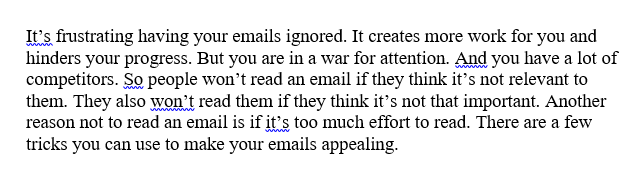
Be honest. You didn’t even read it all. A block of text is hard work. Compare it to this:
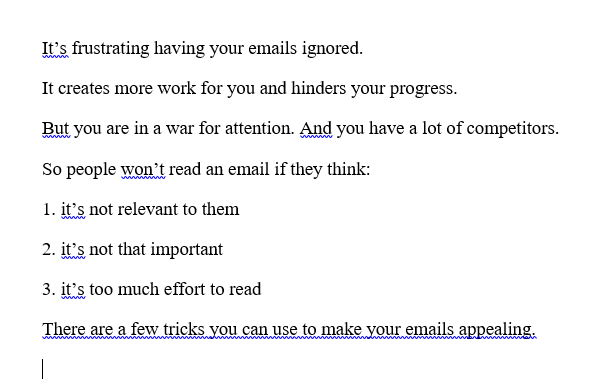
Nice and effortless to slide down the page.
The right formatting is your best friend. It will keep people reading. When people click on your email if it looks like hard work they are less likely to read. Hard work = big blocks of text.
Make it easy:
- short paragraphs
- mix up your paragraph lengths (1 line followed by 3 lines followed by 1 line)
- use sub-headings if your email is quite long
- turn lots of points into bullets
- lots of white space makes it easy on the eye
4. Get to the point
The less you write the more people will read.
We include a lot of padding when we talk — introductory sentences, repetition, and explanations. When writing you need to delete the fluff and get straight to the point. Shorten sentences. Delete sentences from your paragraphs. Get rid of adverbs that add nothing. The main criminals are:
- really
- generally
- usually
- probably
You might find this difficult — keep telling yourself people won’t read if you don’t reduce your words.
I’ve found it amazing how much I can delete without changing the meaning.
Say less to say more
(people will love you for it)
5. Use influence theory
Following tips 1–4 will make your emails loved by your readers.
But if you want to people to take action on what you write. Then you need the help of Robert Cialdini. He’s brilliant at identifying to how influence others.
Here’s his top 3 ideas you can steal:
Consistency
People do what they say they will do. Or what they have done before.
Make reference to what they have said or done in your email.
Examples:
- You were the first to use the X software so thought you might like to use the Y software
- At the Z meeting you said you wanted to improve your computer skills, here’s a course…
Social proof
People do what others do. Especially those who are like them.
Make references to others who support your idea.
Examples:
- So far 15 people have signed up
- John and Edith have decided to make these changes
- Sue said…
Reduce friction
Do you know why an orange is left in the fruit bowl?
People pick the easiest fruit to eat. The skin is too much effort. Sounds stupid. But anything that adds a little effort will lose people.
Examples of reducing friction:
- Bold the request and put it in its own sentence (plus key details: link, phone number, email)
- People don’t read attachments. So put the key paragraph in the body of the email copy (or paste the whole thing)
With a little thought, you can get people enthralled with your emails. The more important what you write, the more effort you’ll want to take
If this was helpful then you’ll love this one:


