
How to Get Over a Breakup When You’re Already Married
Some binge on ice cream or Netflix, but I built a tiny house to hold my grief

When my husband and I agreed to open our marriage in 2020, the initial result was thrilling.
After years of living in a sexless marriage, I dove into dating apps and received instant attention from men. Selecting “something casual” on my profile as a 37-year-old woman drew men to me like flies.
Soon after setting up my profile, I was making out with men I’d just met on park benches and taking sexy selfies in my work bathroom.
Life suddenly felt juicy again. Things felt unknown after years of living with my life planned out before me.
And then, shortly after the COVID-19 pandemic began, I started falling for something more than casual. I met Collin, and we quickly fell in love. It had all of the ingredients of a passionate affair, except for the part about my husband knowing about it.
It only took a few months for me to realize that this new arrangement was not sustainable. I spent only two evenings a week with Collin, but I found myself planning a life with him.
We talked about our children meeting one day.
We joked about living in a home in Tucson and covering our bedroom wall with a hundred decorative message boards from HomeGoods. The kind that say things like “Family is Everything” and “I’d Rather Be at the Beach.”
Things came to a head when my husband broke down sobbing one night at home. He was jealous and unhappy with our arrangement. He said he couldn’t do this anymore. I had to decide whether to stay or go.
So I decided to stay, at least temporarily.
My last night with Collin was an intense mix of passionate love-making and crying. I had mailed myself a black lace lingerie set to be delivered to his apartment, and I wore it proudly that night for him.
I hadn’t felt this much angst in my romantic life since watching my high school boyfriend leave for college. Ours felt like young, gut-wrenching love. We spent our final moments together on the rooftop of his apartment building the next morning, drinking coffee and holding each other.
The emotional end to something that felt so profound would be difficult for anyone to get over. But it was excruciating trying to do it while being a mother and wife during a pandemic.
I searched online for tips on “getting over an affair partner,” and I read Reddit posts about people struggling to hide their grief from secret affairs. It made me imagine thousands of people crying in their bathrooms at night over love affairs they couldn’t talk to anyone about.
But I couldn’t cry in my bathroom all night or curl up in a ball on my bed, because I was parenting two children during a pandemic.
So I did the next best thing: I built a miniature house to contain my grief.
This is the part where you say,
“Oh, she’s clever! She means she built a metaphorical house to put the grief into.”
But no, I mean an actual miniature house.
A glimpse of an immaculately-designed miniature house on the internet convinced me in a flash that my next logical move was to build a dollhouse myself.
I had no previous interest in dollhouses, and I had never built one myself. But I was convinced that I, too could craft a dollhouse from scratch with nothing more than my own two hands, a few supplies from Michael’s, and some YouTube videos.
So I set to work. And I spent every waking minute of free time over the next three weeks focused only on this house.
When my kids were napping or watching a movie, or late at night when I should have been asleep, I stood barefoot next to my kitchen counter gluing tiny pieces of wood together.
The work felt profound. Every tiny piece I held in my hand, every detailed edge I painted felt like I was bringing meaning to something that hadn’t existed before.
The work was methodical. I gained a rhythm of cutting, painting, and gluing and lost all track of time.
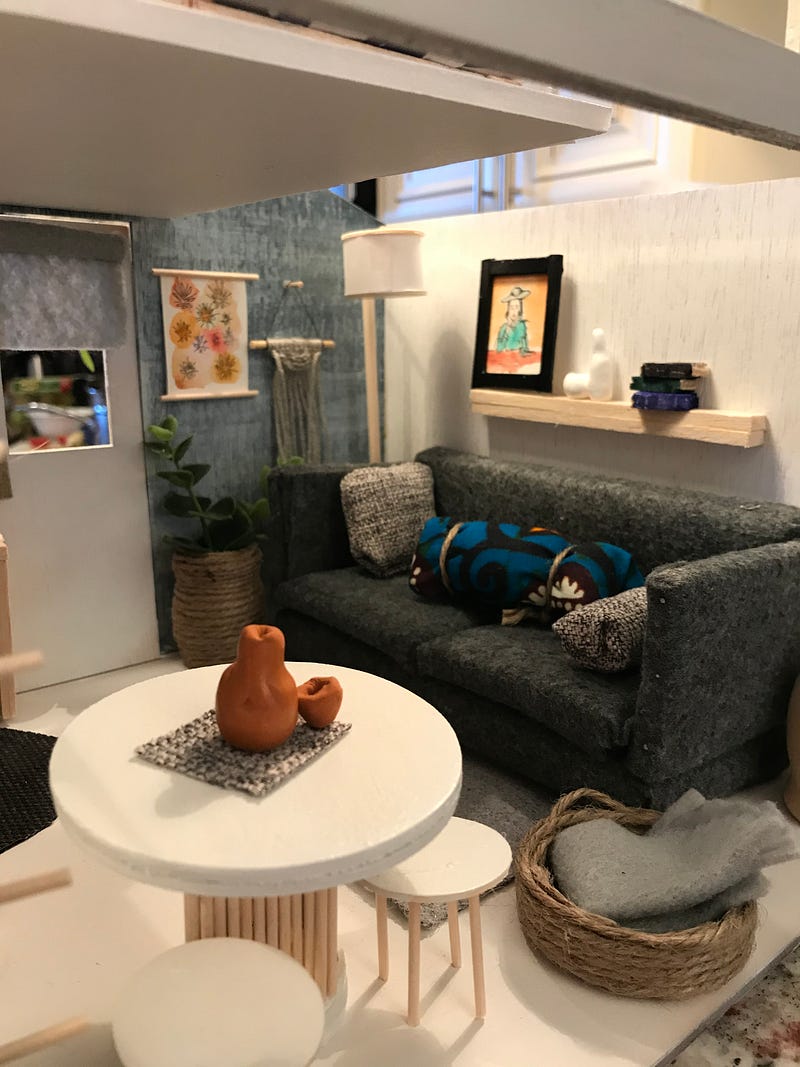
I braided a miniature hanging macramé out of gray yarn.
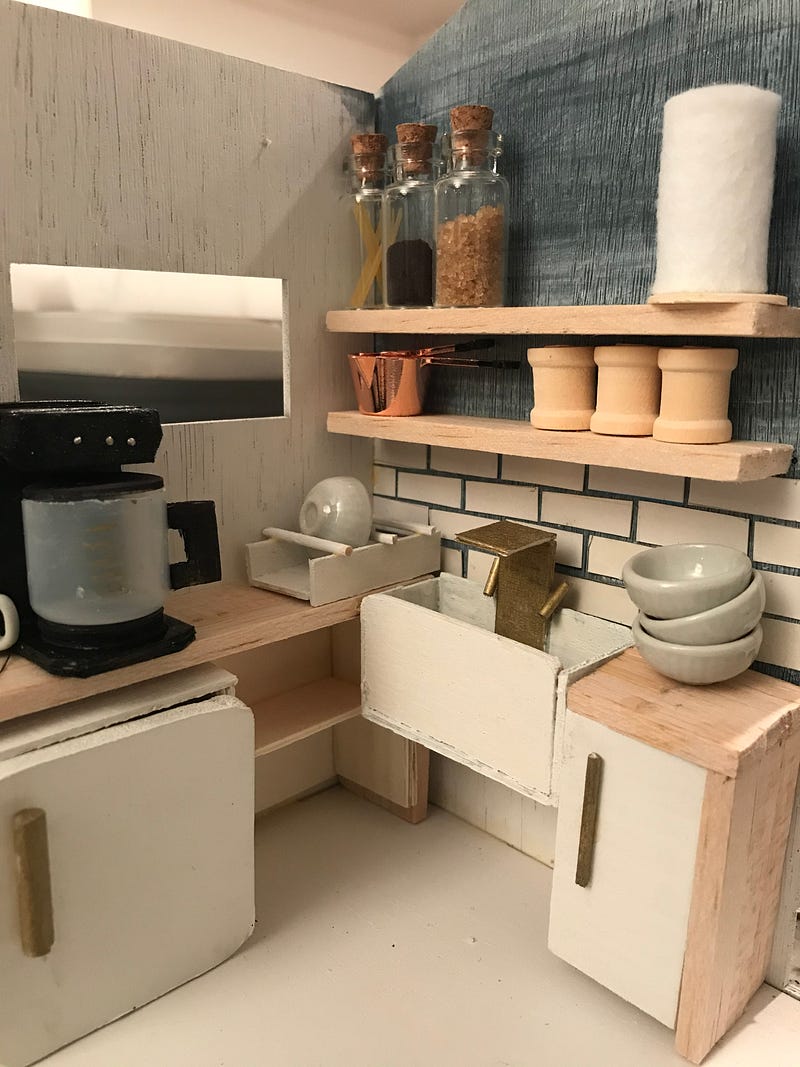
I cut out 100 tiny subway tiles from white paper, painted them with clear nail polish, and glued them into a kitchen backsplash.
I hand-painted delicate portraits to hang from the dollhouse walls.
I upholstered a couch and sewed throw pillows.
I made a coffee pot out of a bottle cap and styrofoam painted black with a sharpie.
I whittled balsa wood with a hand saw to build cabinetry and floating shelves.
I wrapped twine around a jar lid to create a basket for soft felt blankets.
I cut rectangular cubes of wood and painted each side into tiny books to place on shelves and bookcases.
I mixed colors of air-drying clay to create the perfect shade of terracotta and molded it into a pitcher and cup to place on my miniature wooden table.
I poured every ounce of myself into this house. At night, my legs and back would ache from having leaned against my counter all day gluing toothpicks together or sponge-painting an interior wall.
My end goal for this house was unknown.
My children were too young to play with such a house; their curious hands could easily snap my delicate furniture in half.
I had no place for this miniature house to sit. We had no shelves with space to contain it, and it would so easily break were it to end up amongst the toys piled high in every corner.
So it lived on our kitchen counter, next to the bowl of bananas, surrounded by my tools and scraps of wood and fabric. Even once it was near-complete I would take another look and decide it needed one more detail — another pillow for the bed, a rope ladder suspended from the loft, a paper towel dispenser in the kitchen.
My husband watched my unraveling with concerned curiosity. I didn’t speak to him about my longing for Collin. He knew I was struggling, but we exchanged few words about it. He was kind enough to give me the space to create my masterpiece in silence.
Besides, there weren’t really words that made sense to explain how it felt to lose someone you never had.
My small act of creation did not diminish the grief I felt from ending my affair. But it channeled my energy into something concrete. I had built this house from nothing, and every addition felt like it was something uniquely mine.
Grief can feel emptying. It hollows us out and leaves vacant space. Creating something new that was beautiful and rich with detail felt like the only way to spend this time.
Many before me have crafted poetry or song in times of pain. My art was a miniature house made mostly of birch plywood and scraps of felt.
Two years later, my miniature house no longer lives out in the open on our kitchen counter. It’s tucked away in the basement atop a bookshelf, the tiny bed unmade and one piece of the ceiling propped against the loft bedroom.
Every once in a while one of my children asks me to take it down so they can see it. They are old enough now to play with the delicate pieces of fruit molded out of clay, or to align the wooden books on the floating shelves.
And today, I no longer feel pain when I look at these details. They feel like they belong here.
More stories from Michelle A. Cmarik you might enjoy
Read even more stories with a Medium Membership!


