
An Average Person Spends 4.5+ Hours Doing Leisure Activities Each Day
How to get one month of your life back.

How To Get One Month of Your Life Back
We are often complaining about not having enough spare time. I wish I could work on my side project or read this book.
Today, I’ll show you how to free up at least one month of your time from unnecessary tasks so you can focus on more essential things in life.
I have completed 11 30-day challenges by focusing on building tiny sustainable habits — one at a time. Here is the complete list of 30-day challenges if you would like to read it.
According to CDC (Centers for Disease Control) research, an average person has 5+ hours of free time each day. The research included 32048 participants from age 15 and older in every activity within 24 hours for two years.
I would like to emphasize that the study did not consider working, spending time with kids and family, formal education, or grooming as free time.
The bad news is time flies. The good news is you’re the pilot. — Michael Altshuler
According to the research, the necessary tasks you have to do no matter what, for example: taking care of kids, work, house chores, cooking, eating, sleeping, and grocery shopping. We cannot live without doing these things.
What is free time, according to CDC research?
We can easily take some time from these unnecessary activities, for example, gym (45 minutes is enough), sports, Netflix, playing video games, shopping every other day, aimlessly exploring, TikTok for hours, etc.
Women work more than men
Anecdotally speaking, it makes absolutely no difference how much I do around the house. My wife is always the winner. My brain doesn’t think that has to be done most of the time, yet she does it like a pro. Then I realized, oh yes, I forgot about this chore.
Researchers divide the time into two buckets.
Bucket #1 Necessary time
Women have 18 hours and 42 minutes of non-leisure time and men have 18 hours, 4 minutes each day.
There is a clear gap of 38+ minutes each day. Simple math tells us women work at least 19 hours more than men per month.
Bucket #2 Unnecessary time
Unnecessary time or free time, I put this bucket in leisure time; men are winners here.
Men, on average, spent 5 hours, 56 minutes unnecessarily each day. The women spent 5 hours and 18 minutes.
Let’s do the simple math; men spent at least 19 hours more unnecessary time each day.
Learning tip
Before I move, I would like to recall that every successful person on the planet spends at least 5 hours each week learning something new. By merely spending an hour less on unnecessary time, we can get 5+ hours to work on something more meaningful each week. Here is a detailed article on how to spend 5 hours.
What were people doing in their free time?
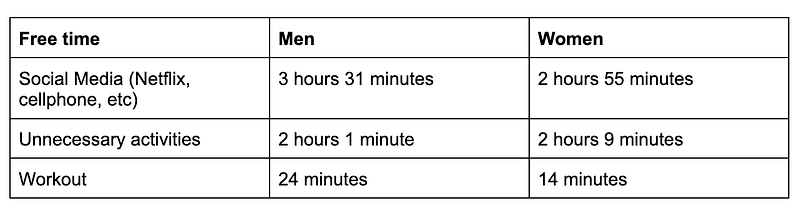
As we can see in the social media row, men spent at least 37 more minutes than women per day or 19 hours per month.
Income vs. free time
It comes as no surprise to me.
According to CDC research, higher-income earners spend less free time than people living under the poverty line. However, they spend 4.5 hours each day doing unnecessary tasks on average.
How to get back 5+ weeks of your life each year?
The answer is pretty straightforward. By building tiny sustainable habits, use a minimum of 25 minutes time interval each day from your 5+ hours of free time.
I’m not asking to give up everything in order to focus on living a more productive life. That will never work.
All I’m proposing is to divide your free time into bite-sized time chunks. For example, I began using the Pomodoro approach to spend no more than 25 minutes starting to read or build my website.
Now I work in 50 minutes time intervals. I am a huge fan of Deep Work by Carl Port. If you have the time, I highly suggest reading the book.
Let’s do the simple math.
For the first five months, you took 25 minutes a day from your free time. That will be 62.5 hours of extra time in five months.
For the rest of the seven months, you took 50 minutes per day from your free time; that will be 175 hours total of 237.5 hours or 5+ weeks of free time at the end of the year.
It’s the small habits of how you spend your mornings. How you talk to yourself. What you read and what you watch. Who you share your energy with. Who has access to you? That will change your life. — Michael Tonge
A piece of advice
An average person touches his phone 2617 times per day. After a couple of minutes of struggle, I make sure my screen time is less than 90 minutes per day. I also wrote a detailed article on how a cell phone destroys your life.
Take control of your time and start now!
Thank you for reading; follow me and clap a couple of times.
To get access to unlimited stories, you can also consider signing up to become a Medium member for just $5. If you sign up using my link, I’ll receive a small commission (at no extra cost to you). Thanks


