
How to Get More out of Your Conversations
Check for intent and attitude

My problem is that I talk a lot and I love connecting and reconnecting with people. I am also guilty of indulging myself in long, meandering phone conversations. So much so that I have considered creating an auto cut phone app like a pre-set timer to keep me in check.
Realizing, that I get easily drawn into conversations at home, one day I went to a local coffee shop to get some work done. I wanted to avoid distractions by being amid strangers.
At the coffee shop, I needed the wifi password and I figured the quickest way would be to just ask the guy sitting close by.
I ended up talking to this stranger for over an hour!
What was I seeking by talking to him for so long and not focusing on my work at hand? I justified the conversation by reminding myself that I enjoyed listening to his motivations for his non-profit. I found his goals intriguing and inspiring at the same time. As our conversation neared the end I had a sinking bittersweet feeling as I tried to justify the time I had spent. My original intent of focusing on my work was in shambles once again, but surely I had gained a lot.
Even after leaving the comfort of my home, I still found myself in the same quandary of getting distracted. I then realized it was not the surroundings but how I engaged in conversations that hampered my work.
As I tried to be more introspective about improving my conversations, two factors stood out to me: Intent and Attitude.

Take a minute to reflect on any interesting talk you remember having. Did you have a clear goal in mind or did you just go with the flow?
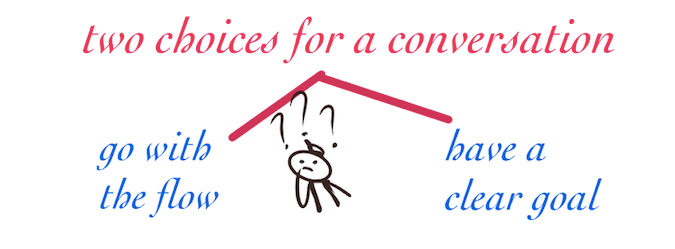
The second choice may seem devilish at first glance. Is this akin to having an agenda or at a more sinister level a hidden agenda, every time we open our mouths? Are we robots? Pre-programmed?
Is it so wrong to monitor a conversation to see if is serving its intended purpose? For example, if the end goal is to help the other person would it be wrong to monitor the talk to see if we are serving the purpose we intended?
What about just fun? Why can’t conversations be simply for fun? Of course, they can be, and just being aware of that end goal may make them more satisfying.
Usually, there are a few clear goals for engaging. Yes, there may be overlapping intentions but even then, if you dig deeper, there is probably an overriding intention.
One is to listen to viewpoints that are different from our own. Another is to brainstorm solutions, evaluate them, and make decisions. A third is to connect with others — be ourselves, relax, entertain, and have fun sharing our thoughts for the sake of sharing. Another reason is to convince others, to influence their thought process and try to get them to follow our viewpoint.
Sometimes when self-doubt creeps up, we seek validation of our thoughts from those that we respect, so that we feel better about our stance. We look for people to talk to who will assure us that we are right. These conversations allow us opportunities for loud thinking, where our thoughts can marinate and become clearer. On the surface, the conversation may look like one is trying to convince the other person but actually one is trying to convince oneself.
Some conversations happen out of curiosity, others to make our intentions clear or gain clarity about someone’s intention. Often times, for those of us who think out loud, conversations are the exploratory sandbox that allows us to play with our thoughts.
The challenge for people like me is to learn how not to filibuster our productivity goals by permanently living in the sandbox but to know when to step out.
My new self created rule:
Think of your intention, remind yourself that you have control over your thoughts. Before you go into a meeting or pick up the phone and look for someone’s name to call them, think
— why … what goal
— for how long?

We find some conversations to be more rewarding than others. This is probably due to the attitude of the participants. Next time you get a chance to analyze the quality of a conversation check for some of the following constructs, just for the fun of it. Are you or someone you know responsible for any of the following?
Conviction Bias
Is everyone listening with an open mind? Or, is there someone who always assumes that they know more or better? Someone who thinks that they have all the knowledge needed? Someone with an “I know for sure that I am right” attitude?
Power Bias
Does everyone view the conversation as one among equals? Is one person always telling others what to do? “I am the boss” bias?
Attention Bias
Are all parties listening intently when it is the other party’s turn to talk? Does someone check out as soon as they are done talking?
Winning Bias
Is the conversation a dialogue? Or is someone intent on turning it into a debate so that they can win?
Air Time Bias
Is everyone getting enough time to articulate their thoughts? In a discussion either extreme does not help. If you always sit silently, nod your head, and do not say much then you may not be adding value. And if you want all the time to explain your brilliant ideas, you may be stiffling others.
Being aware of our conversation style can help us improve it.
I realized that I would often cut people once I thought I knew what they meant, without waiting for them to finish their thought process. And I would have never recognized this except when a good friend pointed it out to me. She helped me immensely… now I try to be more patient and I make a conscious effort to let others complete their thoughts without interruption.
I learned that one of the highest forms of respect you can pay someone is your undivided attention and your willingness to improve your conversations.
If you liked this article, please subscribe to occasional thoughts @ mindkyte.com


