
How to Get Control of Your Time and Your Life
Rereading THE classic 1973 time management book by Alan Lakein. The most important lessons that stuck for 35 years.
This is the granddaddy of time management books. It is chock full of wisdom and practical advice. I’ve gone back to my copy countless times over 35 years. Most modern productivity writers are simply expanding on one of Lakein’s chapters. Let’s just go to the source pull out the most important lessons.
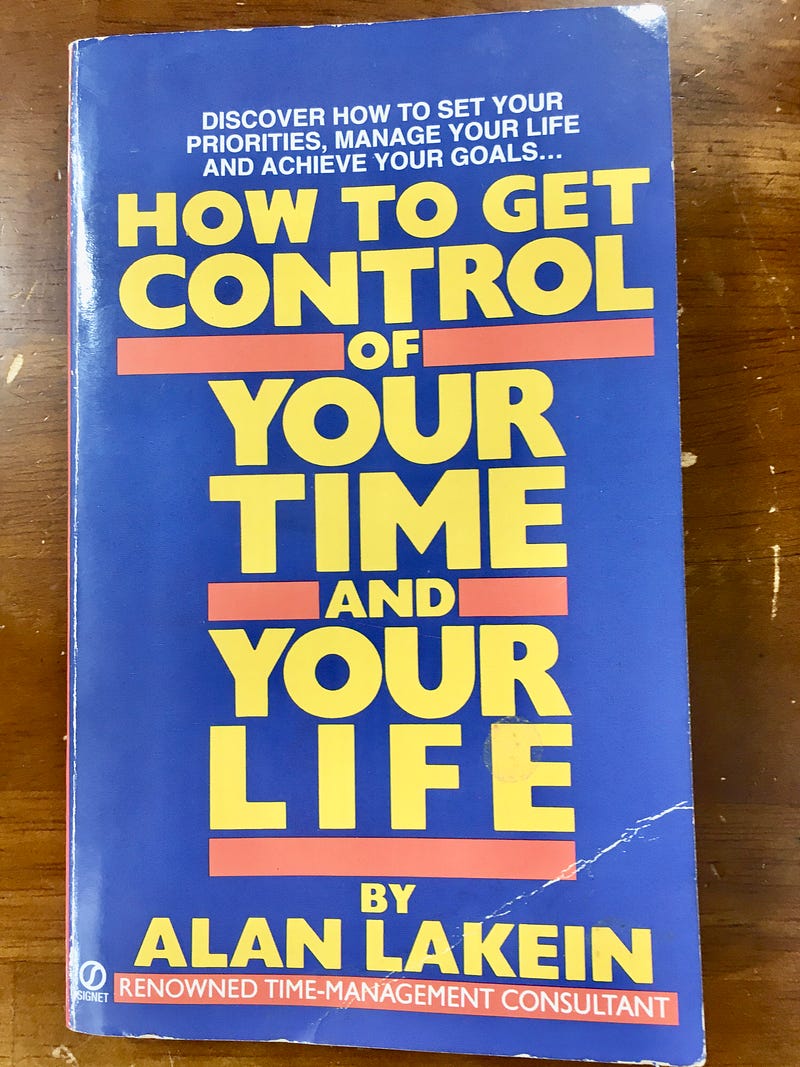
The book, the author, and the quotes
Published in 1973, “How to Get Control of Your Time and Your Life” has sold over 3 million copies worldwide. Alan Lakein graduated from Harvard Business School and vaulted to fame due to this book. You are probably familiar with concepts from this book without knowing it. Have you heard any of these quotes from Lakein?
Time is Life.
Failing to plan is planning to fail.
Planning is bringing the future into the present so you can do something about it right now.
And of course “Lakein’s question”,
What is the best use of my time right now?
Highlights and Main Ideas
Time is Life
“Time is Life. It is irreversible and irreplaceable. To waste your time is to waste your life.” At first, the book seems to be all about uber efficiency. However, it is about getting the most out of life. We don’t lack time but we don’t use it effectively to achieve our highest goals so we don’t feel dissatisfied and out of control.
Control = Freedom and Choice
The key idea of this book is “control”. Not an obsessive control. A balanced control that will allow you the freedom to get things done and still enjoy your life. Control also means choice. You are the judge of what is working and what is not. Successful time management is highly individualized.
Control = Planning
Control starts with planning. You need to do time planning consistently. As Lakein says, “Failing to plan is planning to fail.”
Another Lakein quote is, “Drift, drown, or decide.” The world and other people constantly want some of your time. You must proactively make decisions for yourself.
According to Lakein, “Planning is bringing the future into the present so you can do something about it now.” Planning is best thought of as “writing” rather than “thinking” so get out your notebook now.
Goals
You need goals to be able to set proper priorities for your daily activities. Ask yourself these questions and write your answers:
What are my lifetime goals?
How would I like to spend the next 3 years?
If I know I only had 6 months to live how would I spend them?
If the answers you’ve written to the three questions don’t align closely, you likely have a problem. Ask yourself why they do not connect. Be honest with yourself or it will be hard to be in control of your time and plan your life properly.
Priorities
The basics of planning are: 1) Make a to-do list and 2) Set priorities. Once you have compiled the list of possible activities then the real work of prioritizing them starts. You must ask yourself on what criteria you are ranking your priorities. Look at your goals. Is family the most important? Making money? Fun? The order of priority you put them will influence which actions you take first, which ones get left for later, and which ones never get done.
Rank activities in order of importance from A to C. Then rank the activities again in each category from 1 being the most important, 2 being the second most important, and so on down the list. ABCs are relative depending on the individual and the situation. You decide. Your answers change over time.
Work on your A-1 goal until finished. Resist the urge to work on other more comfortable goals, even your A-2 goal. Don’t work on Bs or Cs when an A is left undone. Keep the list visible as much as possible and work from the list.
Scheduling
We all understand this is important but easier said than done. The world throws stuff at us and we have to deal with it. Suddenly it is hours or even years later and we haven’t worked on what we said was our A-1.
You must schedule your A-1 goals into your calendar. Reserve your best time for your own goals. Work on those goals when you are most productive. Push busywork and other’s requests to the fringes of your schedule.
Doing Nothing
Taking control of your time does not mean being what Lakein calls a “Time Nut”. Relaxing and doing nothing is important. Do not cram every available minute with a task.
We all need time to relax, take care of ourselves, enjoy ourselves, and reflect. The core of the Lakein method is making the best choices. Good choices are better made when we can slow down and link our goals with reality. When it is “decision time”, SLOW DOWN. Making rash decisions under time pressure does not help in the long run.
Saying No
Inevitably, sometimes someone will be disappointed with how you spend your time. You can’t please everyone. Saying no promptly and with courtesy solves a lot of problems.
However, sometimes you may have to postpone your A goal to do someone’s C goal. Perhaps it is your spouse or your child. Decide on the level of your relationship with the person and the consequences of not helping them. If a straight “No” is not an option, then discussion and compromise will be needed to help others and still preserve some time for your A goals.
The person you will have to say no to the most is yourself. Leave the low priority Cs undone. You must resist the urge to skip down your to-do list out of internal resistance or avoidance. Stick to your plans and priorities. Bunch others’ non-emergency requests and your own low priority busywork to prescribed “office hours” at times that don’t interfere with your main work.
Be Aware
You’ll experience resistance to your own goals from within yourself. You will use escapism to avoid unpleasant tasks. You will suffer failures of willpower.
Slow down and analyze the sources of this resistance. Is it fear, the wrong goals, or over-commitment? Commit to being honest with yourself. Work on achieving small tasks relevant to your A goals to build momentum.
Analyze your results using Pareto’s 80/20 principle. Where is your success coming from? Focus there. Where is most of your resistance coming from? Cut it off at its source.
Recenter yourself as often as you can by asking, “What is the best use of my time right now?”.
Acceptance
No one is perfect. There is rarely a straight line to success. Go easy on yourself. And as Lakein says,
“Do your best and consider it a success”.


