
How To Get A Great Mentor, Even If He’s Been Dead Awhile
You still have access, even if you live in different centuries
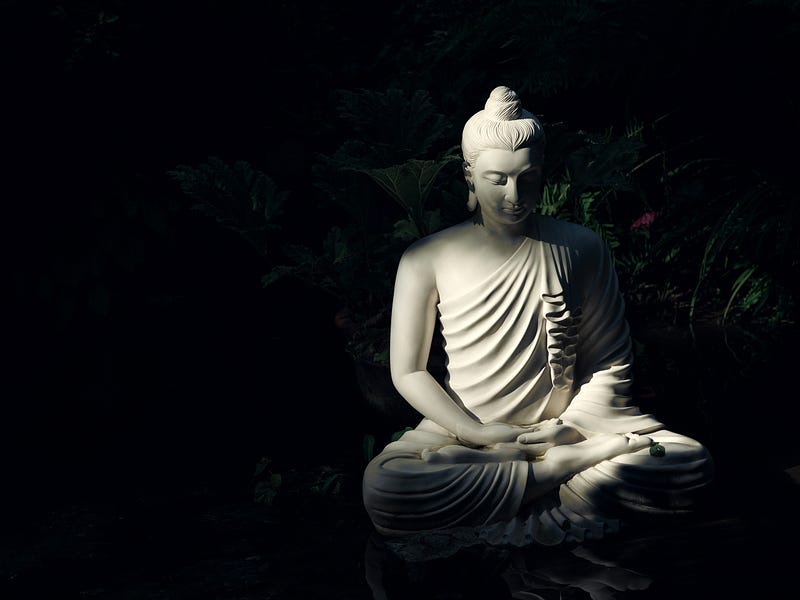
I’ve been mentor-hungry for most of my life. Somehow, I’ve always known that if I wanted to up-level in any way, I needed someone to model for me what it could look like to work and live at that new level. So it always seemed like a serious bummer that I’d never have the chance to sit at the feet of the Buddha — you know, as a student and acolyte.
Laugh if you want. And sure, maybe the idea seems weird — the kind of fetish that would pester you only if you were meditating a lot and had way too much time on your hands. But for someone who puts a premium on learning from exceptional teachers and cultivating the deep value and potential of those relationships, I felt like I’d always be missing out on something extraordinary.
And remember, this was always an imagined proposition, right? One that mixed wish-fulfillment and magical thinking.
The revelation
My big aha came a few years ago when I realized: a mentor didn’t necessarily need to be alive to bring value. In fact, I was seriously limiting the scope of my own definition of mentoring by defining it so narrowly.
The implied contract of any mentorship involves nothing more than the mentor imparting wisdom and the mentee metabolizing that wisdom and putting it into daily practice.
Given this definition, it really made no difference whether the Buddha and I ever got to hang out. And, while logistical issues (like his being dead for centuries) obviously wouldn’t ever allow for conversations wherein we could thoughtfully discuss my progress (and maybe sip some great tea), I could nevertheless access his help quite regularly, if I wanted.
And I could do it by diving deep into the teachings of distinguished dharma followers and practitioners who are alive now. I could have any number of mentors, in other words — all of them potentially connecting me to the wisdom I desired to incorporate into my life.
The Buddha and me
I started meditating almost seven years ago. You could say I’m a longtime practitioner — something which, a decade or two ago, would have carried zero currency. But today, with even the titans of tech staging wisdom summits featuring speakers of real stature like Jack Kornfield, for instance, meditation has gone mainstream.
And that’s precisely how I found my Buddha-stand-in and extraordinary personal mentor.
How Jack Kornfield taught me to meditate
When I first decided to get serious about meditation, I thought maybe I’d sit a retreat. There was a Zen master coming to a city near me, and I thought this’d be just the thing . . . until I saw the price tag. Have you ever priced those retreats?? Maybe you’ve got six thousand sitting around to cover a week’s worth of wisdom, but I sure didn’t.
In lieu of that, I decided to do some research and find out who the other acknowledged masters were in the meditation space. Kornfield’s name surfaced instantly. References to him were everywhere. And that’s when I remembered that a friend had once given me a copy of his book, A Path With Heart: A Guide Through The Perils And Promises Of Spiritual Life, so I pulled it off my bookshelf, blew off the dust, and plunged in.
I can’t tell you how profoundly that book affected me. His chapter on naming the demons and learning to sit with them, for example, gave me a completely new and novel paradigm for dealing with the things that routinely upset me. Whether we’re talking about a spouse-type demon triggering my anger, or the midafternoon-hour demon triggering my mortal fear of growing sleepy during the day, I learned that you tame the demons “out there” by coming into a much more cheerful and compassionate relationship with the demons who live “in here.”
Even more illuminating, I learned that when you stop resisting and tightening against what feels too upsetting/disturbing/triggering to hold, suddenly your relationship to it shifts dramatically. For folks who believe that their problems exist outside them, it’s highly fruitful to open to the idea that the life events unfolding each day merely serve to teach us where we’re really stuck. It takes some mental calisthenics to appreciate that when we react in anger, for example, the anger was already in us, and the event simply tripped a wire that was primed to heat up. In this sense, each of us is basically a walking landmine, ready to detonate whenever the right conditions arrive. As Kornfield says,
We have to do away with the landmines in the human heart. We have to do away with the violence in the human heart.
So how do you figure out what’s going on in your own heart? You bring awareness to where you’re triggering, that’s how. And the potent feelings that surface during those episodes become mentors themselves, signaling to you exactly where your landmines are, where your narratives are — all by way of the inner chaos they activate inside you.
Let me clarify: I’ve never met Jack Kornfield, but his many books have given me actionable and highly useful techniques for practice, as well as endless material on which to reflect. As a Vipassana (Insight) practitioner working in the Thai Forest Tradition, which descends from Theravada Buddhism, Kornfield has helped me appreciate the simple but profound truth that right now is the perfect time to awaken. His prose style is elegant, his experience vast (decades-long, starting in Southeast Asia, where he studied with the renowned Thai Forest master, Ajahn Chah), and his wisdom deep and authentic.
Doing the mentee’s work
While meditation in any form promises deep and real benefits, you’ve got to practice often and consistently to reap them. To be clear, real means you’re probably going to do a fair amount of heavy crying as unacknowledged feelings begin lobbying for your attention. Real means that sometimes you’ll feel ecstatic, and sometimes you’ll feel burdened with thoughts of the laundry pile waiting for you downstairs. (Points for you if you caught my riff on Kornfield’s other famous book.) Real means that sometimes your thoughts become thinner and airier until nothing is left but unbounded space; and sometimes, on the other hand, real is your overactive monkey mind, leaping around and siphoning away your will to do anything but take a nap.
What I needed help with was all the real, you know? And that’s what I found when I started incorporating the Insight teachings into my life through diligent practice. By way of Kornfield, I discovered a distinctly American Buddhist movement that taught me how to reckon with all my real: both the numinous and the everyday; both the transcendent and the quotidian.
In his uniquely warm and practical voice, Kornfield taught me to understand more clearly the first two noble truths of Buddhism: one, that humans suffer; and two, that the cause of our suffering is that we cling. Oh BOY am I a clinger! — a wantist, a yearner, a grabber. I want the moods that effervesce and shimmer; I want the goods I believe will satisfy my overactive appetites; I want the experiences that seem lifted from the pages of a Conde Nast publication; and I want the close and protected family circle which is impervious to the buffetings of the fallen world. With Kornfield’s uniquely skillful and wise help, I have come to see my grasping nature and my longing for a kind of glossy, static perfection as the original demon whose shenanigans I can simply observe and co-exist with each day as a prelude to touching in to my more compassionate nature.
Perhaps most important, he has taught me not to judge how I cling, not to have contempt for my patterns, but to wrap them in the warmth of my affection and understanding, so that their hooks naturally attenuate and soften.
Like a dutiful mentee, I have practiced day in, day out, regardless of the weather in my inner landscape. This is how I reaffirmed my status as an observant and dedicated practitioner — by sitting when it’s time to sit, no matter my perceived obstacles or my mood.
A mentee does the work, in other words. And the work is not easy. But it is wholly transformative. When you practice daily — when you show up to take your seat and stay for the duration — you touch in with a presence that turns out to be the core at your divine center, a primordial goodness. In other words, practice leads you to pull back the curtain, to see the you behind the constructed, conditioned “you” which you routinely mistake for your Self.
Finally, what I’ve learned from Kornfield and by extension the Buddha is that literally everything that presents itself — the good, the bad, the ugly, the transcendent — becomes the Way. You can work with all of it, dance with all of it, knowing that whatever shows up on your journey is evidence of awakened energy.
Find your mentors
Wherever your mentors are, find them! Then engage with them — if not directly, then by way of their teachings and the content channels that disseminate those teachings. You don’t need anything but the will to study and the determination to apply what you learn.
In the end, with a meditation practice, you become your own mentee. Moreover, your progress is measured by how consistently you come back to just relaxing as it is, which then frees your heart to love more fully.
And with a more loving heart, you can begin to lean in to the generative, soul-affirming work you feel called to do.