
How to Finish Your Side Projects in Times of Uncertainty
Are there ways you can work more efficiently during Quarantine?

Motivation
Before the quarantine, you wished that you could have more free time to tackle your side projects. That can be building a business, creating an app, or taking a class to improve your skills in programming, or data science. Now, as you get a break from school or work, you decided it’s time to master those skills. So you registered for online classes and found great learning resources. But you just can’t sit down and focus on tackling the task! Before you even recognized, you’ve wasted the entire day without finishing anything.
The reason for your non-productive day is not a lack of time, but your approach to working.
“If you do what you’ve always done, you’ll get what you’ve always gotten.” — Tony Robbins
In the first week of starting everything online, I thought I had more time to tackle side projects and learn new data science skills but struggled to finish any of them. I knew I needed to change my approaches. Or add a little adjustment to the approaches that worked for me.
Now I find myself keeping up with my work and remote internship, tackling three side projects, and exponentially mastering new data science and programming skills. So I want to share the approaches that work for me with the hope that they will enable you to finish your side projects in a short amount of time and accelerate your success.
Just Three Tasks Today
Scenario
You should tackle more tasks since you have more free time right? Yes, you can, but you’ll add little to your growth and productivity if most of those tasks aren’t important.
Solution
Many people spend time on urgent but not important tasks. Thus, to produce more meaningful work, it’s important to make a switch from many small non-essential tasks to important tasks. How can you do that?
You always have time for the things you put first
You can either use some tools to figure out the important tasks for the day like what I’ve mentioned here:
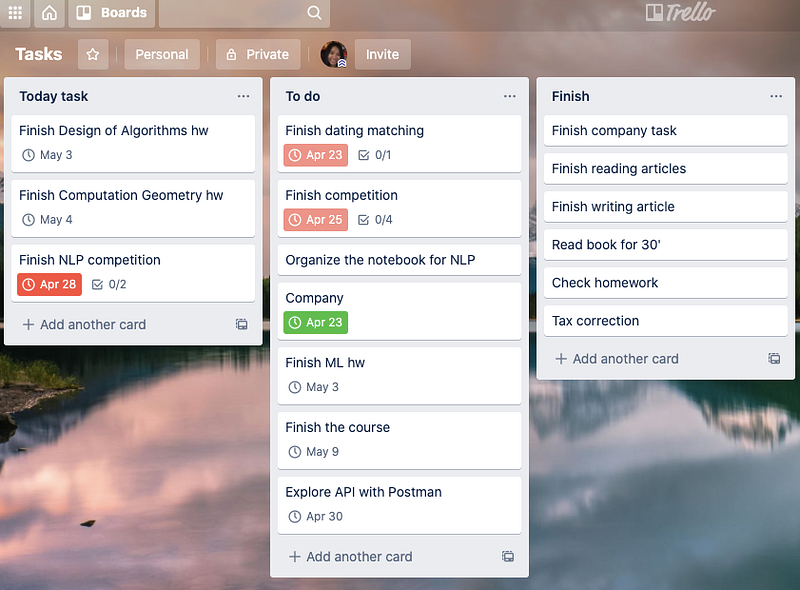
Or decide on three important tasks you’ll work on today. Why three? Because it’s just the right amount of tasks that seems reasonable to finish within the day. Deciding which tasks to tackle at the beginning of the day will give you some goals to work toward. Once you’ve accomplished one task, you’ll feel a boost in dopamine that motivates you to finish the rest of the tasks for the day without feeling overloaded.
I use Trello to help me organize which tasks of my bucket list to finish today.
Be Flexible
Scenario
After deciding the tasks for the day, you really want to try out what you’ve learned to get a better understanding of the material. But since experimenting isn’t part of the task, you decide to skip and wait until tomorrow to start the implementation.
Solution
Being rigid with your schedule isn’t an optimal approach because you’re following the rules that are no longer relevant to your current situation. If you see that changing the tasks for the day is appropriate for what you’re working for, do it. After all, you want to incorporate strategies that help you to be an effective learner right? If you have to choose between not finishing all the tasks but going deep in to one task and finishing all the tasks, but doing them shallowly, aim for deep and meaningful work.
Sometimes I find myself spending more hours to debug the codes than I planned to and know that I’ll end up having less time for other tasks. But I make a decision to skip other tasks and will focus on debugging today because I know that knowing how to debug this error will add hours to my time in the future.
Work in Chunks
Scenario
With more free time at home, you become more available by enabling the notification of emails and messages. It turns out that the free time that you have is consumed not only by commuting to places but also by being more available to people remotely. So should you disconnect from the world, not only physically but also socially?
Solution
That approach isn’t ideal because it may affect you emotionally. You just need to twist your approach a little bit by working in chunks. That means doing one thing at a time to avoid distraction.
Why should you do one thing at a time? I like to demonstrate my point with the formula from the excellent book Deep Work by Cal Newport:
High-Quality Work Produced = (Time Spent) x (Intensity of Focus)
Whenever you get distracted, it takes a while for you to get back to the work you were doing. Thus, you wasted a lot of time by multi-tasking. Turn off all your notifications and emails when working. Establish a rule for when you’ll check emails.
Let’s say I can check my email after establishing the tasks I’ll finish for the day and don’t check again later in the afternoon when I’ve finished a good amount of meaningful work. And schedule another time for socializing and connecting. By fully engaging with the work I’m doing, I can get more things done in the same amount of time.
Invest in Organizing and Automating
Scenario
You find yourself doing some tasks repetitively. You think it would be nice if the tasks you’re doing can be automated. But you decide not to do anything about it because it’ll take a lot of time to set up a system for task automation!
Solution
“For every minute spent organizing, an hour is earned. “— Benjamin Franklin
Imagine a messy room compared to an organized room. Yes, it’ll take time for you to organize things in your room, but once they’re organized, it’ll take a second for you to put a new piece of clothes in the closet while still keeping it in order. In contrast, if you throw whatever new stuff in some places in your room, it’ll come to a time where it’ll take a long time for you to find a specific piece of clothes. The time you waste on finding adds up — thus, you ended up wasting much more time than the time you spend on organizing.
Therefore, if you find yourself doing one task more than twice, consider creating a template or system to make the next similar task that can be solved in a similar way. For example, in the case of data science, since many projects are similar, you can structure your codes for reproducibility. Although it may take longer to set up, once you have a template, you just need to fit the next similar project into that template. The result? You can complete much more in a short amount of time.
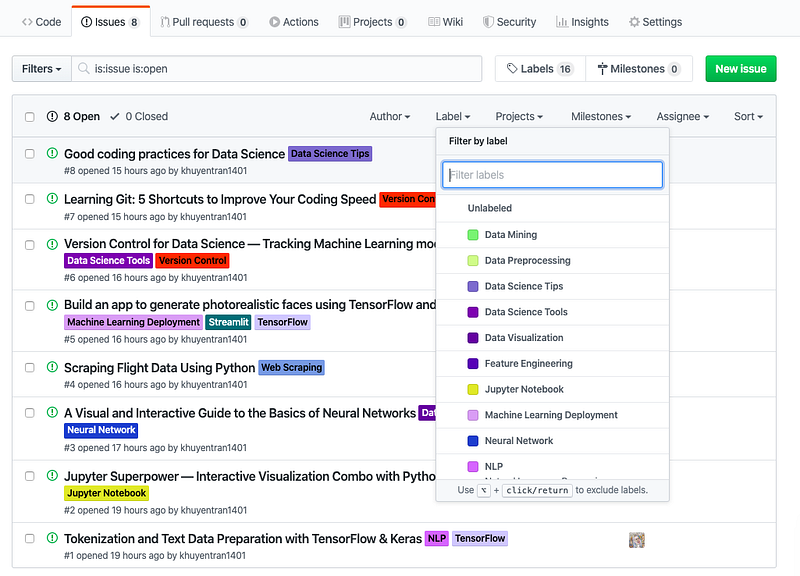
Or maybe instead of reading many articles and forgetting them after a while without applying them, you could organize them by categories in Github?
Don’t Regret the Time Wasted
Scenario
After having decided on the tasks you want to finish today, you happen to see some videos that seem interesting or get caught up in the conversation with your old friends. Thus, you waste the entire morning doing nothing. You regret the time wasted and decide to watch other videos to make you feel better. Instead of wasting only the morning, you end up wasting the entire day.
Solution
We’re human in a disordered society so we should expect not to be able to follow what we’ve established. But if we regret what we’ve done, not only can we not change anything, but we also waste the rest of the time on regrets.
Think about climbing the mountain. The road to the top of the mountain will not always increase. There can be a time when we’ll go down, but overall, we’re climbing up. When it comes to finishing tasks, I adopt the 80/20 rule. It’s okay not to be productive 20% of the time. I forgive myself for not being productive and keep moving on to the next task because I don’t want to waste another 80% regretting what I’ve done.
Now it’s Time to Take Action
The strategies I’ve covered in this article to work more efficiently are:
- Choosing 3 tasks to finish in a day
- Changing your established tasks based on circumstances
- Concentrating on one thing at a time
- Organizing and automating the repetitive tasks
- Being okay not to be productive once in a while, and not regretting it
I hope some of the things I’ve shared in this article are helpful for your learning journey. These ideas just stop at the level of ideas if you don’t apply them. Think about your learning approach right now. Can you change one thing in your workflow that would add significant value to your life?
“And that is how change happens. One gesture. One person. One moment at a time .”— Libba Bray
One change at a time and you’ll get to where you want.
I like to write about basic data science concepts and play with different algorithms and data science tools. You could connect with me on LinkedIn and Twitter.
Star this repo if you want to check out the codes for all of the articles I have written. Follow me on Medium to stay informed with my latest data science articles like these: