How to Find the Upside to Depression
Imagine if you could turn that powerful mental energy to your benefit
Don’t mistake me for being flippant. Depression is a serious issue. I know it’s a serious issue. But I want to talk about depression in a new way because nothing I’ve read about it up until now has been very helpful.
Let’s consider depression from another angle.
Perhaps it would be beneficial to see our inclination to bouts of depression as a beautiful, powerful and fundamental component of our essential selves. In a weird way depression can even seem magnificent at times.
If you could harness your moments of depression, or at least make peace with them, it could help you take advantage of all that terrifying and indominable energy.
I’m closing in on 50 years of age and I’ve had sporadic bouts of depression all my life. These days I’ve learned how to better navigate them. Today, my bouts of depression feel less like something to fear and more like coming home.
The deep, dark cave
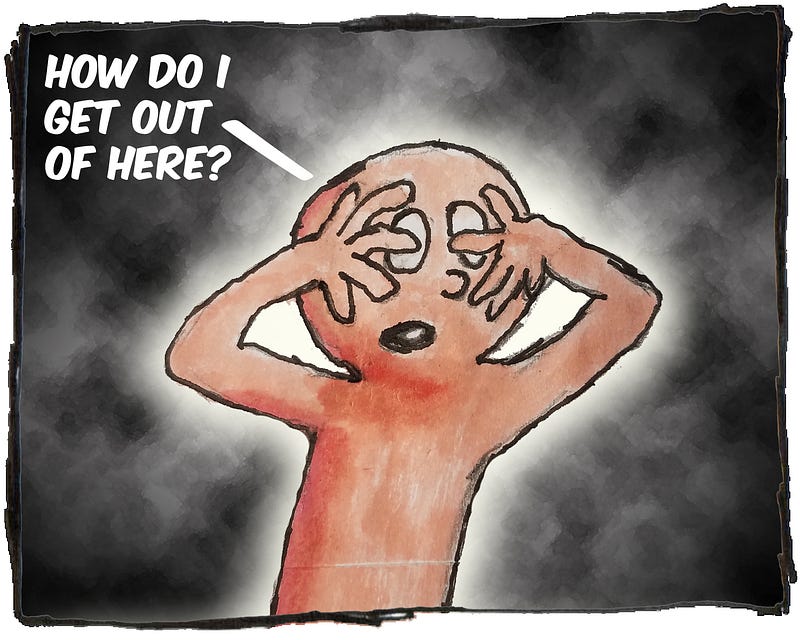
My mental image of depression is like Gollum’s cave from the 1977 cartoon version of The Hobbit. Depression is like being trapped in such a place. It’s cold. It’s wet. The walls are made of stone.
In fact, the cartoon version is too bright. In my mind, depression takes place in total darkness.
Nobody likes the idea of being trapped anywhere.
For me, the experience of depression is like taking that cave with me wherever I go. I might go to the movies, but in my mind I’m still in the cave. I might be looking at a sunset, but in my mind there’s complete darkness. I might be with the people I love, but in my mind I’m surrounded by stone walls.
I can’t feel. I can’t see. I can’t breathe. I can’t live.
I want to get out!
With all my force, I want to get out! The problem is that it’s dark and it’s cold. The walls are hard and slippery. It’s futile to rage and pound against them.
The only way to get out is to relax. But this cave is not a place that’s conducive to relaxation.
So, that’s the conundrum. You have to figure out how to make yourself behave contrary to the compulsions of your environment.
I think this is the hardest thing in the world. It’s been the hardest thing I’ve ever had to do.
The pain cave
There’s an odd expression among endurance athletes. They say they’re headed out for some time in “the pain cave.”
I’ve talked to people who can’t understand why anyone would want to run a marathon.
“Why would you do that to yourself?”
“Why would you put yourself through such agony?”
I’ve wondered that question myself many times. In fact, there are a lot of things I’ve done in life not because I wanted to, but because I felt compelled to do them.
I’ve run 25 marathons. During every single one, I’ve gotten to a point at about 2/3rds of the way through and said, “Why am I doing this? Why do I do this to myself?”
Controlled circumstances
I’ve come to think that I run marathons as a reminder that pain is inevitable, but also that it will pass. A marathon is like a controlled version of a bout of depression. The agony seems overwhelming. It crushes down upon you. Then, all at once, it goes away.
Nobody flips a switch. The mechanism that makes it disappear is not apparent. It just goes. It’s terrifying.
It’s also exhilarating.
A marathon is like that. If you can just keep going, you’ll get to the end. Then you cross the finish line and you’re done. The pain is gone.
We have to train ourselves to persist.
Listen to the compulsions that are beyond the comprehension of this simple life.
The power is terrifying and wonderful
Of course, with a marathon you can just stop. You can ask to get on a bus that will go back to wherever you parked your car.
Depression isn’t like that. You’ve got to finish.
The other advantage of the marathon is that it’s a set distance. That’s not the case with depression. Depression could last forever. There’s nobody you can appeal to. Someday the switch flips and you’re out. Or it never flips.
I’ve learned to not be so scared of that.
I’ve learned to think of the lightless cave as something remarkable and wonderful.
Allow yourself to see the beauty of every moment
When you get over your initial surge of panic, you realize you’re quite safe in there. The stone walls are secure. There’s even beauty in the darkness. This is a place that will endure.
Also, being in the grips of depression brings back other thoughts. I’m reminded of moments from my youth. Along with depression comes memories. I catch glimpses of people I’ve known all my life. I am reminded of how they looked when they were young. I’m reminded of people who I haven’t seen in years.
There are a lot of thoughts to explore, and not all of them are negative. Those thoughts are the way out.
Don’t make it your objective to never feel depressed because that’s not going to happen. Instead, understand that moments of depression, just like all of your life, are only passing moments. There are things to appreciate even at the nadir. Every precious second of life is beautiful, even the moments when you are depressed.
Even a mansion can feel like a prison
Even a luxury hotel room would be uncomfortable if you had to stay there your whole life. Depression offers you an escape from your physical surroundings. You enter a world of the mind.
Bouts of depression often make me lose weight. Too much weight loss too quickly is unhealthy, but I’m almost always 20 pounds too heavy.
When I jump on a scale and notice I’m down a few pounds, I usually derive satisfaction from that.
The satisfaction changes my opinion. All of a sudden, I’m out of the cave.
Again, I don’t know how this works. I don’t know the mechanism. I don’t have the key. Depression breaks like a fever and goes away. You can’t think yourself out of a fever. I don’t know how that works either, but I know that fevers will end.
Fevers don’t make me panic.
Depression is different than a fever, but in this they are similar: try not to panic.
Small and large forms of depression
I’ve been fortunate in my life. I’ve experienced exhilarating highs. I’ve experienced terrible lows. I’ve experienced everything in between.
I’ve experienced lows on top of highs. I’ve experienced highs on top of lows. There are both short-term and long-term fluctuations.
I think most people would describe me as a “happy” person. I prefer to be happy around other people. When I have a hard day, I go off by myself. Actually, these days, I take the dog. Dogs can cross worlds and come into the mental cave with you.
I highly recommend that you get a dog. They see better in the dark. They help you navigate back out.
The fortress of solitude
I used to think of depression as a prison. The thought of it filled me with terror and desperation.
Now, I think of it as a powerful sanctuary. It’s a physical location. It’s a fortress in my mind. Maybe it bears me no ill will?
I can leave things in the fortress and they’ll be protected. They’ll still be there the next time I pass through. It’s a magical place.
In the fortress of solitude, my thoughts become real.
It’s like a doorway between the physical reality we know, and the world of spirit that we presume must exist. Maybe that place without light is a place you can go to get instruction?
I said before that I do many things because feel a compulsion I can’t understand. Maybe the stone fortress is where the compulsion comes from?
Maybe it’s not all bad?
I don’t blame you for being scared
Imagine if you were put behind the wheel of a race car at the Daytona 500. Imagine the roar of the engines. Imagine the vibrations. Imagine the surge of power as you hit the accelerator.
It would be terrifying right?
I remember how scary it was to go 55 miles per hour when I first got my driver’s license. Imagine going 180 miles per hour. You’d be in a panic. You’d start to cry. You’d be desperate to escape the vehicle.
But what I’m trying to convey is that you can learn to adapt to that situation. You can learn to control it. You can learn to even find joy in it.
I think the same thing is true of depression. It’s not so bad. There’s power there.
Lost moments
I’ve spent a lot of my life lamenting that I wasn’t in the right head space to get the most out of an experience. I’ve come to understand that’s not true. The simple fact is, you still have an experience no matter what head space you are in.
You don’t “miss out” on anything. In fact, you have a greater variety of experiences.
I think, as a general rule, human beings are too hard on themselves. Even when we do well, we wonder if we could have done even more.
That’s a nonsensical line of thought.
No matter what you do, you’re exposed to beauty. Focus on the beauty. Don’t be distracted by fabricated fears about what you might have missed.
Don’t think. Just try to soak it in.
We’re all susceptible to depression
I had a doctor put me on a depressant briefly back when I was around 20. I didn’t like it. I’m sure other people have had success with medications and I’m happy for them, but it wasn’t right for me.
I didn’t want to sacrifice the highs to avoid the lows. Actually, I think part of me was even afraid of losing the lows.
All of our talk about mental health is in its infancy.
We take a few days off work when we have a fever. Why not take a few days off work because we’re depressed? Your body needs a reset sometimes. Your brain needs a reset. Some compulsion reaches out and pulls you into the fortress of solitude.
Maybe you need that?
Did you ever think that?
Too often I’ve been caught up in the belief that everything about depression was bad. I felt ashamed to be seen that way. I felt embarrassed. I felt it was a waste of time and nothing positive came from it.
But maybe those moments of depression are a good thing? Maybe they helped me? Maybe they provided nourishment I didn’t recognize?
The world is full of magic
I tell my children stories that I invent. I spend my free time imagining beautiful places. I suppose those places must sit on a foundation of stone. Why shouldn’t I go into the depths and explore what’s underneath from time to time?
How could I be expected to achieve a full comprehension of the human experience if I limited myself to only exploring the surface?
It’s natural to feel panic when you don’t feel like you’re in control.
However, here’s a little secret for you: you’re never in control.
Maybe by the end of my life my perspective will have completely flipped. Maybe I’ll see depression as the “good place.” After all, it’s a solid and enduring fortress of stone. It’s something that can be relied on. It will always be there? Right? There’s comfort in certainty.
You can learn to control a car going 180 miles per hour.
I think, too, you can learn to navigate in complete darkness surrounded by stone.
I think it’s possible to relinquish the fear.
Try thinking about it in a new way.
I sincerely hope this helps.
Subscribe to my emails here. Sign up to Medium via my referral link here, and THANK YOU!