
How To Find That ‘Extra’ Time To Work On Your Goals?
If only we had a little ‘extra time’, we would have changed the world. Believed by many, solved by few
The presence of hope and the absence of execution hits us the most.
People from all walks of life wish they had a little extra time, spare time to work on themselves, improve their health, add new skills, work on their side projects, finally play that guitar or make progress with painting skills. For some, to give more time to the family, maybe?
And these are hard-working people we are talking about; they slog their 9–5 job, complete their chores, and give the necessary time to their families.
I have all but respect for them.
But as human beings, we are ambitious; we are aspirational; we seldom find people who will say that they are content with life now and don’t want to experience anything further.
Despite our best efforts, we cannot find any spare time.
All this would have been fine in non-digital times; sometimes, ignorance is bliss.
But here we are. We frequently read success stories of people who are killing it in life. People donning several hats and becoming successful in life.
There are software engineers who have millions of followers on YouTube; we have doctors publishing books; and teachers who are equally good artists.
We naturally begin to have assumptions about those who are making it
- they must be gifted; otherwise, who has the energy to work in an excruciating role like a doctor and publish books at the same time or
- they are privileged, they are definitely in a job that is easy to do, so they have enough time to spend on their hobbies and hustles
and at the same time, we judge ourselves all the time
- my job is painstakingly hard; I am left with no energy to drag myself to my bedroom after a hectic day at work; after work, I have a family to look after, a child to tend to, true!
- I am not gifted enough, talented enough to go beyond my current roles and responsibilities.
Most of the time, both the thoughts, the one we have for others and all the judgement we have passed for ourselves is not true.
I do not categorically deny that these can not be true at any time.
There could be someone privileged for a short period; they got lucky. Some days, weeks or months, your job can be draining, leaving you with no energy or time to think about something else.
But deep within our hearts, we always know that there is a possibility, there is hope. You don’t get disappointed when you cannot work on your side project after a hectic day; you know that you were, in fact, busy, jam-packed.
You are only troubled on those days when you knew there was a possibility, and you could not grab it. Somehow the time just slipped out of your hand, the clock hit 10 PM, and you had to retire. And the cycle restarts.
The presence of hope and the absence of execution hits us the most.

If you have come this far, you could be guessing that what follows is a listicle on time management; please be assured it is not!
There is ‘enough’ content on time management on the web, thousands on Medium alone. I would not want to pollute it with my amateurish writing.
I am only going to bring to your notice something I have improved upon and how I was able to reclaim my time for my endeavors.
Before we come to the solution, let’s do a quick introspection — how much ‘extra time’ do you think we need daily to work on our side projects?
If you are starting with something, is 1 hour enough? Imagine 1 hour of working on your blogging, 1 hour of exercise, and one whole hour of painting or playing the guitar? For some activities, you will not be able to consume 1 hour if you are in the initial stages. For instance — exercise or playing any instrument.
Here are some facts — an average American spends about 7 hours on screen; if you are someone from India, this is about 4–5 hours.
This article is not about the damaging effects of phones on your health, brain, personality or anything.
I am only demonstrating to you a possibility of how you can reclaim your time back and use it on something you have always wanted to do. I am trying to revive your hope.
This may not be news to many folks reading this, and reading this will bring no immediate change. What can help here is constant awareness.
Constant Awareness is to be aware of something all the time that gradually impacts our thinking process and brings changes in ourselves.
The first step towards solving a problem is seldom action; the first step is understanding a problem, the next is the analysis of the problem, and then the solution follows.
Technology companies have realized that we all need to strike a balance. At least they have started taking some steps. Both Google and Apple have launched well-being apps that allow you to record time spent on your screen across various apps and other methods to disconnect.
A quick tip to create constant awareness, in this case, is to install screen widgets that continuously tell you how much time you are spending.
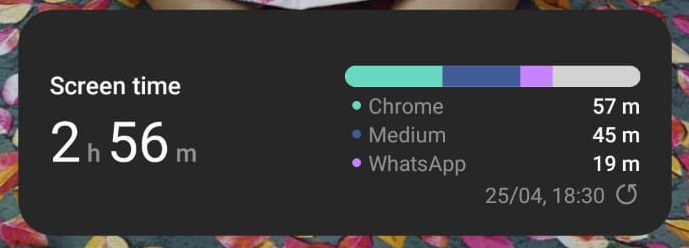
Above is the screenshot from my phone. As you can see, I am still struggling, but I was worse!
Now, on some days when you are thinking how tiring your day was, how you barely managed to grab food and dragged yourself to sleep, wishing you had one spare hour to work on something else.
Just before drooling off, you suddenly see this widget on your phone, white on black, screaming out the time spent on WhatsApp, Instagram, and Twitter. That is when the awareness starts to solidify.
If you want a reference, it took me one day to know that I am spending too much time on my phone and one year to take some steps to reduce it.
Widgets will make you aware of your time spent on the phone; similarly, you have plugins for your desktop and browsers.
The idea is to be in a state of awareness, and actions will trickle down gradually. Soon you will be able to reclaim that extra time and spend it on things that matter to you.


