
How to Finally Overcome Your Imposter Syndrome (with Science)
Re-wire your brain, for good
It’s around this time of year that 90% of resolutions fall off.
After an exciting start to the year, momentum slowly fades away. And, you may begin thinking, ‘I’m no different. So, why would this year be any different?’
Well, the answer is simple — although, not easy.
Here’s how you can overcome imposter syndrome and accept the success you know you deserve.
With an incredibly simple shift in mindset…
You’re not a loser.
At least, you weren’t born to be.
In 2017, China’s National Natural Science Foundation conducted a social experiment, revealing a powerful truth about the human brain.
Winners and losers aren’t born — they’re bred.
The study put 72 sets of mice in what are called ‘dominance tubes’ and monitored their brain activity in 5 main categories:
- Initiation
- Push-back
- Resistance
- Retreat
- Stillness
After hundreds of battles inside the tubes, researchers discovered an amazing phenomenon. The mice that won initially continued to win. And, the mice that lost, continued to lose.
Professor Hailun Hu, a lead researcher, noted how the “winners” weren’t bigger, stronger, or predisposed to win. But they merely possessed more “perseverance, motivational drive, and grit.”
It re-wired their brains.
This “winning effect” is prevalent in humans as well. And, all stems from an increased activity in a part of the brain called the paraventricular thalamus — which is responsible for courage, perseverance, and motivational drive.
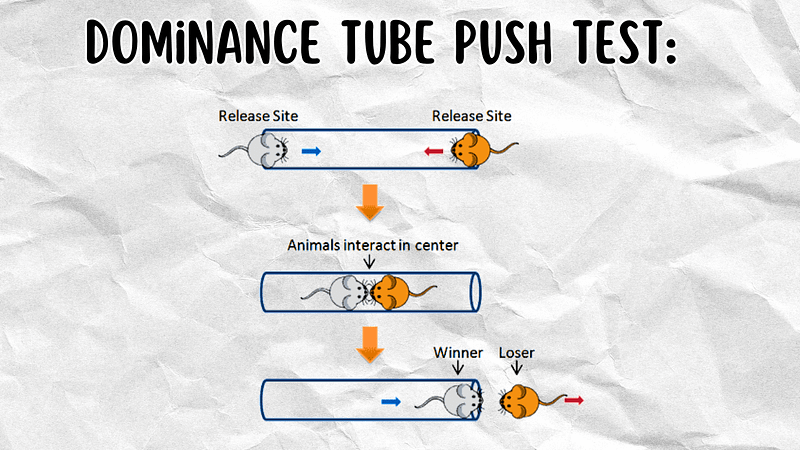
Just like in humans, when this area of the brain lit up, the mice showed higher scores in initiation, push-back, and resistance. These attributes helped them to continue to win in future matches.
On the losing bracket, the mice that lost originally showed decreased scores in these 3 categories. And, increased scores in stillness and retreat.
In layman’s terms, losers aren’t born. And winners can be bred…
Make your bed.
In life, we often think of successful people as being born into success.
And, for the most part, your upbringing and environment do shape your ability to become successful.
A confident, passionate, and/or motivated person can pretty much bulldoze their way into success.
Regardless of skill, merit, or intelligence.
But, we often overlook the specific experiences that shape our minds. And, allow us to feel comfortable receiving success. Social hierarchy is embedded in our DNA. We’re wired to judge others and place ourselves in the appropriate pecking order based on our self-perception.
If you’ve lived a life of losing, you begin to feel like a loser.
And, if all you’ve ever known is winning, it feels only natural to see yourself on the winner’s podium.
But, as we’ve learned from the mice experiment, this self-image can be developed. And, a large part of success comes down to simply lighting up the right parts of the brain, consistently.
Meaning, you can change the way you see yourself.
You can re-wire your brain.
Little tasks like making your bed, brushing your teeth, and sticking to an exercise routine all shape your unconscious mind.
Reinforcing the image of who you’d like to become.
It’s why psychologist and best-selling author Jordan Peterson preaches the importance of making your bed in the morning. Small and seemingly trivial tasks light up your paraventricular thalamus, giving you the drive to tackle larger tasks.
And, over time, allow you to see yourself as a winner…
Most people feel like imposters.
A recent study showed that 70% of people have felt like an imposter at some point in their life.
When you start a new job, you feel like you don’t belong. That is, until your actions solidify the idea that you do. And, when you look back at how far you’ve come, you often lose sight of how insecure you were at each step.
Life is a constant balance of wanting more while feeling like enough. And, it can be frustrating to see other people achieve your dreams — despite appearing to have less drive, passion, or intelligence.
Truthfully, you’re right.
The most successful people in the world often aren’t more talented, hard-working, or intelligent than others.
They merely have the confidence to accept success.
Personally, my life has largely been about allowing myself to accept success.
In high school, during my first wrestling season, I got pinned in just about every match — largely, because I was accustomed to being used as a practice dummy for my older brother.
It wasn’t until I won a few matches by fluke that I started realizing I could pin others. And, over time, I started being recognized as a good wrestler.
Not great, but good.
That confidence allowed me to talk to girls I liked, perform better at tests, and start new tasks that had scared me in the past. Not because I was better or different, but because I merely felt comfortable winning and accepting success.
So, to overcome imposter syndrome, you don’t need to lie to yourself. Or, pretend to be something other than you are.
But, you do need to flip a mental switch. Which, luckily, can be done over time. With baby steps…
How to overcome imposter syndrome.
Childhood trauma is a virus known to just about every adult on Earth.
If your parents told you you were special, you probably grew up thinking you were special. And, if you started racking up accolades young, you entered maturity with a heightened sense of self.
But, if you were told you were never good enough. And then, cast out into the world without the tools to succeed, you probably developed the mindset that life is hard. And, you don’t belong at the top.
Although your past experiences shape who you are, they’re not a life sentence.
Luckily, they can be altered.
Feeling like an imposter largely comes from comparing yourself to others. Seeing others win, whether it be in real life or on social media, deflates the winning part of your brain.
Increasing your stillness and retreat behaviours, and seeing yourself as less than others.
So, to strengthen your sense of self, you must first draw power back to your winning mind — your paraventricular thalamus.
And, you can do this with any sort of winning task:
- Make your bed
- Get to work on time
- Follow through on your word
- Do those chores you naturally resist
Even the smallest win will light up the winning center in your brain, which in turn, will give you the drive, grit, and motivation to tackle bigger tasks.
Over time, as you continue to be the person you see in your head, you create a snowball effect — eventually launching itself upwards through your glass ceiling.
Final thoughts: this year, keep things simple.
In life, the simple explanations are often the most powerful.
So, although diving deep into your psyche and past trauma can be helpful, start with a simpler approach.
Do the things you know you should. And, avoid the things you shouldn’t.
Over time, you’ll realize there’s no need to speak in future tense. You’re doing the things you’ve always wanted to… now.
And, with each daily win, your brain molds the person you want to become. Over time, you’ll realize you’ve stepped into that new person without even realizing it.
Not an imposter, but a new you.
Hi, I’m Hudson. I write about living healthier, happier, and more mindfully. To see my stories pop up on your feed, I’d love for you to follow me (Hudson Rennie). And, to have stories sent directly to you, subscribe to my newsletter.👇
💸 Join 1,000+ people who enjoy getting free stuff (online store). 🧘


