
How to End Racism—Martin Luther King was Right that Basic Income is Essential
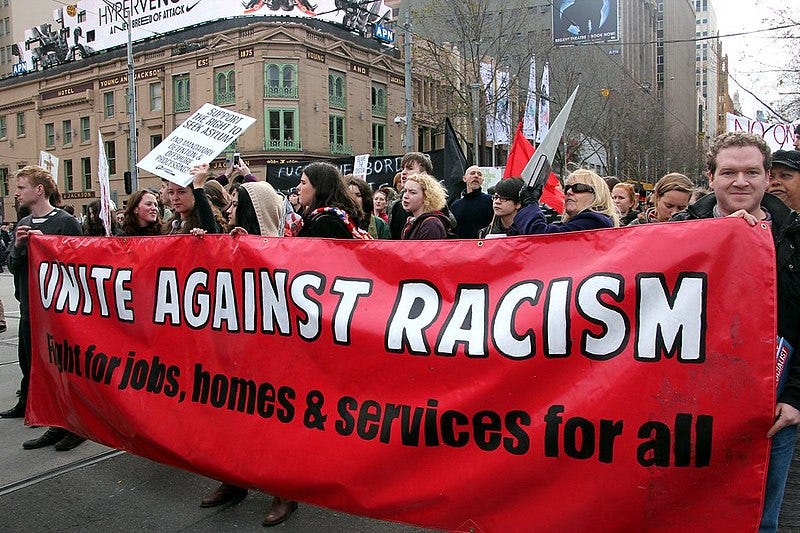
When Race and Economic Opportunity in the United States came out in 2018, many writers wrote about how racially unequal the US still is and ignored the promising findings: There are places in the US that show no signs of racism. We can apply the lessons from them to end racism in the entire US.
The researchers, Raj Chetty, Nathaniel Hendren, Maggie R. Jones, and Sonya Porter, found:
1. Black women now do better than white women who grew up in families with comparable income.
…black women earn slightly more than white women conditional on parent income. Moreover, there is little or no gap in wage rates or hours of work between black and white women.
2. Black women are on track to do better than white men who grew up in families with comparable income.
…Black women have higher college attendance rates than white men, conditional on parental income.
3. In 99% of neighborhoods in the United States, black men do worse than white men who grew up in families with comparable income. The 1% of neighborhoods where white and black men do equally well share similar traits.
…Both black and white boys have better outcomes in neighborhoods commonly perceived to be “good” areas: Census tracts with low poverty rates, high test scores, and a large fraction of college graduates
…In low-poverty neighborhoods, two types of factors are most strongly associated with better outcomes for black men and smaller black-white gaps: low levels of racial bias among whites and high rates of father presence among blacks.
Black men who grow up in tracts with less racial bias among whites — measured by testing for implicit bias or explicit racial animus in Google searches — earn more and are less likely to be incarcerated.
Black men who move to better areas — such as those with low poverty rates, low racial bias, and higher father presence — earlier in their childhood have higher incomes and lower rates of incarceration as adults. These findings show that environmental conditions during childhood have causal effects on racial disparities, demonstrating that the black-white income gap is not immutable.
So, how do we ensure low poverty rates, high test scores, a larger fraction of college graduates, low racial bias, and higher father presence?
- End poverty for everyone with Martin Luther King’s preferred solution, Universal Basic Income.
- Produce higher test scores with Basic Income. We have strong evidence that “The stresses of poverty — such as crowded conditions, financial worry, and lack of adequate child care — lead to impaired learning ability in children from impoverished backgrounds.”
- Produce a larger fraction of college graduates with either a high Basic Income that makes college affordable for everyone or free higher education that includes trade schools.
- Promote low racial bias by providing job programs where people of different races could work together as equals, which would eventually eliminate the class discrimination and economic discrimination that feed racism wherever there’s a major economic gap between races.
- Promote higher father presence in families with Basic Income. Fatherlessness is a growing problem for American children of all races. We have known since at least 1993 that “Poor two-parent families were about twice as likely to break up as were two-parent families not in poverty” and “Poor African-American families are nearly twice as likely to break up as poor white or Hispanic families, which may be at least partly explained by the fact that black poverty is deeper than white poverty.”
There are no long-term studies of Basic Income to tell us how much ending poverty would increase father presence in families, but we have one example from the Stockton test:
One man talked about how he was forced to work side jobs to make ends meet. But because of the extra 500 dollars a month, he was able to cut back on the extra work and spend more time with his kids. He talked about going to the pool with his kids, for the first time in a very long time. He was surprised to see that they knew how to swim.
The challenge, of course, is building the political will to create a society where everyone may compete on an equal basis.
Related: King did not support Reparations — His “check” referred to Basic Income. His “campaign” referred to the Poor People’s Campaign, which was for poor people of all races.


