
How to End a Story
Specific tactics for a successful finish of any non-fiction article
Endings are a lot like beginnings. As the writer, if you don’t know what it wants to be, you might not have a full grasp of your story and all its nuances. You’ll know when your ending is not organic: You’ll be trying to “come up with an ending” instead of having the ending flow from the natural progression of the story.
There’s no right or wrong way to start or end a story. But as a writer and an editor of non-fiction articles, I find beginnings often suggest themselves, and endings not so much. We get all hepped up out of the gate, and we put lots of energy into grabbing the reader’s attention, laying out some who, what, when, where, how and why, maybe being clever, maybe backing into the lede with a wonderful anecdote. We’ve got this! On a good day, when we have done our research and crafted a good outline, we simply follow the trail of thought and it all just flows out of our fingers. And then, screeeech. Argh! The story hits the end of the road and does not know how to finish itself.
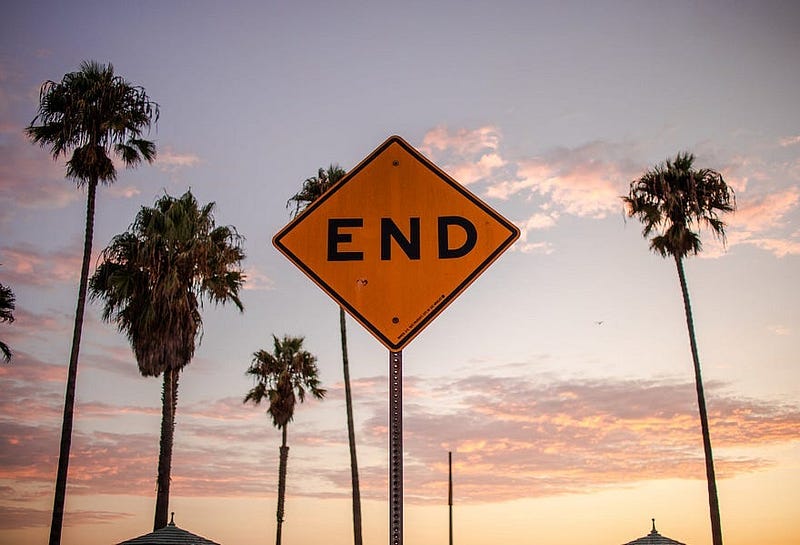
Here are some specific tactics I’ve learned for putting an end to this struggle, and which I share with writers when during the editing process their final sentence falls flat. Before the do’s, let’s clear the air on the big don’t:
Don’t summarize your story. Unless you’re writing a book (or a boring academic paper) odds are pretty good readers will finish your piece in one go. Why summarize what they’ve just read? That’s a classic writer’s crutch. The easy way out. And it’s not just unnecessary, it’s boring.
OK, that out of the way, here are the things you can try:
Look for the ending before you write the beginning. Just as we think about heds, ledes, nutgraphs and subtitles before, during and throughout the process of researching, interviewing sources, outline and writing, we should be looking for the ending. It won’t write itself! Keep this tactic in mind as you consider the next few…
End on a zinger, some fact or next step or follow-on strategy or whatever nugget that was not crucial to point out sooner but which does add something to the reader experience. It may be something that surprises or delights, or is just informative but perhaps tangential. But every story can’t end on a doozie. Don’t force it. And don’t be random. It has to flow, to make sense. When it works well, your reader will smile, or at least nod in appreciation for what you’ve done.
Shift gears. Save some tangential tidbit that can be framed as an “Oh, by the way,” or “And guess what?” or “However” or some other sort of surprise or interesting short thing that didn’t quite make the cut as a crucial part of the story. This does not have to be a zinger, but it’s similar in spirit. It’s OK to leave readers hanging like this (as long as you’re not confusing them). A cliffhanger, if you will, for some tangentially related story you might or might not write someday.
Circle back to the beginning. When we jog the reader’s memory, it’s like a fresh discovery that delights. Oh yeah, that’s what this is about! Don’t repeat the beginning. Just give it a nod in some knowing way. If this were the end of this story, for example, I might circle back with something like this: If your beginning was good enough to be the beginning, perhaps it can be referred to again in the end, organically.
Quotes somebody. As I’m doing interviews, reviewing press materials and otherwise gathering quotes, I’m on the lookout for a pithy one to set aside. My favorites are quotes that add additional perspective to the article but don’t make a reader feel like, “Hey, why the f didn’t you tell me that sooner?!” Even a quote that summarizes things can work — because it’s an expert summarizing some points you’ve made, rather than you regurgitating. Just make sure it’s not boring as hell, and not a verbatim repeat of things you’ve written; it needs to add at least a wee bit. (Note: I’m not suggesting you search BrainyQuote for a quote to end your story. Don’t be random, and don’t try to show off your ersatz literary knowledge.)
If you don’t have any of the above, then don’t try too hard. Just end it. Endings won’t always be special, hard as we might try. I was editing a draft recently in which an entire section at the end, with three paragraphs, felt forced. Here’s what I told the writer:
All this feels a bit tacked on. It’s not bad, but it doesn’t sing, doesn’t add much. Feels like you weren’t sure how to end it, but you felt some words were needed. My general advice: When the story is done, stop writing. :)
And on that note, one final thought: Every story has an ending from the moment you start writing. It’s either something you wrote for the end at the beginning (yay, you!), or it’s the last sentence in the draft at any given moment — and sometimes that’s exactly where the story has to end.
Cheers, Rob
This article first published in my Writer’s Guide newsletter on Substack, where you can subscribe to get weekly articles like this in your inbox and learn about my coaching and mentoring services.


