
How to eliminate the greatest distraction during writing
A lot of things can distract us when we write: Push notifications from smartphone apps, roommates, our own thoughts, and a thousand other things. But one thing most authors overlook.
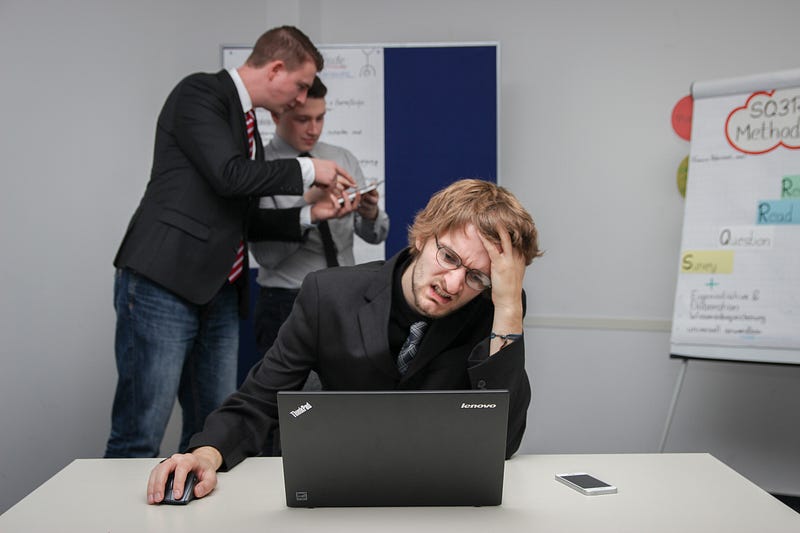
Things that distract us from writing — what most authors know
1. Internet: When writing, checking emails again and again or looking up what’s new on Facebook is a common distraction. The simple solution is to install software that blocks individual pages on the Internet for a specified period. Every author knows this, and the problem is easy to solve.
2. roommates: No matter whether your spouse is distracting you or your children are continually disturbing you — here it is enough to explain that you don’t want to be disturbed while writing unless the house is on fire. This problem can also be easily solved.
3. push notifications: Our smartphones make everyday life easier for us in a variety of ways. But social media apps like Facebook, Twitter, and Instagram are always trying to get our attention. Everyone knows how difficult it is to ignore a push notification. But because everyone knows that, this problem can also be solved quickly. Just deactivate all push notifications or move the smartphone to another room.
4. wandering thoughts: This distraction is much more challenging to eliminate than the others. But here, too, we are aware of the problem, and most professional authors will find a way to deal with it sooner or later. For example, you can write down ideas when they appear and then continue writing immediately. They don’t block our consciousness all the time. If wandering thoughts have other causes, suitable tactics can be found.
Something that distracts us from writing and that almost no author recognizes
Strangely enough, most authors are not aware of the most significant distraction they experience every day in their writing flow: The autocorrection of the word processor.
No matter what software you write with, this program certainly has an autocorrect function. The vast majority of users have activated this function permanently because it seems so practical.
As soon as you spell a word wrong or set a comma wrong, the program sounds an alarm and underlines the wrong word.
It’s great, isn’t it? No, it isn’t, because our brain can’t ignore this alarm.
Think for yourself: If you write an article or a new chapter for your novel and the autocorrection sounds an alarm — do you just keep writing or interrupt immediately and take care of the error the software reported first?
I bet you do the latter. Our brain, just as we try to focus on something, is continuously looking for ways out of that state. It scans the environment for possible threats and is always ready to sound the alarm.
Our brain does this not to annoy us, but to protect us.
Concentrated work may be essential to us, but the brain sees it as a distraction from the ubiquitous dangers that surround us. Its job is to keep reminding us that a saber-toothed tiger could be lurking behind every tree, even if these animals have been extinct for tens of thousands of years.
Our brains don’t know that we now live in a high-tech world where most of the dangers of prehistoric life no longer exist.
It still reacts to movement and sounds. So if our text suddenly shows a red line under a word (optical stimulus) or a sound is heard that is supposed to tell us a mistake (acoustic stimulus), our brain will immediately make sure that we turn our undivided attention to this stimulus.
The fatal thing about autocorrection is that it continually produces distractions. A roommate may disturb us twice a day, and we only give in to the urge to check our emails once or twice an hour at most, but the autocorrection comes in every minute.
A study has shown that we need an average of 23 minutes after an interruption to be able to continue working focused again.
If we now imagine that messages of the autocorrection appear every minute, the whole extent of the problem becomes apparent: We don’t even manage to get into our work so profoundly anymore to get into the flow state.
In other words, autocorrection ensures that we are permanently distracted and always work below our capabilities. So we only perform a fraction of what we can do without being aware of it.
Try it out now — you’ll be amazed
If as an author, you usually write with autocorrection turned on, I invite you to an experiment: Turn it off before your next writing session and watch what happens.
The experiment is most effective if you first write an hour with autocorrection and then an hour without.
If you compare the number of words you’ve written within an hour with and without autocorrection, you’ll fully understand how significant the effect is.
I am very sure that after this experiment you will never write again with autocorrection turned on.
Correcting all mistakes at the very end in one go will save you a lot of time.
Read also:
do you want more of this?
Receive weekly email and don’t miss any of my articles.
suscribe here http://bit.ly/ReneJunge


