
Lowering the barrier to understanding these new technologies
How to easily post data in the Ethereum blockchain network forever -with no programming
Software to interact with decentralized blockchains has become simple enough that you can now in few steps do things such as writing data that will stay there forever uncorrupted, uncensored, and dated. I present here a short, easy how-to, and reflect on the possible applications this enables. All this will hopefully help you grasp the power of decentralized blockchains and understand more about this world, just like it helped me.
Notes: (1) This article is not about cryptocurrencies, even less about their trading or finances; rather, it is about helping you to self-learn about blockchain technology by using it hands-on through a very simple interface. (2) To run the small tutorial you’ll need to spend some dollars worth of ETH; of course I cannot be held liable for any problems or losses you incur into.
Distributed/decentralized blockchain technologies and cryptocurrencies are hard to grasp, and sound totally abstract for most people -even for me until recently. But as I always say, trying things hands-on often allows us to learn faster and better!
I will show you here that the software for interacting with blockchains has become quite easy to use; in fact, some have gotten so simple that you can nowadays do things such as writing data to a blockchain in few steps and without any programming skills. For this I will guide you through writing a small piece of text as a transaction in the Ethereum network.
Interestingly, the data records you write in networks like Ethereum’s remain anonymous unless you reveal your name, cannot be removed or censored, and are physically written in thousands of computers of the network that agree on its content -the key to distribution and decentralization. Moreover, the records are dated, which means you could possibly do things such as establishing contracts or setting precedent on something that you invented or created -roughly speaking the core of smart contracts and NFT technologies.
Let me show you in this article how to write a small piece of text in the Ethereum network, where it will stay “forever” uncorruptable -at least as long as the network exists and of course considering today’s technologies!
Why do I bring up this minitutorial?
Well, because many people believe that all this crypto/blockchain world is too far out of their reach and understanding. In fact I thought this myself! By doing this tutorial hands-on I could more easily grasp the essence of the blockchain, distribution, smart contracts, etc., and unveil the meaning of several buzz-words and concepts from the crypto-world. All this then reduced the learning barrier. It is my intention that your working on this tutorial will help you in the same way, to learn more about all this.
Specifically, here I will show you how to post some text that will live forever uncorrupted and uncensored in the Ethereum network, in a private format unless you reveal your identity. Then, on a small closing note I will reflect on potential applications that this technology could have -some of which are in fact the basis for what other networks are already doing.
Writing a message in the Ethereum blockchain
What you need:
- A web browser compatible with MetaMask. I’m using Brave, a superb browser as I explain here, but others such as Firefox or Chrome should work too.
- The MetaMask plugin connected to the browser you’ll use. You can get MetaMask for free at https://metamask.io/. Just open that link with your browser, choose Download and it will get installed and linked to the browser. A small icon like the face of a fox will appear on your browser. MetaMask is a “wallet” that lets you hold, send and receive cryptocurrencies.
- An account on MetaMask, that will of course start with no crypto in it if you are opening it right now. You create this account right inside the MetaMask interface when you add it to your browser. You won’t need to add any email address or any other information that reveals your identity. But you’ll have to generate two security checks: a password and a seed phrase.
NOTE: Be extra careful about storing your MetaMask seed phrase (a recovery phrase) somewhere safe. Not even the MetaMask developers can recover your account if you lose the seed phrase!!!
- Some ETH in your MetaMask. For the example I show here I spent around 3 USD, but it might be a bit more or less depending on the status of the Ethereum network at the moment when you ask it to run the transaction. To get ETH you can buy right there in MetaMask (I never did this) or send from any other wallet where you have some (I did this, with no problems and within a minute I got around 0.045 ETH deposited).
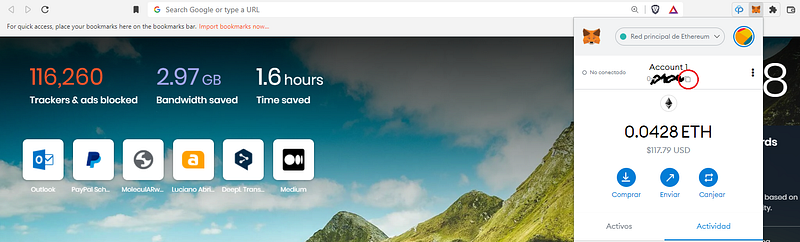
Once you’ve done that -which is far simpler than it looks- your browser with MetaMask will look something like this:
The procedure
The procedure is quite simple. Essentially it consists in sending 0 ETH to yourself, writing in the transaction a note with the contents that you want to post to the network. Note that although you send to yourself 0 ETH, you actually do spend money because you pay the so-called “gas fees”! In my example, I had to pay around 3 USD. The exact number will vary but should be single-digit for very short messages.
First, prepare the message
Messages are stored in hexadecimal format, so you need to convert your text into this format first. Here you have a free online tool that converts text to hexadecimal format and the other way around (there are lots of similar free converters…)
Note: you’ll see in other tutorials that hexadecimal messages begin with “0x”. However, what you encode with the tools above does not start with “0x”. For example:
Example writing in the Ethereum networkGets converted to:
4578616d706c652077726974696e6720696e2074686520457468657265756d206e6574776f726bIf you add “0x” in front and make a mistake in doing so, then you will screw up the conversion and your data will end up unreadable. To make your life simple, just copy the hexadecimal number as it is and MetaMask will handle it automatically in the proper way.
Second, a small setting in MetaMask
By default, MetaMask will not show you the option to attach a message/data to a transaction. But this can be easily enabled. Just go to the MetaMask icon in your browser (the fox face), click the upper right icon, and choose Settings (in the figure below this says Configuración since my browser is in Spanish).
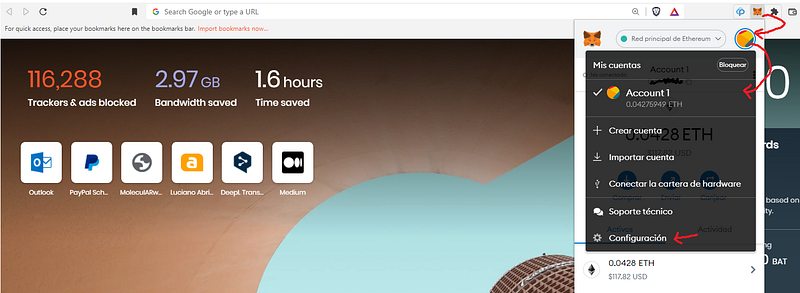
Once in MetaMask’s Settings, go to Advanced and scroll down till Show hex data. Activate this.
Now, the transaction with the message in it
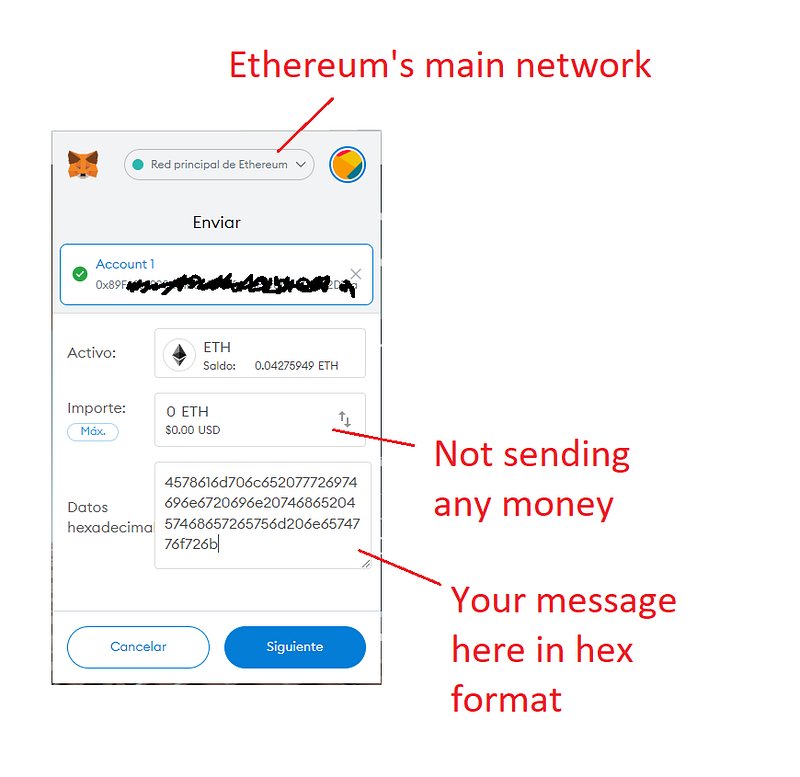
To do the transaction you just need to click the fox icon to enter MetaMask, then click the Send button, enter the number of your own account and a value of 0 ETH, and paste the message that you prepared above in hexadecimal format.
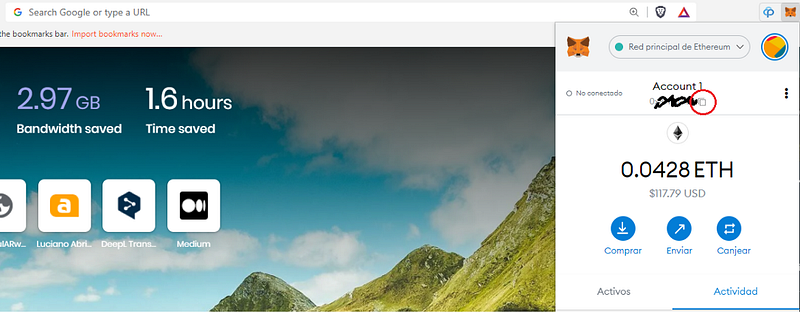
How to get your own account number? Well you have it right there on MetaMask, with a button to copy it to your clipboard that I show here in red:
So you’ll then have a window like the following, when you set up the transaction:
When you click continue, you get to the point where you are presented the gas fees you’ll have to pay. In this case it’s USD 2.7 worth of ETH
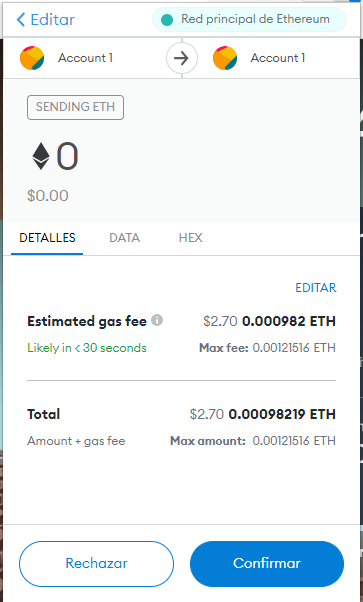
You can see that the transfer is being sent from your account to itself, for 0 ETH but with a gas fee that fluctuates depending on various factors. Here it was moving around 3 USD, and it was 2.7 USD when I took the screenshot.
On clicking Confirm the transaction is sent for processing, irreversibly. In a matter of seconds, perhaps a couple of minutes if the network is very busy, you’ll get a receipt saying that the transaction was successful. And together with it you’ll get a unique identifier for that transaction.
Seeing (and possibly sharing) your transaction
You can see all transactions online, not only yours but everybody else’s if you have the identifiers or browse or search the network, in a website called Etherscan.io.
You can access your own transaction right from the receipt you got, or from MetaMask’s section that lists all your transactions. Here’s one example from a transaction I did some time ago:
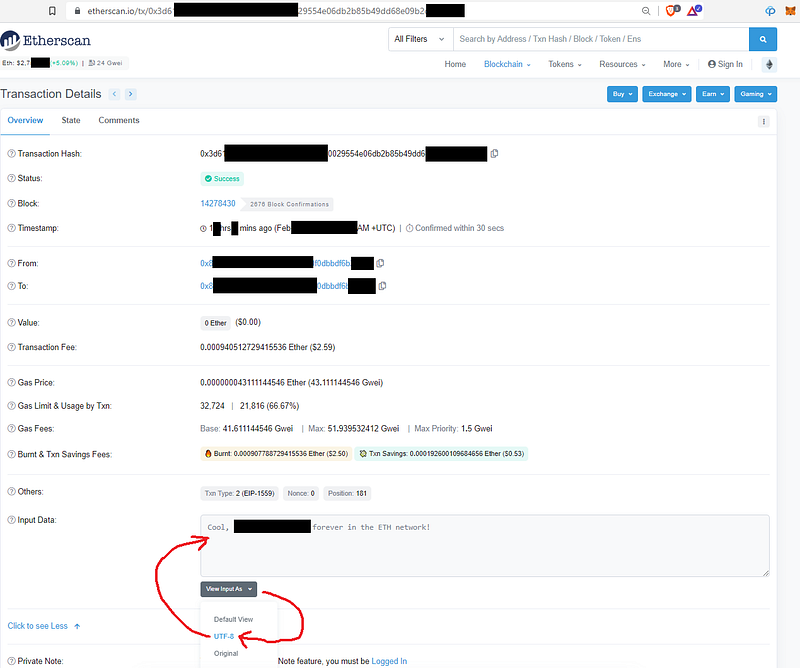
The red arrows show what you have to choose to view the data in a human-readable form (UTF-8).
If you want to see some examples of things that people have posted, you can just check for yourself:
https://etherscan.io/tx/0x904f8e3af19f1fdbbe7a0e534b6a8f080ff6b2ad79c7a874cee22b53ee70f717
https://etherscan.io/tx/0x813850ba423fe4a7e38d89c0c4a1d0a166f58f9d369778086b3b1a28edf92bc0
What could be done with this?
I think the potential applications are quite straightforward once you got the concepts: You can write messages that cannot be removed or changed, thus will not be lost or suffer censorship; besides, as the messages are dated then you can set precedents, i.e. make clear in a formal uncorruptable way (but without paying any lawyer!) that you discovered or built something new first (well… at least that you put it in the network first).
- The resilience to censorship has already been exploited in multiple cases. Just see these two examples:
- As for setting precedent, an obvious direct application is about “patenting” inventions or discoveries. (No conflict intended about what exactly can be patented or not, I’m just drawing an analogy… I hope you got the idea).
One could for example write in the blockchain the formula of a new molecule created with some specific application, to prove that this person got it first. Or whatever other thing.
The law is actually seriously considering the implementation of such kinds of systems in the form of so-called “smart contracts”, computer programs hosted and running in a blockchain that “supervise” themselves and thus the fulfillment of the contract. Examples:
Alternatively, one could attach a record of the blockchain to an external (physical or virtual) object, just like when a paper proves that your car is yours, or that you have a quality watch, or that the gold in your ringer is of a given karat value. Very superficially, that is the idea of the Non-Fungible Tokens (NFTs), which are handled by special computer programs that host their records (in this case who created the piece, who bought it at what price, who bought it next, etc.) in networks just like Ethereum’s.
Further reads of interest
Two potential uses advanced for medicine that keeps data private:
Rather interested in cryptocurrencies?
Liked this article and want to tip me? [Paypal] -Thanks!
www.lucianoabriata.com I write and photoshoot about everything that lies in my broad sphere of interests: nature, science, technology, programming, etc. Become a Medium member to access all its stories (affiliate links of the platform for which I get small revenues without cost to you) and subscribe to get my new stories by email. To consult about small jobs check my services page here. You can contact me here.


