avatarMelissa Gouty

Free AI web copilot to create summaries, insights and extended knowledge, download it at here

3476

Abstract

_VjObnEa1WXiMUD9T65RG_YvRLZ-1eYO3fqfqRu0fynRL_1nukNa4gH1t86pc1SP&__fp=VsrOGjBOxf43yWPvuidLz-TPR6I9Jhx8&hpts=1576852873027&showSwitchService=true&usernameImmutable=false&rememberMe=true&login=&login=Sign+in&login=true&hptsh=M4TWlEJZ8rCtzCWOSI5ZxvZWEIU%3D#n=4c6a513b-d5ad-43ed-a7f6-2f8b7c356e08&s=s563&ses=4&sh=2&sds=5&">effective book cover</a> that boosts sales is not an accident. Multiple factors that play into what goes onto the cover:</p><ul><li>Genre of the book</li><li>Intended target audience</li><li>Tone of the story</li></ul><p id="30ac">Within 90 seconds, 70% of the population decides whether or not to pick up an object. Since 62–90% percent of a person’s assessment of an object is based on color alone, the choice of hue is crucial. People associate colors with temperature, taste, and smell.</p><p id="95b3">For this reason, “happy” books like romances often have covers featuring light hues, often with a pink or yellow tone to them. Horror novels are usually dark because it’s hard to suggest terror with pastel pink.</p><p id="e647">Fiction books often use warmer shades because they evoke a sensory response.</p><p id="6596">Nonfiction books and reference works use cooler colors like dark blue or brown, more serious and trustworthy.</p><p id="08ba">In addition to the psychological effect of color on a book cover, artists have to consider the balance between suspense and insight. They have to tease without telling too much.</p><p id="b2e7">In today’s world, the science of book covers has been reduced to basic facts and standardized templates. Don’t you get tired of plain colored dust-jackets with nothing but contrasting titles in big fonts? When was the last time that you purchased a book with truly memorable artwork on the cover?</p><h1 id="8759">Dress Your Book for Success, But Also For Love</h1><p id="c7e6">It’s hard to love a story wrapped in nothing but a plain cover and logical title. Where’s the allure in that?</p><p id="2f63">Tim Kreider wrote in a <i>New Yorker</i> essay,<a href="https://www.newyorker.com/books/page-turner/the-decline-and-fall-of-the-book-cover"> “The Decline and Fall of the Book Cover,” </a>that he</p><blockquote id="9ab5"><p>“When was the last time I was really entranced and drawn in by a book cover? …I can’t remember the last cover that caught my eye in a store and caused me to pick up, read around in, and ultimately buy the book.”</p></blockquote><p id="4ad8">Kreider goes on to lament the lack of beautiful artwork in adult books, something I’ve often wondered about myself:</p><blockquote id="b836"><p>“How come books for kids get to look so mysterious and tantalizing and spooky, while books for us grownups have to be so dull? Why don’t the covers of mainstream literary books make me feel that same way — almost scared to find out what’s inside? For some reason children’s books, Y.A. literature, and genre fiction still have license to beguile their readers with gorgeous cover illustrations, but mature readers aren’t supposed to require such enticements. For serious literature to pander to us with cosmetic allurements would be somehow tacky, uncool. The more important a book is, the less likely there is to be anything at all on its cover…”</p></blockquote><h1 id="aa3c">Beautiful Book Illustrations Aren’t Just for Kids</h1><p id="acee">Would I have loved <i>The Lord of the Rings </i>Trilogy so much if I hadn’t been presented with a

Options

taste of their magic in those marvelous illustrations?</p><p id="2afc">Probably not. The pictures were part of the package, a precursor to adventure, a foreshadowing of action. The images on the covers of those books were seared into my memory, the foreplay of literary love.</p><p id="f852">Would I love it if modern-day adult books had more interesting artwork on the front and they weren’t all so similar to each other?</p><p id="3f44">You bet. (I actually watch the intro to Netflix’s Anne of Green Gables series, “<i>Ann with an -e” </i>EVERY SINGLE EPISODE<i> </i>because the illustrations that introduce the show are so beautiful<i>.)</i></p><p id="f75a">And so I come back to the artwork on Tolkien’s Middle-Earth Trilogy and the pictures that reeled me in. <a href="https://www.nytimes.com/2020/02/15/books/barbara-remington-dead.html">Barbara Remington</a> created those alluring illustrations under a tight deadline without ever having read the books. She died last month at the age of 90, dressing those books for success, but never knowing the part she played in making me love them.</p><figure id="0ad2"><img src="https://cdn-images-1.readmedium.com/v2/resize:fit:800/0*tvtcydiBJqebpUYK"><figcaption>Photo by <a href="https://unsplash.com/@freephotocc?utm_source=medium&amp;utm_medium=referral">Andrian Valeanu</a> on <a href="https://unsplash.com?utm_source=medium&amp;utm_medium=referral">Unsplash</a></figcaption></figure><p id="0ee3">If you like this piece, you may also enjoy these:</p><div id="2910" class="link-block"> <a href="https://readmedium.com/one-magnificant-prize-you-need-to-know-about-73e42c76b0fb"> <div> <div> <h2>One Magnificant Prize You Need To Know About</h2> <div><h3>Carol Shields Prize for fiction by women beginning in 2022</h3></div> <div><p>medium.com</p></div> </div> <div> <div style="background-image: url(https://miro.readmedium.com/v2/resize:fit:320/1*cCw9XDFeDTo63HTOFouwoA.jpeg)"></div> </div> </div> </a> </div><div id="9a5f" class="link-block"> <a href="https://readmedium.com/how-many-pulitzer-prize-winning-novels-have-you-read-982cb3ed53d5"> <div> <div> <h2>How Many Pulitzer Prize-Winning Novels Have You Read?</h2> <div><h3>Learn what’s awarded as a “distinguished” representation of American life — and get a good story in the process</h3></div> <div><p>medium.com</p></div> </div> <div> <div style="background-image: url(https://miro.readmedium.com/v2/resize:fit:320/1*A-BXDKhxIinLpgXDQTniVQ.jpeg)"></div> </div> </div> </a> </div><div id="f30e" class="link-block"> <a href="https://readmedium.com/7-ways-keeping-a-book-journal-will-improve-your-writing-b63b5a758b96"> <div> <div> <h2>7 Ways Keeping a Book Journal Will Improve Your Writing</h2> <div><h3>If you haven’t been doing this, start now</h3></div> <div><p>medium.com</p></div> </div> <div> <div style="background-image: url(https://miro.readmedium.com/v2/resize:fit:320/0*8IO6AHqwlRWkyjG-)"></div> </div> </div> </a> </div></article></body>

The Cover Art of Tolkien’s Lord of the Rings Seduced Me

The trilogy was dressed for success
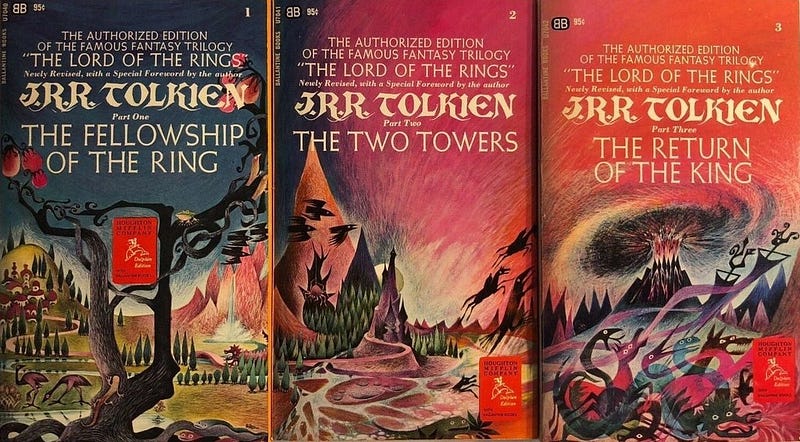
Barbara Remington’s Cover Illustrations for Tolkien’s Lord of the Rings Trilogy. Photo: Ballantine Books and The New York Times

Yes. You CAN Judge a Book by Its Cover

You’ve heard that you can’t judge a book by its cover, but I beg to differ. That statement has been attributed to different sources: First, an 1867 quote in a newspaper called, “Piqua Democrat:”

“Don’t judge a book by its cover, see a man by his cloth, as there is often a good deal of solid worth and superior skill underneath a [???] jacket and yaller pants.”

The Don’t-Judge-a-Book-By-Its-Cover-phrase has also been credited to a 1944 phrase in an African journal called “American Speech.”

“You can’t judge a book by its binding.”

Two years later, Edwin Rolfe and Lester Fuller wrote Murder in the Glass Room and popularized the phrase,

“You can never tell a book by its cover.”

No matter who coined the phrase, those men were wrong. What do they know about fashion — not for the ages — but for the pages?

Every book needs a wardrobe worthy of attention, a classy cover, not a dust-jacket, but a “Must-Jacket” so readers will notice.

The Allure of Illustrations

My mother, bless her soul, ALWAYS gave books for Christmas. It was part of her holiday tradition, and until she died at the age of 86, every person in our family, from daughters and their spouses, to grandchildren, and great-grandchildren could count on receiving a carefully-chosen book as a gift.

One Christmas, in 1969 or 1970, I was gifted with a boxed paperback set of J.R.R. Tolkien’s Lord of the Rings. I had already been seduced by The Hobbit, become an admirer of wizards and dwarfs, and was an ardent fan of the beautiful, wise elves. Bilbo Baggins infected me with his wanderlust, sharing his strange and magical friends with me. How could I NOT wish for such adventure?

“Far over the misty mountains cold To dungeons deep and caverns old We must away ere break of day To seek the pale enchanted gold.”

I was an awe-struck eleven-year-old that Christmas morning, pulling each volume of Lord of the Rings out of its cardboard wardrobe and gasping with delight. Those colors. Those weird lines. The way the pictures on one book continued onto the next. Adventure. Mystique. Danger. All with the stroke of a pen and the slash of a paintbrush.

The Importance of Dressing a Book for Success

We’ve all picked up a book because of its cover. The visual packs a faster wallop than the words do. Plots can’t have much power until you read them, but pictures can pinch you in the eye as you go by.

Producing an effective book cover that boosts sales is not an accident. Multiple factors that play into what goes onto the cover:

  • Genre of the book
  • Intended target audience
  • Tone of the story

Within 90 seconds, 70% of the population decides whether or not to pick up an object. Since 62–90% percent of a person’s assessment of an object is based on color alone, the choice of hue is crucial. People associate colors with temperature, taste, and smell.

For this reason, “happy” books like romances often have covers featuring light hues, often with a pink or yellow tone to them. Horror novels are usually dark because it’s hard to suggest terror with pastel pink.

Fiction books often use warmer shades because they evoke a sensory response.

Nonfiction books and reference works use cooler colors like dark blue or brown, more serious and trustworthy.

In addition to the psychological effect of color on a book cover, artists have to consider the balance between suspense and insight. They have to tease without telling too much.

In today’s world, the science of book covers has been reduced to basic facts and standardized templates. Don’t you get tired of plain colored dust-jackets with nothing but contrasting titles in big fonts? When was the last time that you purchased a book with truly memorable artwork on the cover?

Dress Your Book for Success, But Also For Love

It’s hard to love a story wrapped in nothing but a plain cover and logical title. Where’s the allure in that?

Tim Kreider wrote in a New Yorker essay, “The Decline and Fall of the Book Cover,” that he

“When was the last time I was really entranced and drawn in by a book cover? …I can’t remember the last cover that caught my eye in a store and caused me to pick up, read around in, and ultimately buy the book.”

Kreider goes on to lament the lack of beautiful artwork in adult books, something I’ve often wondered about myself:

“How come books for kids get to look so mysterious and tantalizing and spooky, while books for us grownups have to be so dull? Why don’t the covers of mainstream literary books make me feel that same way — almost scared to find out what’s inside? For some reason children’s books, Y.A. literature, and genre fiction still have license to beguile their readers with gorgeous cover illustrations, but mature readers aren’t supposed to require such enticements. For serious literature to pander to us with cosmetic allurements would be somehow tacky, uncool. The more important a book is, the less likely there is to be anything at all on its cover…”

Beautiful Book Illustrations Aren’t Just for Kids

Would I have loved The Lord of the Rings Trilogy so much if I hadn’t been presented with a taste of their magic in those marvelous illustrations?

Probably not. The pictures were part of the package, a precursor to adventure, a foreshadowing of action. The images on the covers of those books were seared into my memory, the foreplay of literary love.

Would I love it if modern-day adult books had more interesting artwork on the front and they weren’t all so similar to each other?

You bet. (I actually watch the intro to Netflix’s Anne of Green Gables series, “Ann with an -e” EVERY SINGLE EPISODE because the illustrations that introduce the show are so beautiful.)

And so I come back to the artwork on Tolkien’s Middle-Earth Trilogy and the pictures that reeled me in. Barbara Remington created those alluring illustrations under a tight deadline without ever having read the books. She died last month at the age of 90, dressing those books for success, but never knowing the part she played in making me love them.
Photo by Andrian Valeanu on Unsplash

If you like this piece, you may also enjoy these:

Book
Reading
Illustrations
Publishing
Literature
Recommended from ReadMedium