

How to Double Your Productivity with a Tomato and Some Juggling Balls
The Pomodoro technique skyrocketed my motivation and productivity.
I don’t have enough time. The thought was on loop in my head, like my mind was playing an old CD with a scratched surface. I was five days from my deadline, with work for about ten. You don’t exactly have to be an Einstein to see the mismatch.
But let’s rewind a couple of weeks, back to me writing articles and reading books instead of working on the scientific paper that was now giving me headaches.
The project was doomed from the beginning, as I didn’t like writing scientific papers anyways, the first couple of subjects I picked didn’t work out and I rather spent my time with articles. So here I was, in dire need of something that could somehow double my productivity.
Tomatoes for productivity
Enter: The Pomodoro Technique. I heard about it in a stress management seminar I already mentioned here and decided that it might just be what I was looking for.
See, the main problem tackling big tasks is that even if you cover a lot of ground in the beginning, sooner or later, you will get distracted. As anyone who has been working on projects for an extended period of time can confirm, maintaining focus and flow is hard. Sooner or later, the distractions come and get you.
Whether it be your annoying coworker asking you for a favor, you want to check your phone or you can’t stop thinking about your summer vacation and if you should book the flights right now.
Before you know, you find yourself comparing flight fares when you should be comparing spreadsheets. Or you end up watching a video of a guy showing you how to touch a wall with an apple, wondering if this might also work with red apples instead of green ones. Uhm…
This is where the Pomodoro technique steps in. Developed by Francesco Cirillo in the 1990s, it is as simple as effective.
First, you pick a task you want to work on. Then you work in intervals of 25 minutes, separated by five-minute breaks. After four intervals, you take an extended break of 20–30 minutes. Then, you start again with another block.
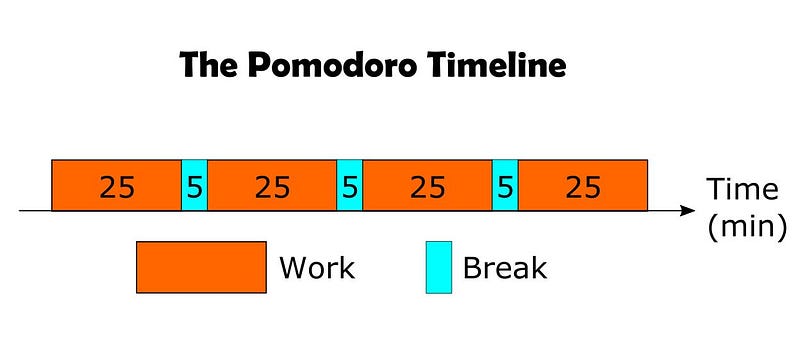
The name Pomodoro Technique goes back to Francesco’s use of a timer shaped like a tomato, which is Pomodoro in Italian, which is also what he used to call his 25-minute intervals.
How the Pomodoro Technique works
The Pomodoro Technique has several advantages. First, it is super simple. No need for fancy schedules, equipment, acronyms or task splitting. Second, it benefits you in two ways.
First, it consists of short, high-productivity sprints of 25 minutes, which make it far more likely that you keep your focus than if you worked for two hours straight. This ensures your productivity stays high because you don’t waste your time dabbling at other things.
Second, the regular, short breaks make sure you stay on top of your creativity and motivation.
The Pomodoro technique provides you with an easy and effective way of separating your time into work and play. This makes you a lot more productive than brute-forcing your way through a three-hour session during which your thoughts trail off and you check your phone constantly.
Another nice bonus of the Pomodoro technique is that it works wonders for tasks you despise. As I said, I hate writing scientific papers. All the quoting, looking up references and detailed style and format guidelines don’t create an environment that is beneficial to creative writing.
Ergo, no fun.
However, I found it rather easy to put my ass down on my chair and start typing away. Why? Because I was only doing 25 minutes at a time. You can survive pretty much any task for 25 minutes that would otherwise bore you to death.
So what do you do with your five-minute breaks? Whatever you wish, basically. However, something that requires a certain cognitive load but is light in nature and doesn’t challenge you too much works wonders. It should take your mind off the task you are working on at the moment, but don’t call for too much brainpower, so you can actually relax.
My personal favorite is juggling. It gets you moving, improves your hand-eye coordination as well as your ability to focus and takes your mind of the current problem. Most important, it’s fun and I’ve always wanted to learn it.
How to deal with interruptions
If you ever heard of Murphy’s Law, you know that sooner or later, something will go wrong. You will get distracted by external influences, such as an urgent phone call, your colleague asking for your help or your dog trying to eat your neighbor.
In this case, it is best to follow the INSC strategy — inform, negotiate, schedule, call back (here is a little mnemonic to get it inscribed in your head so you don’t forget. You’re welcome.)
Let’s pretend your coworker Joey comes up and asks you to check on a report before he sends it out to his boss. Unfortunately, you are in the middle of a Pomodoro, blinders on, flow state and everything.
Following the INSC strategy, you can do the following:
- Inform the person about the fact that you are in the middle of something.
- Negotiate a time at which you can get back to the person.
- Schedule the follow-up immediately.
- Call back once your Pomodoro is done and you have the time.
A simple “Hey, I’m working on an important presentation right now, but can I get back to you in about 15 minutes? I’ll call you straight away.” usually does the trick. Not turning your attention to everything that comes your way keeps you in your flow and allows you to take control of your workday.
Of course, sometimes there are things that you have to turn to immediately. Your dog might have eaten your neighbor if you wait for ten minutes. In this case, get done what has to be done and then start your 25-minute block anew.
Personal Pomodoro Practices
The Pomodoro technique is a prime example for the old saying “A stitch in time saves nine”. By taking short, targeted breaks, you stop before your productivity deteriorates, your motivation plummets and you burn out.
It definitely is one of the best tools to stay productive and motivated for an extended period of time.
The only personal modification I have made is that I merge the first two Pomodoros into one interval of 50 minutes. I feel that after the first 25 minutes, I still have sufficiently high focus so I don’t need a break that early. Also, sometimes when I am in the middle of something and the timer goes off telling me to take a break, I’ll simply turn it off and finish what I was doing.
You will have to play around with the system and see what works for you. These modifications can improve your performance, but be sure to not mess with the core principle of the Pomodoro technique: Short bursts of productive work combined with mini breaks in between designed to get you ready for the next burst.
I handed in my paper about a week ago and yesterday I had a feedback meeting with the responsible supervisor. It seems like I am shooting for a pretty good grade, somewhere around A-levels.
Not too bad for cramming ten days of work I hate into five.
Thank you, Pomodoro.
~Moreno