
How to Distinguish Journalism From Fake News
Flattening the propaganda curve in the age of the coronavirus
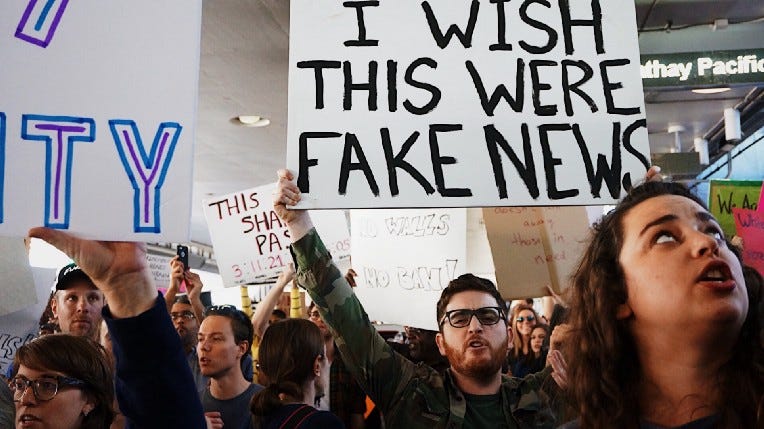
As we struggle to rationalize the minute-by-minute dread of this unfolding pandemic, the Washington Post ran one of the most surreal and outright alarming articles yet: “Coronavirus modelers factor in new public health risk: Accusations their work is a hoax.”
It’s not enough that we’re being attacked by a pernicious and unseen virus from the outside: we are creating a self-made enemy by denying the validity of the crisis itself. We are in danger of propagandizing ourselves to death.
This has been a problem in American politics for a long time, but perhaps never with such high stakes. Because if social distancing or wearing a mask or staying home is how we defeat a virus, then we absolutely need everyone to join in and participate. That means (and I can’t believe I have to write this) that we all agree the virus threat is real. Essentially, we need to recognize the difference between “fake news” and journalism, and immediately.
If you’re like me, you find this situation highly unnerving. It’s one thing to manage the anxiety of a pandemic; it’s a whole other thing to feel like half your community is experiencing a completely different reality, and supporting policies that seem inexplicable.
It feels hopeless. It’s not. I’m here to tell you that there’s a simple way to overcome this. I’ve been interested in this problem for some time, and have learned how to understand how I might be manipulated—as well as a surprisingly easy way to distinguish propaganda from journalism.
Who Is Affected by Propaganda?
Propaganda is not simply information you disagree with.
It’s easy to look at Nazi Germany and bemoan the fools who fell for the foolishness. It’s a lot harder to see it in ourselves. And trust me, you and I are just as easily propagandized as the smart, educated Germans who gave us Beethoven and Goethe and Einstein.
Because everyone can be propagandized — right or left. Our susceptibility seems coded into our evolutionary design. Research shows that both liberals and conservatives are motivated to believe fake news and dismiss real news that contradicts their ideologies. It’s not about intelligence. It’s not about how many books you’ve read. This arrangement appears to exploit the biological function of our psychology.
In other words, it’s not them. It’s me. It’s you. No one is immune. And this is the opportunity. Self-awareness is the antidote, the first step towards intellectual freedom. By recognizing our role in the situation, we have power. The solution is within us. We each have a responsibility and capacity to recognize and reject propaganda. Not along ideological lines, not as a search for an elusive “truth,” but as a more responsible way of engaging with the news. Every “side” can do this. It’s a bridge over the chasm of polarization.
Social media has become our new junk food, and we like stuff that “tastes good.” This means we tend to comfort ourselves with information that satisfies our preconceptions and makes sense of a complicated and unsettled world. But we’ve learned to eat in a healthier way; we can learn to consume media in a way that’s better for us, too. It takes effort to read nutritional facts; it takes a little work to recognize the coercion in our news feeds.
And to do that, we need better skills. We haven’t been taught how to read for coercion — not in a mass way, and not very well. Most of our schooling teaches us to follow directions, commit facts to memory, or perhaps challenge authority. In an age of overwhelming media saturation, we have to read for intent.
So let me suggest: All media is manipulative. This is the foundational concept to put front-of-mind when interacting with information. If you don’t believe that you could possibly be manipulated by media, because you’re too well educated, because you’re above that kind of thing, because you know better, then you are actually more susceptible to being propagandized than others. Because propaganda manipulates your internal bias to lead you to a one-sided, monolithic point of view that feels, in a deep and authentic way, like the truth. If you’re not willing to recognize your inherent susceptibility, then you’ve lost your primary defense.
There’s been deep research on propaganda that has been used to distill its characteristics into recognizable traits (e.g., name-calling, stirring up emotions, etc.). This article is not intended to be a historical summary of the concept. It’s here to offer something you can share with your FOX News-watching uncle, or your passionate socialist friend, or to challenge your own sense of awareness to recognize — and reject — propaganda.
A Better Goal Than Trying to Win Arguments
Whether our polarization is a result of manufactured intent, or just a natural outcome given our predispositions, we are a divided society. And we push the divisions all the time. We seem driven to “convince the other side” that their position is wrong and ours is correct. We send articles that undermine their facts and substantiate ours, with the foolish expectation that they’ll respond by saying, “you know, I never saw it like that, you’re right!” I’ll bet that’s happened as many times as you’ve responded to their facts by changing your views. (Like a magician, I’m holding up a card that says “zero”).
I’m suggesting another way. The idea is not to convince others to change their minds and agree with you. The goal is to keep from being propagandized in the first place. So if you catch yourself thinking that you have “the truth” and others are “fools,” then you are standing on a foundation of delusion. Even if you’re “sure” you’re right.
I’m not saying this is easy. In fact, being open to the idea that we are capable of unseen manipulation is very, very hard. I’m just as guilty as anyone.
How to distinguish propaganda from real journalism
Assuming you’re willing to consider that you might be subconsciously susceptible to propaganda, how do you know if what you’re reading or watching is trustworthy?
Here’s how:
- If it treats any possible alternative view as absurd, then it is propaganda.
- If it references the existence of other interpretations without mocking them, then it is journalism.
That’s it. A simple calculation. It’s not hard.
You might argue that this is too simplistic. And that’s the point.
There’s a well-established marketing principle that successful companies understand: In an overcrowded marketplace, the simplest message is the one that gets through.
Social media — or cable news — is an insanely overcrowded marketplace. Relying on a simple test is a way to overcome the information overload that is seeding discord, spreading lies, and threatening our way of life.
But what about the exceptions?
I already hear the counter-argument: Aren’t there self-evident truths? Are we supposed to stand under falling water and be open to the idea that it “might” not be raining?
No. But I am suggesting that we push the extreme examples like this to the side, and let the general principle stand. It works pretty well, most of the time. Try it with your friends. Try it on yourself.
If you’re a conservative, and you watch FOX News to avoid the “liberal bias” in other media, then you have been propagandized.
If you’re a liberal, and you watch MSNBC because it “corrects the record where others are slanted,” then you have been propagandized.
If you just agreed with one of those statements but rejected the one that describes your preferred news source, then you have been propagandized.
You might like your news channel. It might resonate well with your ideas; you can certainly keep watching it. But don’t for a second think you have the “truth” and everyone else is blind. People who proclaim themselves enlightened and others “fools” are so deep into their own self-delusion they can no longer see the propaganda they’re drowning in.
Look at this way: When you catch yourself disdaining others because they’ve been propagandized, you have found your awakening. It’s like an alarm going off about your own deception. This is where your self-awareness needs to kick in.
How This Is Working for Me
I posted a shorter version of this to Facebook, and long-time friends, with whom I’ve had long-standing political disagreements, responded with, “you won’t believe this, but I actually agree with you.” Though a small sample, it’s been surprisingly well-received. I think it’s because I’m not trying to “prove them wrong,” but acknowledging that I’m struggling with this too.
Generally speaking, most people would rather find a way to get along politically than seek strife. Research shows that “nearly 40% of Americans surveyed said politics is stressing them out, and 4% — the equivalent of 10 million U.S. adults — reported suicidal thoughts related to politics.” Think about that: actually ending your life over our polarization.
The key to this, like so many personal growth strategies, is self-reflection, authentic honesty, a willingness to consider that even our core views could be wrong. Humility, basically. It’s a powerful tool for personal growth, and also for social change.
So consider this “journalism vs. fake news” test a form of social activism. There’s a new hashtag making its rounds that started in the Czech Republic: My mask protects you; your mask protects me. Well, my propaganda test protects you; yours protects me.
Start by allowing the fact that everyone — including you — can be and is already being propagandized. This might be the most honest way to approach it and the most empowering step to defeat it. It’s also a powerful tool to reach across the aisle, find common ground, and start a conversation.
So, recognize that every advertisement, political speech, newspaper article, news broadcast, Facebook post, Twitter tweet — all of it might be a form of potential coercion. And run it through the test:
- If it supports one side and paints any possible alternative as ludicrous, then it is propaganda.
- If it references an alternative view without mocking it, then it is journalism.
Not all FOX News is propaganda. Not all MSNBC is journalism. And vice-versa. Trust journalism. Ignore propaganda. And we’ll get through this.
Further Resources
There’s extensive research that explains the nature of propaganda and the human psychology that drives our susceptibility, offering compelling support for the theme presented here. The references used in this article, as well as works that I’ve found particularly enlightening, are listed below.
- Cognitive bias cheat sheet — A comprehensive and succinct overview to help identify the hidden flaws in our thinking.
- Washington Post: “Coronavirus modelers factor in new public health risk: Accusations their work is a hoax”.
- Facts, Beliefs, and the Brain: How Propaganda, Ideology, and Donald Trump Inhabit the Group Mind: An overview of research that illustrates how the basic working of the human mind makes us vulnerable to propaganda.
- “You are Fake News”: Research finds that liberals and conservatives are equally likely to believe political news that is consistent with their views, and to disbelieve news that is inconsistent with their preconceptions.
- The Fine Art of Propaganda: a classic work by the founders of the Institute of Propaganda Analysis (1937–1942), which describes seven common propaganda devices employed by “specialists in the distortion of public opinions.”
- The Positioning Era Cometh (PDF): the foundational Advertising Age article from Al Reis and Jack Trout that introduced “product positioning” as an antidote for an over-communicated world.
- Friends, relatives, sanity, and health: The costs of politics: Research that suggests a large number of Americans believe their physical and emotional health has been harmed by their exposure to politics.
- The Bias Blind Spot: Perceptions of Bias in Self Versus Others: Princeton psychologist Emily Pronin has found that “individuals see the existence and operation of cognitive and motivational biases much more in others than in themselves.”
- Exposure to opposing views on social media can increase political polarization: We assume that listening to “the other side” would reduce polarization. A recent experiment found the opposite might be true.