
How to Detect the Right Marketer in a 10 Minutes Interview
A Guide to Hiring a Marketing Manager Developed by a Marketer

What is the difference between a random burger bar and McDonald’s? Both of them sell burgers with french fries. McDonald’s does not offer the tastiest and healthiest food ever, but it is a multi-billion brand, which serves plenty of orders every day. Why is it so? The difference is in the powerful marketing and branding.
Dedicated professionals and hard work always stand behind the scenes of a successful brand. People with the brightest ideas will most likely fail if they do not have anyone who would share their passion.
Marketing is not an expense. A janitor is an expense. Your computer is an expense. Marketing is an INVESTMENT — Ali Maadelat
I used to help recruiters with the evaluation of candidates for marketing positions. Surprisingly, it was quite challenging for me since I had to understand if a person possesses all the needed skills within 10 minutes. I want to share my methodology on how to detect a perfect marketer within 10 minutes. It is solely based on my experience, but I hope you will find it useful too.
“Alright, I will Hire one Marketer to Do Everything for Me.”
It is a common mistake I’ve seen multiple companies make when hiring digital marketing managers. CEOs and recruiters assume that one marketer can be an expert in PPC, SEO, Content marketing, SMM, Lead Gen, Referral and Affiliate marketing, etc. This is a lot of hats to wear at once, isn’t it? Multitasking, constant pressure, and lack of time will have adverse consequences for any business.

Some specialists have worked in various sectors and indeed can cover multiple streams of work. However, it is more common to see marketers working in specific areas only. Why is it so? Well, I can name a few reasons for it:
- Time and human capacity are limited. To progress fast, it is wiser to gain deep experience in a few streams of work ONLY.
- It is not possible to become an expert by multitasking at work. Covering multiple areas might lead to an absence of deep professional experience.
To find an employee who would eventually fit the company, recruiters must be specific in their job description and the evaluation process.
CV matters
Someone can say that this is an old school and it is no longer important to have a CV to get a job. However, the reality turns out to be different. CV serves as a screener to eliminate applicants that might not fit the position due to:
- Lack of experience
- Irrelevant background
- Unsuited physical location
CV is just the first step to understand if an applicant can be a potentially good employee. If your company is searching for a marketing expert, make sure to thoroughly check the experience section in the CV. I believe that the manual check does a much better job here. Ask your HR manager to evaluate CVs and define the applicants who will move to the next step.
Set a marketing challenge for applicants
Before setting personal interviews, it is reasonable to check applicants ability of critical thinking and problem-solving. I used to check multiple marketing challenges before deciding who will be invited for a personal talk. It takes some time to check all the challenges. However, you end up with the best candidates for an interview. Here are a few things to remember when you develop a marketing challenge:
Short and comprehensive
Your marketing challenge has to be short, engaging, and clear. Otherwise, applicants might not want to dedicate their time for its completion. 3 questions are ideal for the marketing challenge that should not take more than 2–3 hours to complete.
Utilize different question types
Questions might differ significantly depending on the actual job position. However, the questions should be able to check the following skills:
Writing. It is an essential skill for all marketers. Thus, you might want to make sure your ideal candidate possesses good writing skills. Ask a potential employee to write a short (no more than 500 words) article that would suit your company blog. It should not take much time for a middle or a senior specialist to craft a small blog post. Besides, check if the content is original and was not copied from online sources.
Data analysis. A marketer is supposed to make decisions based on empirical evidence and historical data. If none of the suggestions proposed by a candidate are supported by research or data from Ahrefs, Semrush, or any other marketing tool, this is already a red flag. Marketing is a long-term investment. You are not always able to see the results right away. Thus, you have to trust your new marketer and be 100% sure that this person knows what to do.
Strategic thinking. An ability to foresee what influences business long-term success is priceless. The marketing challenge answers should reflect the strategic thinking of an applicant. Suggestions or strategies should be developed to present the benefits for a company in the long-term. There is no way to do it differently. Vague responses are noticed right away, and usually, such applicants are rejected.
How to detect the right marketer in a 10 minutes interview
Once you have a few candidates selected based on the marketing challenge, it is the right time to invite them for a personal talk. Some people claim that the first personal contact with an applicant should appear much earlier and be via a phone call.
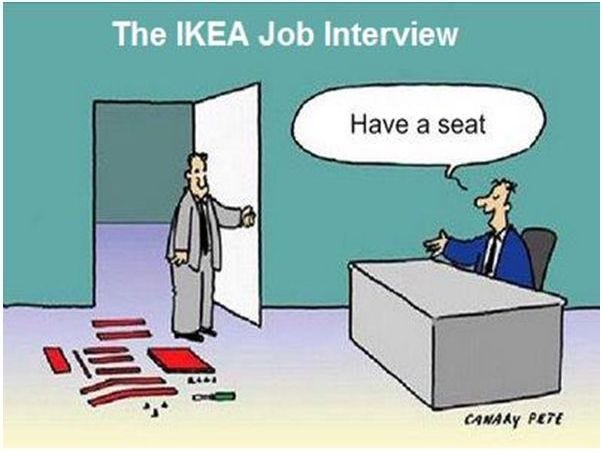
An HR manager is supposed to call and ask a few questions before sending a marketing challenge. However, phone interviews might be time-consuming and cannot evaluate how well an applicant is suitable for a given position. Let’s see how you can organize a personal interview to find your ideal marketer:
Step 1: Getting to know each other
This is a classical way to start an interview, where an HR manager asks a few questions like:
- Tell a bit about yourself (hobbies, interests, current job, etc.)
- Why did you decide to change your job place?
- Expectations from a new job place.
The first impression from a candidate’s behavior, communication skills, and answers can already give you a perfect personality overview.
Listen carefully to understand a candidate’s responsibilities at a current workplace, reasons for leaving, and his/her expectations from a new job. If your company cannot offer what a candidate is looking for , he/she will sooner or later quit. This is wasted time and resources for a company.
Figure out if a candidate’s hobby or interests are related to his/her work. I admit it is not obligatory. However, if a candidate has a personal blog by any chance or runs a personal online store, it is a great sign of self-management and persistence.
Step 2: Checking a professional background
This is the most challenging part of an interview. You are supposed to evaluate a candidate’s expertise and make sure he/she fits the company's needs.
Wrong recruitment decisions are costly, thus there is no room for mistakes.
Describe a certain work-related case and ask your candidate to explain how she/he would handle it. I believe this is the best way to evaluate a candidate’s decision-making and critical thinking skills. Here are some example questions I used to ask:
- Imagine a new Google ad campaign you handle has a poor quality score and a high CPA. Describe your next steps.
- You need to create a strategy for a company blog. What would you focus on? What KPIs would you choose?
- You have a team of writers that produce content for a company blog. You need to give away a task about a blog post writing. How do you find/select/evaluate topics? Which metrics are important for you here? How would you optimize an article for Google?
Questions can differ depending on a marketing role in your company. If you are looking for an SEO manager, then questions about quality score optimization are irrelevant.
Remember, you have already filtered out a lot of candidates with the help of a marketing challenge. Thus, do not focus too much on the technical questions. Instead, evaluate how a candidate can communicate his/her ideas and whether he/she can prove an opinion with data and examples.
CoSchedule provides more than 200 outside-of-the-box interview questions for different marketing roles and levels. Besides, I have used their free marketing interview assessment scorecard, which made my post-interview candidates evaluation much easier.
Step 3: Finding a company culture fit
This is the last but not the least important step in the candidate’s evaluation process. Each company has a different corporate culture. Thus you have to ensure that a new employee will be tolerant of different religions, races, and nationalities that work under one roof.
Background questions from step 1 can already give you an idea about a candidate’s cultural fit. However, ask 1–2 more questions that would help you finish an interview in a friendly manner and, at the same time, get answers to your questions.
- Describe your last teamwork and the challenge. How did you solve it?
- What do you prefer: a home office or working from the office? Why?
- Who inspires you?
- How do you manage conflicts with coworkers?
Final thoughts
It is not easy to find an ideal employee. If you are a lucky one who managed to find a perfect match marketer for the first time — great job. 👏
A good marketing manager brings new knowledge and opportunities, which help companies to move forward.
Look for a personality with motivation, creativity, task ownership, critical thinking, cross-functional collaboration, great communication skills, and a huge willingness to learn something new every day.


