
How to Deliver an Unforgettable Introduction and What to Include
Let's answer ‘tell me about yourself’

How do you introduce yourself?
A simple question. One that we encounter every now so often. Yet we struggle to find the best answer. Sometimes it gets difficult to make it interesting.
Have you ever wondered why? We immediately think of “tell me about yourself” as a stressful situation. As if someone has put us on spot. Our brain associates it with interviews. Because that’s when we reflected to find a perfect answer to this question.
In today’s world, however, we encounter more situations where we need to define ourselves. So it is no longer an interview question. Yet at some point, we all struggle with writing a LinkedIn summary or a bio for Twitter or Instagram.
But this shouldn’t be so hard. You know yourself the best. It should be easy to showcase your authentic self. Think of it as an empty frame. It’s up to you on how you fill it and what you showcase.
How you present yourself, is how people first view you. What are you showcasing? — Zainab Ansell
There are so many layers to our persona. How should you decide the ones you want to showcase?
The purpose of this article is to take you through a complete framework that will give you clarity on approaching this question. It’s a one-time exercise. A unique method of deep-diving and self-reflection.
The first step is to identify your true self. I believe five core elements form the essence of an individual. They are — background and experiences, family and relationships, values and beliefs, personality and style, and dreams and aspirations.
Once you go through this exercise, you will find it useful in many scenarios:
- When you join a new company, how do you stand out in your introduction?
- Job interviews. What do you want interviewers to remember?
- When you meet people from different backgrounds while traveling. How do you strike a meaningful conversation?
- Ice-breaker or conversation starters at parties.
- Identifying unique snippets of your personality. These can be used to describe yourself on LinkedIn, Instagram, Twitter, and even on dating websites.
- Showcasing your brand. How do you stand out?
- Finding your tribe.
Elements at the core of our personality
Background and experiences
This is the basic. The first thing which comes to mind when we try to define ourselves. Our background and experiences make us who we are.
Think of your childhood, where did you grow up, what kind of household, things you loved growing up. Do you remember your first recital? Or the first time you stepped on the stage? For a debate club or spelling bee or to lift the best athlete trophy.
People don’t need to know this. Also, it would account for too much information. The idea is to keep this at the core of your thought process when trying to come up with your introduction. This is what makes you authentic.
Now a key thing to remember is to not make this your entire introduction. Rather this is the foundation of who we are. But it doesn’t reflect us in entirety.
Important moments leave a mark and become a lasting memory. Such positive memories get etched in our brains. Reflecting on them calms us. Use them to weave a story. Your story!
Family and relationships
People who we surround ourselves with also add to who we become. It shapes our personality.
Not everyone needs to know if you are married or have kids. It is not the point. But highlighting some of these parts of your life helps connect better with specific audiences.
As an example, in a parents’ meeting, merely stating your day job won’t help the listener to connect with you, let alone remember you. On the other hand, if you start with your parenting style, people will find the connection. By doing so you became one of them.
Identify patterns of how you behave around your loved ones. The behaviors that stand out to you while interacting with others. Some of these patterns are a reflection of you.
For me, I have a thing for showing my love by cooking for people I care the most for. I pay attention to things that matter the most to them. I also have a habit of bossing around at times. Now here’s the thing, not everything has to be positive. Pick on some of the quirks you display that annoy people. This will be useful in coming up with fun trivia. I explain that later in this post.
Values and beliefs
Perhaps the most critical component. This one sets people apart. Even if they come from the same backgrounds and have similar experiences.
Human behavior is driven by core values. They impact our behavior — both in the near and the distant future.
They are our guiding principals. Discover common ground with everyone we interact with. Our behavior is driven by core values. Whether you would like or dislike someone also boils down to your values and belief systems. That’s why it’s easier to be friends with some people and extremely difficult with others.
So let these shine in your introduction. These are the pillars you cannot compromise with.
Yet, I know not many people think this way when introducing themselves. Identifying your core values will guide you to discover your leadership style, your ideal partner (at least in the description), your inner circle, and much more.
Here’s an exercise. Empty your mind with all preconceived notions about self. In other words, start with a beginner’s mind. For more concrete results,
Step 1: Google a list of core values and take a print-out. Then set a timer for 5 minutes, to choose every core value that resonates with you from the list. If anything is missing in the list, write it down. Do not overthink your selections.
You would only be able to cut the list 50% in step one. So, if you started with 100 values, you would be left with 50. Even better if you are left with fewer. You truly approached this with a beginners’ mind.
Step 2: Now you need to cut down the list to only 10 values. This will be hard. Here you would have to let go of some of the items you thought defined you. So make sure to set a timer for another 5 minutes.
Another way to approach this is to look for patterns. Then group values with a similar foundation. Highlight the ones that mean the most to you. All others can be a subset of this value.
Appreciation, Encouragement, Thankfulness, Thoughtfulness, Mindfulness — can be grouped under Mindfulness.
Wisdom, Learning, Knowledge, Growth, Curiosity — can be clubbed under Wisdom.
Step 3: If you already selected the value within each grouping, you now have your 4–5 core values.
If you were striking down the values, set another timer for 3 minutes (shorter this time). Narrow it down to 5 items from the list of 10.
There are plenty of ways of approaching this. But you must do this. Identifying your values will make you more confident. It will also save you from the next bad job or terrible relationship.
The Internet is full of some great articles on this topic. This article from Forbes emphasizes that life becomes far easier to navigate knowing our core values.
Or you can use this one from mindtools for a deeper dive.
Ask yourself some key questions — What values are essential to me? What values cannot be compromised irrespective of the outcomes? What values represent my way of being? What values are essential to supporting my inner self? What values I look most in others?
This is what defines which of these five elements would be at the heart of your introduction. Here are a few examples:
Dad of 3 awesome teenagers, husband of a feminist, scientist who loves to hike.
A Computer scientist enabling teams to simplify their operations.
Leader, collaborator, go-getter, tech geek.
All the above short bios define a single individual. But each one chooses a different skill-set to showcase based on a core guiding value.
Personality and style
This is the most interesting element. Your personality needs to shine when you describe yourself. This is a part of you that stays with the listener.
You might be an introvert but an excellent storyteller. Or an extrovert who loves to spend weekends in solitude. There is more to us than what meets the eye. Yet, it is difficult to pick what we want to highlight.
First impressions, as overrated as they may be, do last for a long time.
You never get a second chance to make a first impression. — Will Rogers
Start by listing all adjectives that describe you best. Come up with at least 15–20. Then ask your family and close friends to describe you only in adjectives.
Then cross-check the 2 lists. You will get a reality check on how you perceive yourself versus how others see you. What qualities are standing out for them? If there is an overlap, you are doing something right. But if there is a great mismatch then you need to work on showcasing your traits.
Keep in mind, this is your inner circle. They are biased and will give you a benefit of doubt. But an average stranger has no incentive to do so. So you need to master this.
A more analytical approach would be to identify your personality based on the Myers–Briggs Type Indicator (MBTI).
According to this theory, there are 16 distinctive personalities based on individual preferences.
Finding your personality is easy by answering a questionnaire about your behavior in certain situations.
The theory states that people form experiences using four principal psychological functions — sensation, intuition, feeling, and thinking — and one of these four functions is dominant for a person most of the time.
The four categories are Introversion/Extraversion, Sensing/Intuition, Thinking/Feeling, Judging/Perception.
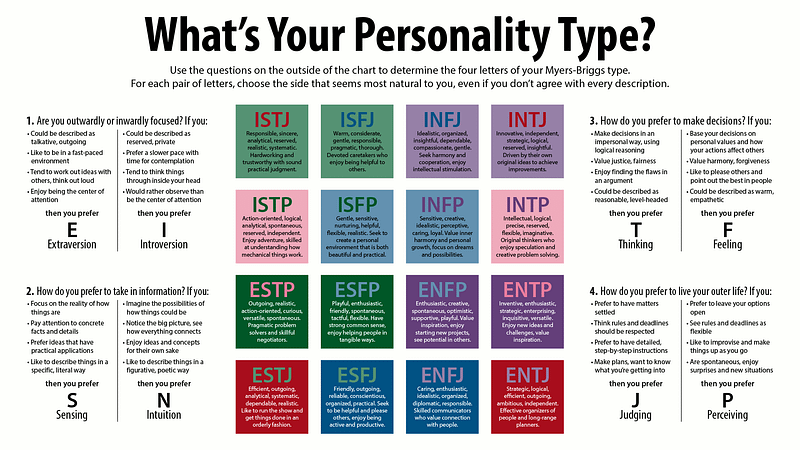
Over the years with more research, the personalities are grouped as analysts, explorers, sentinels, and diplomats. Yet, the foundation remains the same.
You can take your personality test here. The tool is free and you get a complete report for your personality.
Knowing your personality type helps you understand yourself and being understood by others.
Dreams and aspirations
Your dreams guide the present and future of your journey.
Prepare a list of all things you want to achieve in the near and distant future. You can be creative and think of all things that bring you joy. It could be a world-tour or a house in the mountains. Or being a CEO in a company. Anything that excites you and makes you work towards it. The idea is to not limit yourself. There are no rules or boundaries in this one.
Interestingly, people will come up with different answers based on the core values which are critical for them. A writer driven by success would like to be a top-writer or sell more books, while another driven by happiness will seek for connecting with more readers.
There is no right answer here. Simply take this aspect of your personality into account.
How to use this in real life
Once you have figured out your defining elements, the next step is easy. Use it to describe yourself.
By now, you will have a new understanding of your true self. But not everyone needs to know all these traits. Read your audience and cherry-pick the key highlights to showcase.
Always remember, possessing this information, does not mean you also have to express it.
You might have encountered people who keep going on and on about themselves without connecting with anyone. We do not want that.
I usually pick segments from each of the elements to weave a story.
Here are a few points to keep in mind
- Perform a one-time exercise where you use these elements to describe yourself. Put it on paper or a word document.
- Identify your primary and secondary elements out of the entire list.
- Balance the information, do not dwell too much on one fact. If the listener finds it fascinating, leave room for follow-up questions.
- Narrow down your description into 5 adjectives that best describe you. They come handy for short bios.
- Read your audience, and focus on what they need to know rather than what you want them to know.
Make it interesting
A few years ago, in one of my organizations, we did a virtual introduction meeting with our colleagues in the US. One item on the agenda was to introduce yourself and share something unique.
Surprisingly, a lot of people dreaded the question. Some of the answers were — I like to cook, I can sing, I have 2 motorbikes.
They are not wrong answers but they don’t stand out either.
Approach your introduction like trivia. By adding more details to the facts, they translate into fun facts.
So the above examples become interesting if defined this way:
- I can cook 20 different cuisines, or have catered for house parties, or started cooking at the age of 5.
- I can sing in voiceover, or have given stage performances, or thought of it as an alternate career.
- I started collecting bikes at the age of 21. Currently, I have 2 that I take out every weekend for rides outside the city.
Here’s my trivia.
I have picked points from each of the 5 pillars described above. Let’s see if it sounds interesting.
- I started hiking at the age of 8 as I grew up in the foothills of Himalayas.
- I am fascinated by the world of microorganisms and have a Ph.D. in Microbiology. But I love business and strategy too, so I have a double masters’ degree.
- I won a young-scientist award at the age of 22 for presenting a study where bacteria were used to degrade polyaromatic hydrocarbons (such as polythene) while also promoting the growth of agricultural plants.
- I have always acted more like a parent than a sibling to my 7-year younger brother.
- I have lived in 5 different cities across 2 countries in the last 5 years.
- I am an extroverted introvert or an outgoing introvert.
- A campaigner with the personality type of ENFP-T, I am truly free-spirited.
- Happiness is a key core value for me, so I am a hopeless optimist.
- One of my pet-peeve is people chewing loudly and I cannot stand bad odors.
- I have over 50 houseplants and have never killed a plant.
- A dream of mine is to own a house overlooking the ocean.
- I am a lizophobic (self-made term). I have a general fear of reptiles. But lizards, haunt me even in my dreams.
- These 5 adjectives describe me the best: Creative-thinker, Energetic, Communicative, Analytical, Independent.
Let me know in comments if any of this resonates with you, seems peculiar or simply interesting. It will be our conversation starter.
In Conclusion
There is so much that makes us unique. But we often limit our thought process. This 360-degree approach lets you identify and define yourself in a creative yet wholesome way.
A few years ago, I had to deliver a week-long training at my organization. Every day new delegates took the training, but the leadership team remained the same. I didn’t want to repeat my introduction as some of the audience was attending all the sessions. So each day I varied the information I shared. I didn’t realize I was doing anything special but it made me a star at the event. The entire leadership team personally congratulated me on being innovative.
I hope people who struggle with leaving a lasting impression will find this article useful. Particularly, all the introverts of the world.
If you are already excellent at it, this approach will allow you to identify unique perspectives of your personality.
From time to time we come across interesting bios or great ice-breaker stories. They set the person apart. With this approach, that could be you the next time you describe yourself.
If you liked this approach, bookmark this article. Visit it often until you identify your personal brand.
Meeting new people is so much fun when you look forward to the meeting. This framework would make it a tad bit easier.
Thank you for reading and I look forward to getting to know you!