How to Deal with FONKU
Fear of Not Keeping Up

If you are constantly anxious about not learning, not adapting, not being able to keep up — you are not alone: welcome to the club. FONKU (Fear of Not Keeping Up) is the pervasive apprehension that one is not doing, learning, adapting, changing enough to keep up with the latest innovations and knowledge emerging exponentially related to one’s career field.
FONKU is conceptually distinct from FOMO (Fear of Missing Out); which describes a fear of missing out on rewarding or novel experiences that others are having (and showcasing on social media).
FOMO is mostly consumption-oriented; as it reflects the desire to catch up with what others are experiencing (such as travel or eating out).
FONKU, on the other hand, refers to anxiety issues felt by knowledge workers and producers. It is the fear that you will fall behind in your career because you do not learn and adapt fast enough.
Although the phrase FONKU is not yet as established and widely accepted as FOMO, I think the experienced phenomenon is as real, as relevant, and as widespread. FONKU phenomenon, as far as I am aware, has been first described by Jam Gamble here and here.
“Fear of Not Keeping Up” is real and it is witnessed by millions of employees across diverse sectors, including me — and perhaps you.
The more you read and learn, the more you feel compelled to take action. Yet, it is very difficult to maintain your focus and momentum in the midst of the knowledge and technology explosion we are witnessing today.
I sometimes cannot sleep at night for hours because my brain does not shut up or shut down. I know I am not the only one feeling this way.
In this article, I want to analyze this problem (FONKU) from the perspective of the knowledge professional and offer some practical solutions to tackle it.
We do live in interesting times. There is information overload, accompanied by constant anxiety and stress about an unknown future. There is no job security now — all traditional jobs are in decline. The career ladder is long gone.
We face constant shifts and economic turbulence, along with a perfect storm of technology. International markets are more connected and fragile than ever. Industries are rapidly disrupted and reinvented. There is no safety, and there is no safety net.
We know that we cannot be ‘saved’ by the governments. Or by corporations. Or by employment. Or by pensions. The world our parents know is gone.
The rate of change we are witnessing is spectacular. According to A.T. Kearney’s Turbulence Index, our operating environment is twice as volatile compared to the last decade. We live in times of constant change — VUCA (volatility, uncertainty, complexity, and ambiguity).
- 89% of Fortune 500 companies from 1955 are not on the list in 2014.
- The average age of a company listed on the S&P 500 was 67 years old in the 1920s. Right now this age is 15 years only and it keeps dropping.
- In 2028, 40% of all S&P 500 companies are expected to disappear from this list. Similarly, 75% of S&P 500 firms are estimated to be replaced within 15 years.
- A Dell report claims 85% of jobs that will exist in 2030 haven’t been invented yet.
- Technology is disruptive and it keeps transforming workplaces, business practices, and work processes. It is now a cliche that Uber owns no cars, Airbnb owns no property, Netflix owns no theaters, Facebook owns no content, and Alibaba owns no inventory. These are world leaders or contenders in their own categories. They are all monopolies — they own the whole category without owning anything physical.
- Tech companies are hungrier for smart ideas and innovations than ever before because they know they will go extinct unless they learn, improve, evolve, innovate, accelerate, and create constantly.
Disruptive innovations create new markets and disrupt existing ones. In 1996, Kodak had nearly 150 thousand employees and a $28 billion market cap. In 2008, the whole market was gone. In cases of disruptive innovation, the problems are not well defined, the markets are largely unknown and unpredictable, customers have no idea about future products, and technologies are dramatic and game-changing. Think about the printing press, the compass, the PC, cell phones, and satellites. These innovations created entire markets and categories; along with disruptive companies or organizations who were able to dominate these categories.
Many of our everyday products and services — that we take for granted — such as Instagram, Snapchat, Pinterest, Tesla, iPad, Spotify, Whatsapp, 4G, Blockchain technologies, and cryptocurrencies did not exist before 2007. Imagine the year 2027 — what kind of exciting innovations, companies, products, and technologies will we witness? What will be the exciting innovations of the next decade? Where will you be in this picture?
The technology landscape has been changing very fast as technology accelerates on an exponential growth curve. There are already signs that Charlie Brooker’s Black Mirror dystopia (or utopia, you might call it) is turning into a reality. Our phones are a million times cheaper and a thousand times more powerful than a supercomputer from the 1970s.
Kurzweil states: “We won’t experience 100 years of progress in the 21st century — it will be more like 20,000 years of progress.”
As we have grown up in a linear environment, we have a hard time grasping how exponential progression works. Multidimensional technological forces involving automation, 3D printing, augmented reality, machine learning, Industry 4.0, the internet of things, the Metaverse, and blockchain are rapidly transforming the future of work, organizations, and jobs. We are at the beginning of the fourth industrial revolution. Developments in artificial intelligence, robotics, nanotech, biotech, and 3D printing are all building on and amplifying one another.
Exponential innovations are rapidly moving across boundaries and industries. Traditional borders among disciplines, functions, or industries are collapsing and blurring. New categories — some call them sectors without borders — that combine diverse fields are emerging (e.g. nano-bio). These lead to new industries and ecosystems of interconnected businesses. Our brains deceive us by making linear projections. In reality, changes are non-linear.
Moreover, new fields such as AI, Blockchain, or IoT witness incremental — even disappointing — improvements for years and years (and people ignore them and call them ‘hype’) … until the tipping point when things are suddenly accelerating and breakthrough advances occur on a daily basis. Nowadays, things are evolving so quickly that entire industries will either change or disappear.
Look at the field of artificial intelligence and how there seems to be a breakthrough almost every day.
- Algorithms — from Google searches to Netflix recommendations — already dominate our lives.
- As smart speakers and voice assistants (i.e. Amazon’s Alexa, Apple’s Siri, Google’s Assistant, Samsung’s Bixby and Microsoft’s Cortana) are becoming a prevalent part of our everyday lives, they are also learning and getting smarter every day. As the voice revolution progresses in the next decade, these devices are expected to gain much more power, and even act as teachers and psychologists.
- Waymo’s self-driving cars are already on the roads — we know millions of driving jobs will be transferred from humans to machines in the next decade.
- Walmart has already added thousands of robots to its stores — we know millions of retailing jobs will also be transferred from humans to machines in the next decade.
We are not ready for these radical transformations. Not as a society. Not as universities. Not as individuals. In times of such transformation, we need to question everything that makes us successful today. We need to ask ourselves if what we do today is relevant to the future.
I am teaching Employability, Creativity, and Personal Development at Norwich Business School at the University of East Anglia, where I am trying to help my students prepare for the job market.
I feel like we are still preparing students for jobs that are becoming obsolete, and replaced by automation and machine learning. According to the World Economic Forum’s “The Future of Jobs” Report, machines are expected to perform more current work tasks than humans in 2025 (compared to 71% being performed by humans as of now).
When the job markets are being transformed so rapidly, it is not easy to keep our courses relevant and useful for the next decade. Moreover, our educational systems are still largely stuck within the industrial paradigm. We are still preparing our students for large organizations and bureaucratic systems, which are themselves struggling to cope with change and to survive.
In short, the world is changing fast and we need to learn, re-invent and disrupt ourselves every day. If we stop learning and if we stop being curious, it will be too late for us to react to sudden tectonic shifts around us. When an exponential change happens, our time to react will be minimal. If we cannot adapt and learn, we might just fade into insignificance.
An organization that is not trying to disrupt itself is destined to be disrupted. The same goes for individuals. However, as human beings, we are creatures of comfort. We do not like change — let alone exponential change. This means we need to think differently to go beyond our comfort zone and be as open to radical learning, experimentation, and change.
We were much more agile and creative as kids, and perhaps we need to reclaim our childhood creativity. How can you start over, be open, and reinvent yourself every day?
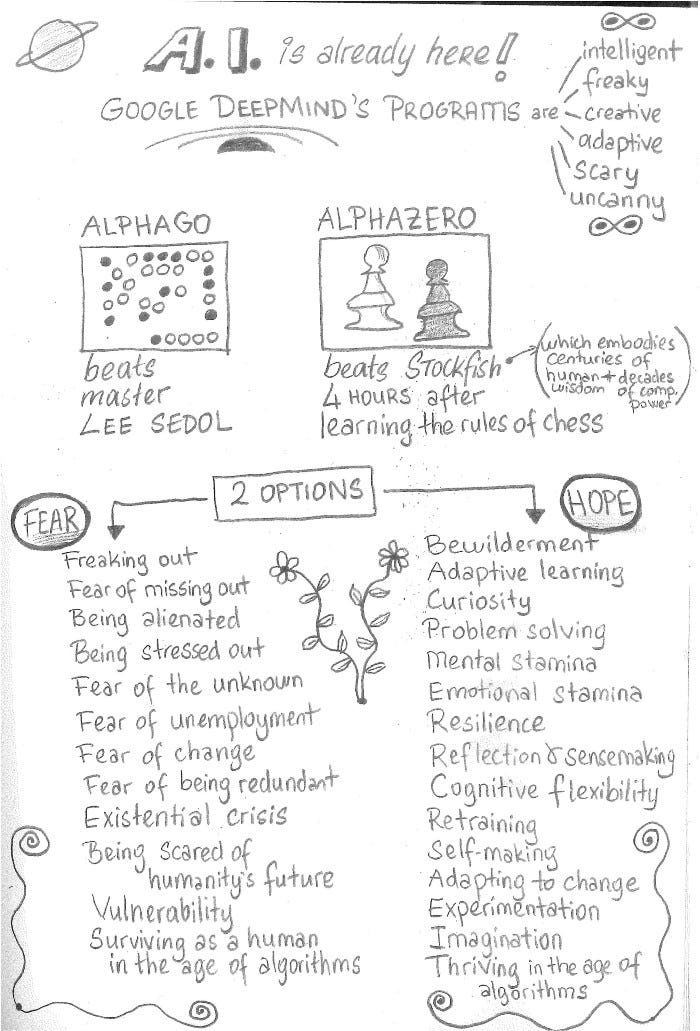
We have two choices ahead of us: Freaking out or bewilderment. Freaking out is not a sustainable or useful solution. To advance in the path of bewilderment, we have to constantly learn, be open to change, and disrupt ourselves. We also need to find our own strengths, meanings, and voice in the middle of all the chaos and noise surrounding us.
I will discuss strategies to deal with FONKU, turn it into a mechanism for advancing your curiosity and learning, and make rapid progress in your career.
How to Deal with FONKU (Fear of Not Keeping Up)

In the remainder of this article, I will share with you my personal strategies and practices to deal with the fear of not keeping up. Using the strategies below, I have been able to both reduce my stress and increase my creativity.
1. Keep calm, develop mindfulness and focus on the present.

Whenever you are overwhelmed, focus on the present moment only. Spending just a couple of minutes on deep breathing, relaxation, and mindfulness will do wonders for you. It will improve your mood, creativity, and productivity.
Find a quiet place where you will not be disturbed. If you have access to a garden or an outdoor space, even better. Look at the sky and take the deepest breaths that you can take. Breathe as if each breath you take is the most precious thing that you can have. Take deep breaths for a couple of minutes.
When you breathe, make sure your belly is moving up and down, be mindful of what goes on in your body, and acknowledge your thoughts. When your mind moves away with thoughts, gently bring your focus back to your breath. Notice all sensations, feelings, and thoughts that you are experiencing.
Whenever you are overwhelmed, focus on the present moment only. Take it one slice at a time. Do not think about the past or the future. Try to be more present and attentive. Think about what you need to do right now and in the next few minutes.
Even if you are facing an enormous challenge or you are working on a very difficult project, you can break it down into small pieces. Focus on what you can do right now and start by tackling the smallest task in front of you. After you start, focus on the critical few tasks that really matter. If you survive today, then celebrate yourself and start again tomorrow.
What can you do to increase your focus on the present? Identify small actions and write below.
2. Disrupt, scare, and reinvent yourself every day.

Robots and algorithms are not going anywhere — figure out how you will work with them in your career. Those who develop advanced skills and knowledge will have their own robots at work, whereas those who do not have these skills might need to apply for ‘job mortgages’ to upgrade themselves.
Invest in yourself to become the best version of yourself. Invest in digital options to upskill, reskill, or recharge your career. Find free online courses to develop and sharpen your skills that are demanded by the job market. Join webinars, seminars, and professional groups on the Internet. Online courses from Udemy, Coursera, Thinkific, or Skillshare allow you to explore the skills needed for the workplaces of the future.
Instead of giving yourself excuses for keeping the status quo, give yourself challenges and stretch yourself. These challenges might be professional, physical, mental, emotional, spiritual, or creative challenges. Get out of your mental comfort zone and always stay eager to challenge yourself. Even if you have no idea how to solve a problem, figure out what to try out and take a small action. You may not know the ‘correct’ solution, but you can always learn, figure out a strategy, iterate, develop, practice, and improve.
Take more risks — it is OK to look stupid and try out new things. Change is always frustrating and uncomfortable, but it is the only way forward. Treat every experience as a learning experience. Go out there and start again. Perhaps you will suck and that is fine — stop taking yourself so seriously. If you really want to get lucky in the long term, give yourself more opportunities for failure. Fail early, fail often, fail again. Failures are merely stopping points along the bigger journey. Celebrate your failures. Use them as learning opportunities. Develop more grit and resilience to get back up after a failure. If it does not kill you, it makes you stronger. It will be all right after all.
When you are learning in a new field, be kind and patient with yourself. Do not seek perfection. Ask dumb questions and let curiosity guide you. Take a walk to address and solve problems. Try to see the problem with fresh eyes. Originality comes from thinking independently and creating a huge volume of ideas and work.
Give yourself time and opportunities for renewal and discovery. Expose yourself to diverse environments and influences. Travel to new places, learn a new language, climb a mountain, run a marathon, play an instrument, explore authentic food, and meet new people.
Design your own challenges and adventures now. What will be your next adventures? Write them below.
3. Keep a journal to maintain your well-being, create ideas, and mark your progress.

Whenever you are overwhelmed, write down in your diary for 20 minutes. Capture your stream of consciousness without censoring anything. Put all your anxieties on paper. Make sure you listen to your fears and make them heard. The best way to do this is to reflect and write. Whenever you write things down, you will feel more powerful and liberated.
In your journal, differentiate between big goals (which are your top priorities, such as creating your own assets and investing in your skills) and small tasks (such as sending an email or calling someone).
Be radically honest with yourself about what is going well and not going well in your life. You will start from a point of gratitude and appreciate all the good things in your life. Then, you will think about your gaps and all the things that you need to improve and get better at. Be clear about all the obstacles, frustrations, and difficulties ahead of you. Create solutions for these problems. Keeping a journal will help you tremendously in:
- Establishing your priorities and goals,
- Formulating your learning and insights,
- Developing your self-confidence and affirming to yourself that your goals are achievable,
- Creating strategic plans to realize your dreams, and
- Finding gratitude for all the good things that happen in your life.
3. Read and learn beyond borders. Learn interesting and fresh things that excite you every day.

Assume radical responsibility for your own learning and development. Schedule time to invest in your own self-development and learning. Write down your vision and predictions of how technology will influence your career and domain.
Schedule sessions in your diary for reading. Be specific and strategic in your reading goals — prioritize, focus, and schedule time. Set yourself concrete targets. Read different topics from diverse sources. A great way to keep track of your reading goals is to use Goodreads.
Develop positive habits and remain committed to your learning schedule. Even if you seek %1 improvement every day, it will compound 37 times in a year, which means tremendous growth. You will form neural connections among the various things you learn, which will lead to deeper knowledge, skills, and expertise.
Be an autodidact: A self-taught person individual who initiates and manages his/her own learning and reads voraciously. Assume responsibility for your own learning. Go out of your comfort zone and learn outside your discipline. Education as usual is dead — long live lifetime learning. This is a great time to expand your skillset and improve your knowledge. You can learn and experiment with new life and work skills, and finish MOOCs in your fields of interest. Find things that are exciting and interesting for you.
Be a polymath: An individual whose knowledge spans a significant number of subjects, known to draw on complex bodies of knowledge to solve specific problems. To be a polymath, expand your horizons and read books from diverse disciplines. Be greedy about your learning. Read widely and diversely beyond disciplines. Read at least 100 books every year (which means 2 books per week).
Which are the topics/areas that you wish to learn further and develop expertise and skills? Make a list below.
4. Schedule time in your calendar for creating your creative assets.

We are living in one of the most interesting times in history. If you have a laptop, a cell phone, and an Internet connection, you can instantly become an entrepreneur and build your own company. You do not need capital. You have access to all the world’s knowledge at your fingertips. You can teach yourself anything that you want. You can master and teach any field. You can become an artist, an entrepreneur, a coach, a teacher, or a consultant.
Would you like to create your own rap song? Your own fashion line? Your own healthy lifestyle brand? Your own crime novel? Your own app? Your own podcast? Your own YouTube channel? Your own blog? Your own product or service or business?
As you learn new things, you can share your passions, curiosities, and creations with the world. Use your imagination to create your own creative assets and share them with the world. Find your niche and purpose. Spend time on your hobbies and interests. Follow what is most interesting and refreshing for you. Time spent on learning, experimenting, playing, and exploring is not wasted.
This is your opportunity to reinvent yourself and create assets for your future. Read new books, listen to podcasts, create lots of ideas, and follow up on your curiosities. Provide yourself with more opportunities for problem-solving and asset creation activities. Imagination and asset creation are linked closely. What will be your game where you can be creative and passionate? Show up for creative work and use random prompts or anchors to get going. Aim for tiny miny steps to kickstart your process. You can perhaps start a small creative project that you have always wanted to do, but you were terrified.
Embrace mistakes and failure. J. K. Rowling was rejected by at least a dozen publishers before she was able to publish Harry Potter. Star Wars was rejected by many major studies until it became a household brand and franchise worth 70 billion dollars. Do not expect any short-term rewards or returns. Do not be discouraged by failures and rejections. Celebrate your failures and use them as learning opportunities. You need to develop more grit and resilience to get back up after a failure.
This is a marathon and you are playing the long game. If you really want to get lucky in the long term, you need to provide yourself with a lot of opportunities for experimentation and play. Asset creation is about investing time and effort in creating something that will generate ongoing value or rewards in the future. The process, the discipline, and the habits of asset creation will create lots of fresh possibilities and opportunities for you.
Be patient. Delay your gratification. It will take years for you to find and connect with your audience. It will also take persistence and grit. The sheer volume of what you produce matters. For example, if you are passionate about creating cartoons, try to create hundreds of them. Sharpen your skillset and keep experimenting. Keep producing the best work you can.
When you are building your creative assets for the long term, you are also inviting financial, creative, professional opportunities for yourself in the future.
Passion, creativity, and play are the new currencies in this long-term game. This is not only about your finances or career (although they are also important). You are essentially providing yourself opportunities for creativity, passion, and adventure. You also find your own voice and share it with the world. This is about making a dent in the universe and it is a journey worth taking.
Think about your unique strengths, skills, and interests: What can you offer to the world? This might be the most meaningful question that matters for your career success and fulfillment.
Conclusion

FONKU (Fear of not keeping up) is real and we need new ways of working to tackle it. We do not know about tomorrow’s jobs, workplaces, and organizations. The only thing we can be sure about is the necessity of self-making: We have to constantly learn, be open to change, and disrupt ourselves. We also need to find our own strengths, meanings, and voice in the middle of all the chaos and noise surrounding us.
In disruptive times, the smartest action you can take is to disrupt and reinvent yourself. In exponential times, the smartest investment you can make is investing in yourself and your asset creation for the long term.
Here are the big questions for you: Are you learning new and exciting things every day? How can you ensure you are learning, pushing yourself and your brain every day?
Takeaways:
- Keep calm, develop mindfulness and focus on the present.
- Disrupt, scare, and reinvent yourself every day.
- Keep a journal to maintain your well-being, create ideas, and mark your progress.
- Schedule time in your calendar for creating your creative assets.


