
How to Cultivate Your Next Generation of Leaders
By using experiential learning in place of traditional training.

This might be controversial coming from a training professional, but let’s face it — even the most effectively executed presentation or lecture can only take our teams so far. And the science backs this up.
Art Kohn, a neuroscientist, shares that “Within one hour, people will have forgotten an average of 50% of the information you presented. Within 24 hours, they have forgotten an average of 70% of new information. Within a week, forgetting claims an average of 90% of it.”
It goes without saying that if I’m a business leader investing precious capital into these traditional training methods, these are not great odds.
There has to be a better way, right? Enter experiential learning.
Experiential learning allows employees to learn by doing vs. reading, watching, or listening.
“When the training incorporates doing, a key feature of experiential learning, it will create more engagement and result in a greater impact on the business,” says Phil Geldart, CEO of Eagle’s Flight, a global training & development firm.
“The knowledge retention rate for employees who go through traditional learning is only 5%, whereas the retention rate from experiential learning can be as much as 90%,” he goes on to say.
According to Eagle’s Flight, the result of these new experiences is that “new competencies are developed, more information is retained, and individuals are more likely to enthusiastically apply their new knowledge to their real-world back on the job.”
But how do the best managers provide their teams with experiential learning opportunities?
Below is a simple, 6-step process that will teach you how to do exactly that.
For example’s sake, we will outline the process for a fictitious trainee named Alexa, and you will play the part of Alexa’s senior leader, the Vice President of Finance.
1. Identify the next step
The first step is simply to identify where Alexa wants to go next in her career.
The easiest way to do that? Ask her. This sounds elementary, but you’d be surprised how many leaders skip over this step entirely only to find out months down the road that Alexa doesn’t actually ever want to be CFO!
Talk to Alexa to understand what she loves about her current role and the work she does, what work she finds less engaging, and what she’d like to be doing more of in the future.
If she has a hard time answering, try putting it into context at your specific organization by asking things like, “Would you be interested in my job in the future?” or “Who on our team is doing the kind of work you’d love to be doing down the road?”
Assuming the role Alexa wants next includes management responsibility, you will also want to confirm whether she’s interested in leading a team of people in the future. (If she’s not sure yet, have her read this.)
In our example, let’s say Alexa does have ambitious goals to become CFO one day in the future. Great! But, let’s take this one step at a time…
As a Financial Analyst II currently, her next step would be a promotion into Finance Manager.
2. Compare the current job to the future job
From here, you should sit down and compare the Financial Analyst II job to the Finance Manager job. The easiest way to do this is to review the job descriptions for each role side-by-side. If you don’t have those handy, you can simply jot down the main responsibilities, projects, and competencies involved in each.
As you compare, make note of where you see the major differences between the two positions:
- What parts of the Finance Manager position will be brand new to Alexa and require skills training? What are those specific skills?
- Will there be responsibilities that will significantly increase her visibility across the organization? What pitfalls should she be mindful of with that?
- What competencies will be markedly different that she should anticipate and start working on now? What competencies does she have now that may not be as critical in her next job?
3. Identify the most beneficial experiences
Once you have a handle on the differences, you can begin to identify the experiences that will be most beneficial in closing the gaps you identified in the previous step.
Because the time to start working on closing the gaps between where she is now and where she needs to be as a Manager is not once she gets promoted — it’s right now.
A helpful way to select experiences is to analyze them through the lens of urgency vs. importance, the way one might use the Eisenhower Matrix to prioritize his/her work (If you’re unfamiliar, Zerin Pekin-Kocakgol wrote a great summary on using the Eisenhower Matrix to prioritize work here).
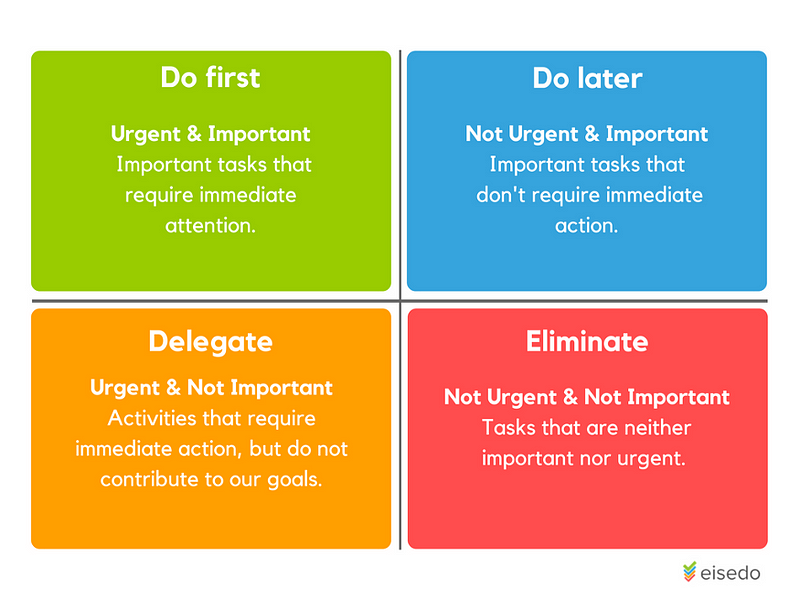
Items that fall into the category of ‘urgent and important’ for a Finance Manager are likely where you’ll want to focus most of Alexa’s development because they will yield the biggest payoff. From there, the next most critical items are those that fall into the ‘important but not urgent quadrant.’
Now, the goal here is not for Alexa to maintain the workload of a Financial Analyst II plus the full workload of a Finance Manager. You can’t expect anyone to manage two full-time jobs. At least, not successfully.
Instead, you will have to be thoughtful and intentional about what you start layering on. Aim for the 3–5 experiences you think will be most beneficial.
4. Involve her in the selection
Throughout her experiential learning, expect there to be times when Alexa feels overwhelmed by the process. When that time comes, you need to know that she will demonstrate grit in persevering through her discomfort.
You can increase the chances of that happening by tapping into your participative leadership style. Participative leadership is a fancy way of saying that you should involve Alexa in the selection process by asking her what experiences she thinks would be most beneficial to her own learning.
You can start the conversation by sharing with her that you have some ideas after working through step 3, but that you’d like to get her initial reactions before sharing yours. This gives her a stake in the final decision the two of you make and when times get tough, she will think back to why she chose the items she did and this shared commitment will carry her through.
You might even learn about a responsibility she’s particularly uneasy about that you weren’t aware of before. Let her know that you appreciate her candor and figure out a way to build in some experiences to support that.
Let’s say that one big difference between Financial Analyst II and Finance Manager would be Alexa’s involvement in the budgeting process from a strategic perspective. As an Analyst II, she’s worked within a budget but hasn’t actually built one in support of the business’s strategic plan.
In this case, the overall budgeting process is likely one element of experiential learning that you’ll want to incorporate as it is both an important and urgent element of the Finance Manager position.
5. Begin with exposure
Now it’s time for us to pivot from planning to exposure. To do this, you’ll want to start by having Alexa experience the budgeting process through observation.
In the context of building a budget, we know she has never done it before and that she very likely doesn’t know what she doesn’t know. We also know that budgeting falls into our company’s strategic planning process which is a series of meetings involving increasing levels of visibility up to and including the C-suite.
We’re not looking to set her up to fail in front of the executives by throwing her into an important and impactful task that she’s never done before. If we took that approach, she’d likely erode her credibility with leadership faster than she would ever be able to rebuild it.
So instead of involving her in building and presenting the budget, we might start by simply having her shadow you in your next budget-planning meeting. She won’t be expected to participate, but she will be expected to soak in as much learning as she can by observing and gaining exposure to the process.
In doing so, she’ll be able to see the types of questions the executives ask, how you answer those questions, and what factors you consider in building your budget recommendation.
Following the meetings, you’ll then spend time one-on-one with Alexa to de-brief, answer further questions, and share what your next steps will be to further refine the budget based on the takeaways from the meeting.
In doing so, your coaching will give her priceless insight into your own critical thinking; the kind of critical thinking that has gotten you to where you are today. She will now have the benefit of learning to think similarly and follow in your footsteps.
6. Advance to action and then ownership
After she has gotten sufficient exposure to the overall budgeting process, she’ll be ready to take on some degree of ownership which you can increase incrementally over time.
Perhaps you start by giving her a small portion of the budget to own— maybe for a small business unit. Then, you might have her walk you through her thought-process in building her portion of the budget while you play the role of the executive and ask questions that will further challenge her assumptions.
Once she’s re-worked things and you feel she’s ready for the spotlight, she can take on the responsibility of presenting her portion of the budget to the C-suite.
By the time she’s promoted to Finance Manager, she’ll be ready to take on complete ownership of the budgeting process, and you will have successfully used experiential learning to promote one of your team members.
Geldart explains that the “hallmark of experiential learning is its immersive, visceral nature. Participants are fully engaged; there’s no desire to tune out, as with a presentation or lecture. Participants must use their own critical thinking and problem-solving skills throughout the entire experience. This deep level of engagement, learning by doing, generates better retention of new concepts.”
And that is the key to cultivating your next generation of leaders.
Not a member of Medium yet?
Join here to directly support my work and get access to every story on Medium. You can also subscribe to my free newsletter or connect with me on Linkedin.


