
How to Create Success Even if You Have Disempowering Programming
Soften the division between the conscious and subconscious mind.

If you regularly traffic in the personal development space, you know what it’s like to get fired up over a set of good ideas. Someone speaks to your desires and reminds you there is a way to get what you want.
Yet a few hours later, the sensory world blasts you with a reminder of where you are. You’ve got seven unpaid parking tickets. Your family members converse only in the language of complaints. There’s a voice within that says you’re prone to foolhardiness.
When you outpace fear and doubt, your conscious and subconscious mind align. After you strike this agreement, you’ll realize that faith in yourself and in your vision doesn’t need to depend on circumstance. You’ll find it easier to trust that inspirations and hunches will come on time and in exactly the sequence you need.
In this way, you won’t be limited by messages from the sensory world. Instead, you’ll take action with minimal friction and with an unwavering trust in the process.
Employ the Power of Autosuggestion
“Every proverb, every book, every byword that belongs to thee for aid or comfort, shall surely come home through open or winding passages. Every friend whom not thy fantastic will, but the great and tender heart in thee craveth, shall lock thee in his embrace.” Ralph Waldo Emerson
Most people spend their days ingesting corporate media designed to elicit fear and cynicism. They listen to music about lost love and opportunity, or watch television that equates sincerity and ambition with missing the point. You probably grew up surrounded by these people.
If you don’t reprogram your subconscious , their imprints will linger within you, limiting your perspectives.
As Napoleon Hill put it in Think and Grow Rich:
“Autosuggestion is self suggestion. It is the agency of communication between that part of the mind where conscious thought takes place, and that which serves as the seat of action for the subconscious mind. Through the dominating thoughts one permits to remain in the conscious mind, the principle of autosuggestion voluntarily reaches the subconscious mind and influences it with those thoughts.”
What you consume does more than impact your worldview: it plunges deeper, impacting the paradigms that operate beneath the surface of conscious thought. This is why you can feel motivated consciously yet become stilted and frustrated when you try to take action. You’re caught in an internal division between your conscious and subconscious mind.
Everything you consume programs your subconscious. What most people forget is that when they’re relaxed, they’re particularly susceptible to suggestion.
Consciously, you can tell yourself that what you’re hearing, reading, or seeing doesn’t apply to you. Nevertheless, the subconscious can’t tell the difference between a real and imagined experience. If you’re reading news that makes you anxious about the state of the world, that anxiety travels directly into your subconscious where it’s transmuted into an underlying sense of tension, suspicion, or futility.
When you’re doing something challenging, those messages live on or persist in the background. They’ll impact what you believe about your capabilities. They’ll determine whether you’ll succeed at what you’re attempting to do.
Optimize Your Consumption
“Half the time you think you’re thinking you’re actually listening.” Terence McKenna
The messages that reach your conscious mind in the morning determine the trajectory of your day. If you spend every single morning consuming empowering material, I guarantee your life will change. After all, you already know what it’s like to read a stressful email immediately upon waking. It warps the entire day.
For this reason, people establish morning routines, wondering if there’s a single routine that virtually guarantees a successful day. I haven’t stumbled upon one, but I know that reading physical books with forward-moving information puts me in an optimal state.
Find five to ten empowering books and spend the first 30 minutes of every day reading. You don’t necessarily need to avoid reading anything else. But when you wake up, carve out space for these books alone. As an experiment, do this for a year and see where you end up.
Most people know what it’s like to feel inspired by a book, but they read it only once. They assume that books are meant to be finished, looked upon with fondness, and that’s it.
Just as you don’t exercise once and expect to be healthy for life, if you feel moved by a book, realize that your relationship with it has just begun. Contrary to the voice that says you’re wasting your time, think of returning to empowering material as your daily apple or walk.
Books hold years of accumulated wisdom on the part of the author. It’s like having your own personal coach or advisor there at the turn of a page. You sit with them at their desk, thinking their thoughts. You’re altered by their perspective often without even being alive at the same time.
Of course, you can practice autosuggestion with an empowering podcast, song, or video, but to my mind, physical books feel pure, idyllic, and tranquil. There’s something pleasurable about starting the day with a book. Imagine getting out of bed, brewing tea, lighting a maple cinnamon hypo-allergenic candle, and reading.
Bliss. It keeps the morning sacred. Listening to a podcast or video on your phone might tempt you into something unholy, like checking your email.
Some of my favorite autosuggestion texts:
Think and Grow Rich by Napoleon Hill
The Practice: Shipping Creative Work by Seth Godin
The War of Art by Stephen Pressfield
The Science of Getting Rich by Wallace Wattles
Tao Te Ching by Lao Tzu
Be Here Now by Ram Dass
The Power of Awareness by Neville Goddard
Money and the Law of Attraction by Esther and Jeremy Hicks
Own Yourself by Kelly Brogan
The Yoga of Eating by Charles Eisenstein
Decorate Your Space with Accurate Thinking
“If I could wish for anything, I would not wish for wealth or power, but for the passionate sense of the potential… for the eye which sees the possible. Pleasure disappoints. Possibility, never.” -Either/Or, Kierkegaard
Autosuggestion doesn’t end with absorbing written or audio content. You also want your environment to suggest ideal behaviors to you. As has been said many times, establishing habits isn’t about being good at will power. It’s about being in an environment conducive to desired behaviors.
Decorate your living space with information that speaks to your values, desires, and the state of mind you want to be in. This might manifest as plants, posters, tapestries, photos, or words. In my case, I post sentences on my walls from impactful books. These are sentences that remind me of what I value. They invite me to return to mindsets that facilitate growth, flexibility, and gratitude.
I also cover my space with art that encapsulates the state of mind I most want to be in. For me, that’s a sense of wonder. It’s captured well by this painting by Rene Magritte, which is on the wall in front of me:
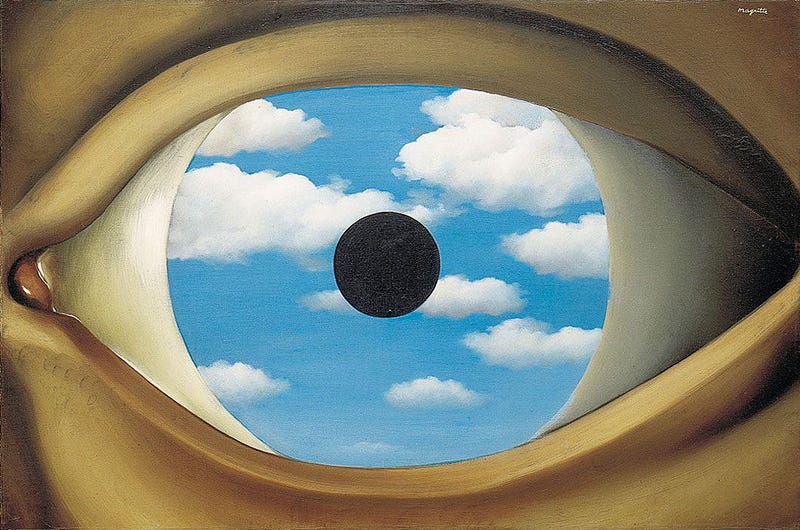
You want your environment to always reflect back to you the state of mind you most want to reside within. This is how you ensure that you’re not constantly swayed by surprise, sore teeth, stained turtle necks, or the noise of other people. This is how you put the rabbit in its hat. You remain loyal to a vision rather than constantly being pulled around by the emotions of a given day, week, or hour.
Embrace Everything as Part of the Journey
Ever hear of the Hero’s Journey? It’s a concept articulated by Carl Jung that exemplifies the highs and lows that characterize all human journeys. We begin with the call to adventure, that sense of being driven toward something despite of the challenge and potential risks it involves. The journey gains traction, courage and excitement mounts. But inevitably at some point we fall.
You read an article that describes one of your problems as a worst-case scenario. You get fired. Your dog develops a rare disorder. Something happens. And you feel knocked off course. During this time, you lose sight of what once held you together, and you’re bitter and finicky and tense.
In the Power of Awareness, Neville Goddard says you materialize a vision by occupying the state of the wish fulfilled. You enter into an agreement with a state of reality by existing as it, not thinking about it. Clearly, you don’t get where you want to be by worrying about not being there. You transform your life by occupying a state of resourcefulness. You recognize the journey as equally enjoyable as the destination.
After you’ve established your vision and the feelings that come along with it, you trust that your manifestation is done. It waits for you on the other side of what Goddard termed the bridge of incidents.
Whatever you experience after living from the perspective of your vision is part of a bridge of incidents that leads you to it. Even if you encounter obstacles that seem to contradict it, your vision is complete. What’s done is done.
Here’s a good example of a bridge of incidents: If you’ve ever bought a digital product explaining how to accomplish something, you’ve bought someone else’s bridge of incidents. They’re outlining for you a series of steps you can take to get a similar result. Your task from here is to alchemize their insights with your own daily energy levels, history, skill sets, aspirations, will power, etc.
The bridge of incidents reminds you that everything you experience, without exception, is leading you to where you already imagined you’d be. Your task is to figure out how your experiences, no matter how grim they seem, contribute to your vision, and are, in fact, necessary for its manifestation.
“The future is the past grown up.” — Unknown source
Your current circumstances don’t limit the possibilities of the future. With careful, conscious selection of the information that occupies your daily 24 hours, honoring the mornings, decorating your space with representations of your ideal state, and keeping faith throughout your personal bridge of incidents, you have the capacity to control your interpretations.
When you cultivate uplifting, forward-moving perspectives, anything you’re experiencing becomes the precondition for a better future.
There’s more to read: