
How to Create An NFT
A Novice’s Experience and Tutorial on Creating His First NFT
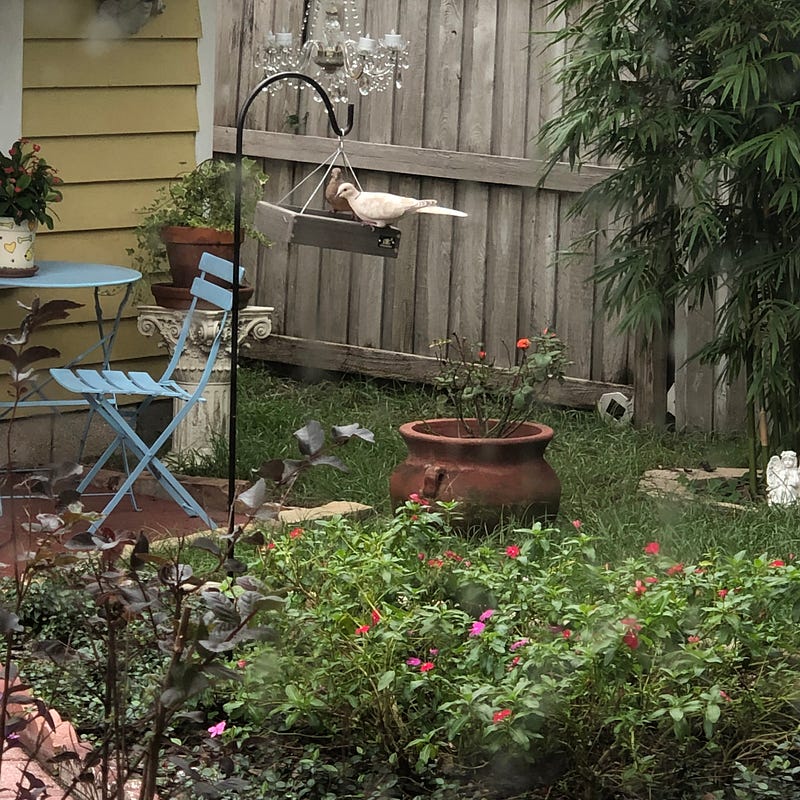
This is a sample how-to about creating an NFT by a first-time user. I did this to learn more about NFTs and to share that knowledge, not to try and make money. I’m sure there are more ways than the ones presented to create an NFT; using different platforms, different wallets, and different currencies for example. This is just one example of using readily available marketplaces, wallets, and currencies. This is in no way a promotion, recommendation, or endorsement for Ethereum, Coinbase, or OpenSea. These are simply the tools I used.
For the picture of the white dove, I was sitting in our courtyard relaxing after doing some gardening work. I looked up at our bird feeder and saw an oddity. An unusual pale-colored dove. We get an abundance of doves, all day. I wasn’t sure what this bird was, but it was different. Unfortunately, I didn’t have my phone to capture a picture. The bird eventually flew off. As soon as it did, my wife opened the door to our courtyard, “Did you see that, what was that?” she said. I didn’t know either. Fortunately, my wife had the presence of mind to snap a picture!
My novice research tells me the bird was a leucitic dove which is unusual but not as rare as an albino dove. Still a great catch. Haven’t seen it since.
A leucistic bird lacks pigment in its plumage. Whereas, an albino bird lacks all pigment, including in its eyes.
Step 1
Create the content, i.e. the picture, video, or music file you want to make into a non-fungible token (NFT). This can be in many forms, such as a *.jpg, a *.bmp, a *.wav, or a *.mp4 file. I simply used pictures taken with an iPhone. It’s that simple. The NFT can be anything digital you want it to be.
The following steps can be in any order but all must occur. Before I started with the NFT process I already had a Coinbase account (where I have purchased cryptos, such as Bitcoin and Ethereum). However, I did not have a crypto wallet that was needed by OpenSea to facilitate the NFT creation. In my case, I created a Coinbase account, purchased some crypto on that account, began creating an NFT on OpenSea, created a Coinbase wallet, linked them all, then completed creating the NFT on OpenSea.
Step 2
Establish a Coinbase account.
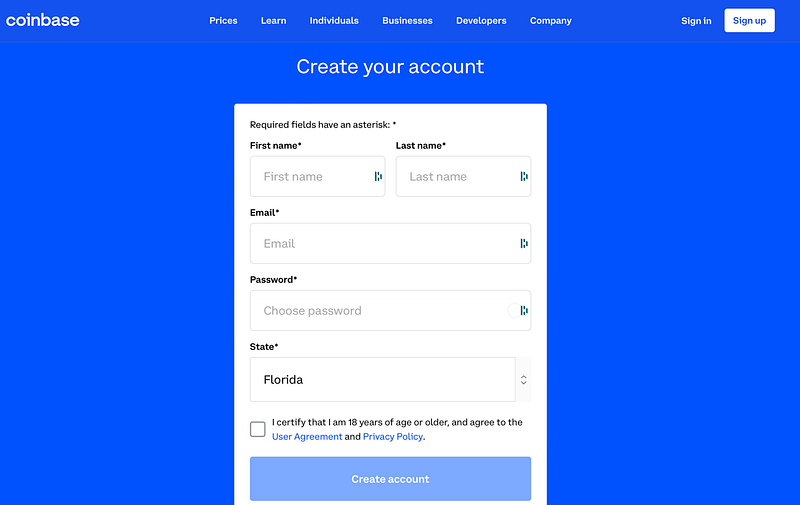
This can be done via the web on one’s computer or via the Coinbase app on one’s phone or tablet. I used a combination of the two, starting it on the web and finishing it on the app. Once one has a Coinbase account they need to do two more things. First, add a “Payment Method” and secondly fund or link their payment method to the Coinbase account. One can select several different methods, simply following the prompts to add the required information and linking the accounts (such as your bank to your Coinbase account).
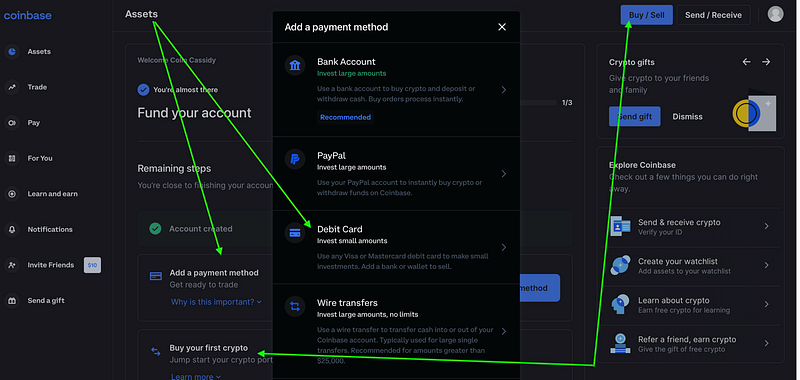
Once you have an account and a payment method you can buy your first crypto. Again, just follow the prompts, selecting which crypto you wish to purchase.
Step 3
Visit Opensea and navigate to “Create.”
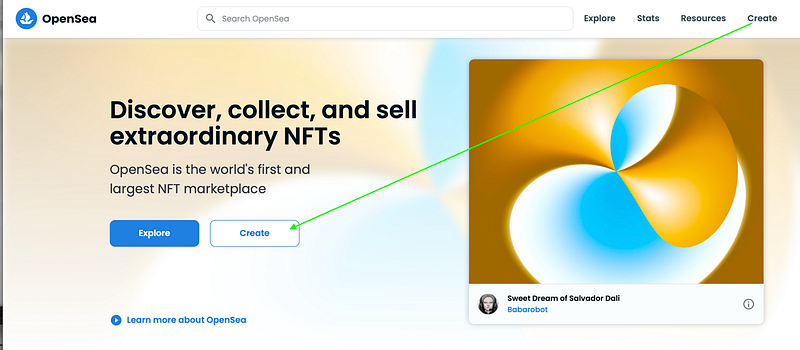
Coinbase is a cryptocurrency marketplace. OpenSea is an NFT marketplace. A digital wallet facilitates transactions between the two.
Step 4
Create a digital wallet. I initiated this from OpenSea as part of their prompted steps in creating an NFT.
For simplification, I created a Coinbase crypto wallet. One can use other wallets, as shown below.
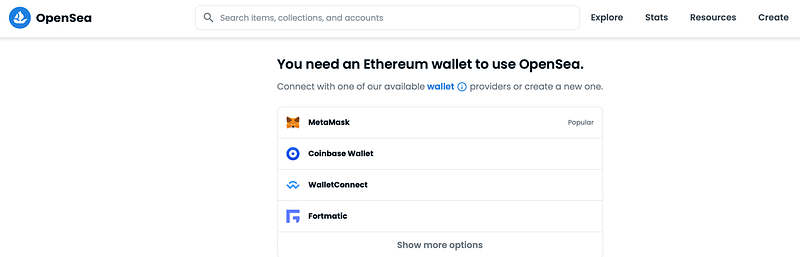
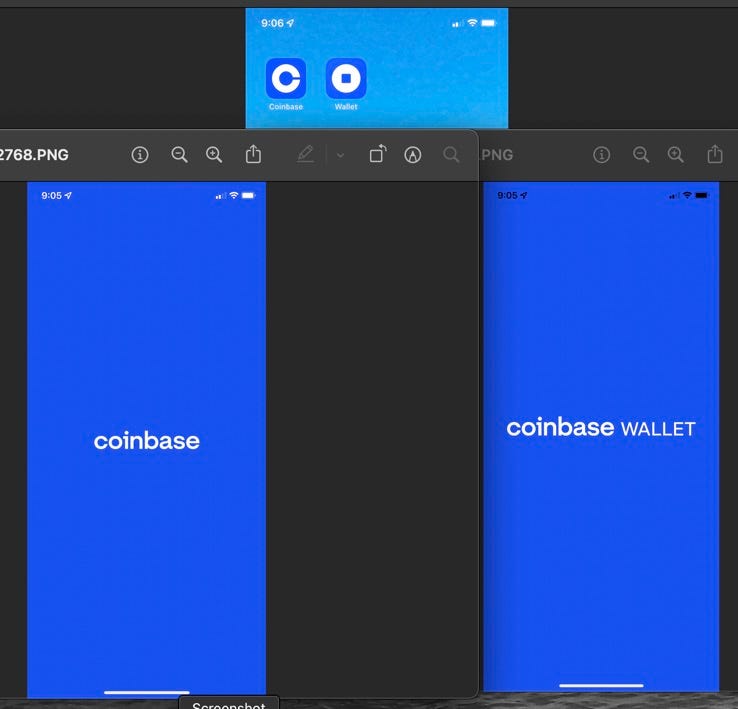
As part of creating the digital wallet one will need to “link” their wallet to their cryptocurrency account. Admittedly, I didn’t fully understand what I was doing or how it was done, but simply following the prompts got me there. Note the Coinbase wallet is a separate app from Coinbase itself, as these screenshots from my iPhone depict.
Now one is set-up to create their actual NFT.
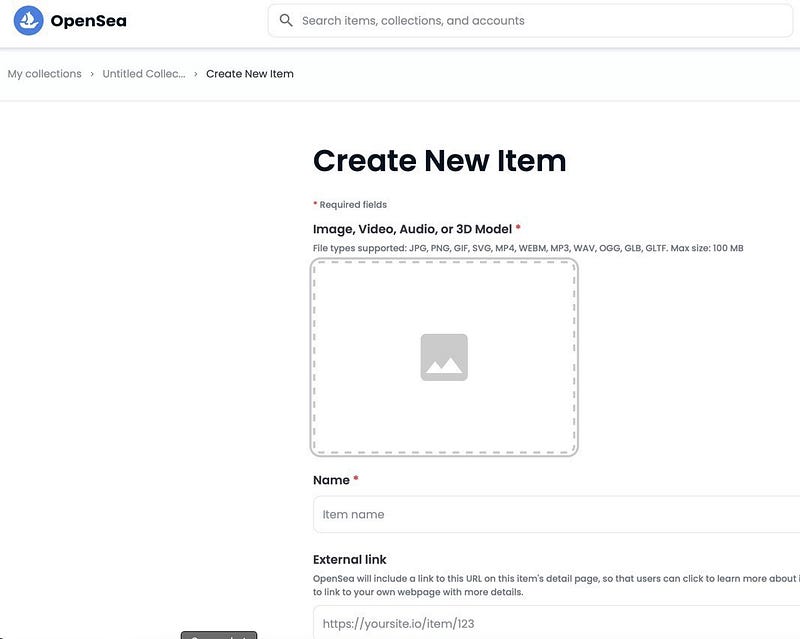
One simply selects and uploads a picture (for example, this may be a video or audio file) and selects various parameters, as shown below, which then become the metadata for the NFT.
For this example, I chose a picture I randomly took in Paris while on vacation with my wife in the Spring of 2019. It was one of my favorite pictures of our trip because of the way it captured a non-descript man and a single pigeon in a quiet alleyway amongst the tall adjacent buildings. It captured a secluded and reflective non-tourist version of Paris I enjoyed.
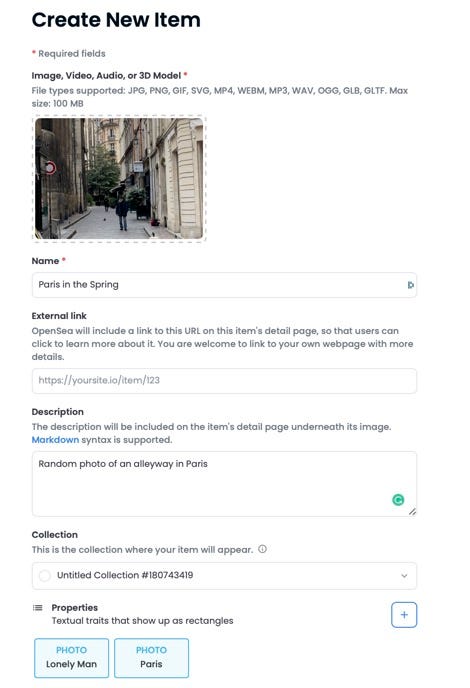
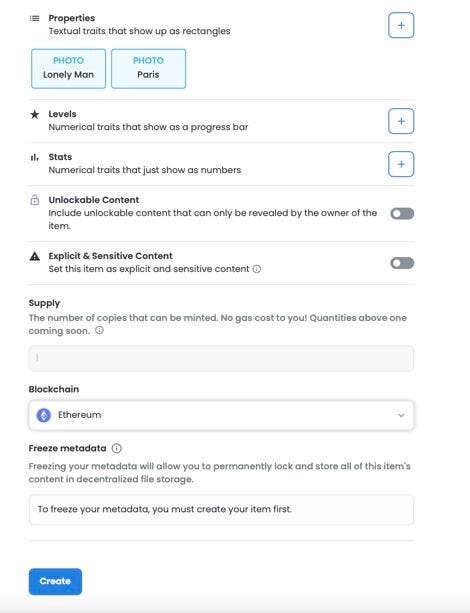
After selecting “Create”…success!
Next Steps
Now that my first NFT is created and stored on OpenSeas and I can share my new NFT via the user-friendly hyperlink OpenSeas provided.
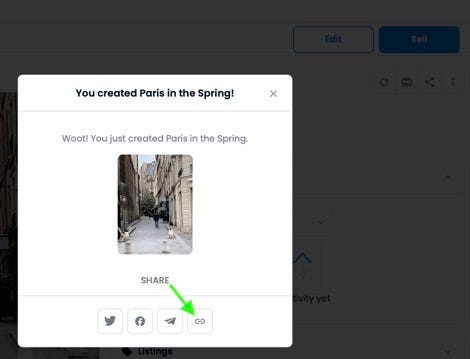
There are two more steps I could do, which I haven’t yet.
First, lock my NFT. Locking is fixing the NFTs associated metadata so it cannot be changed.

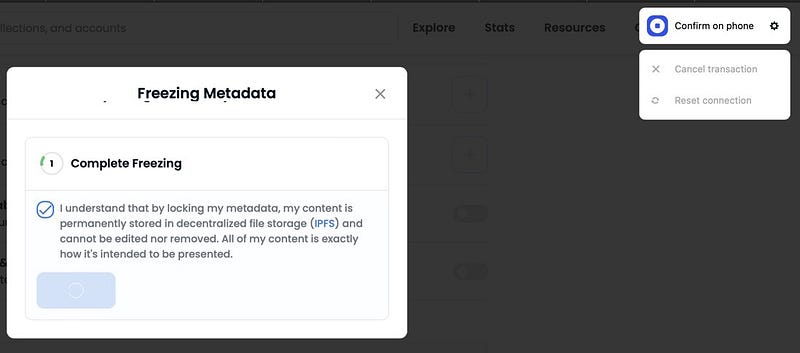
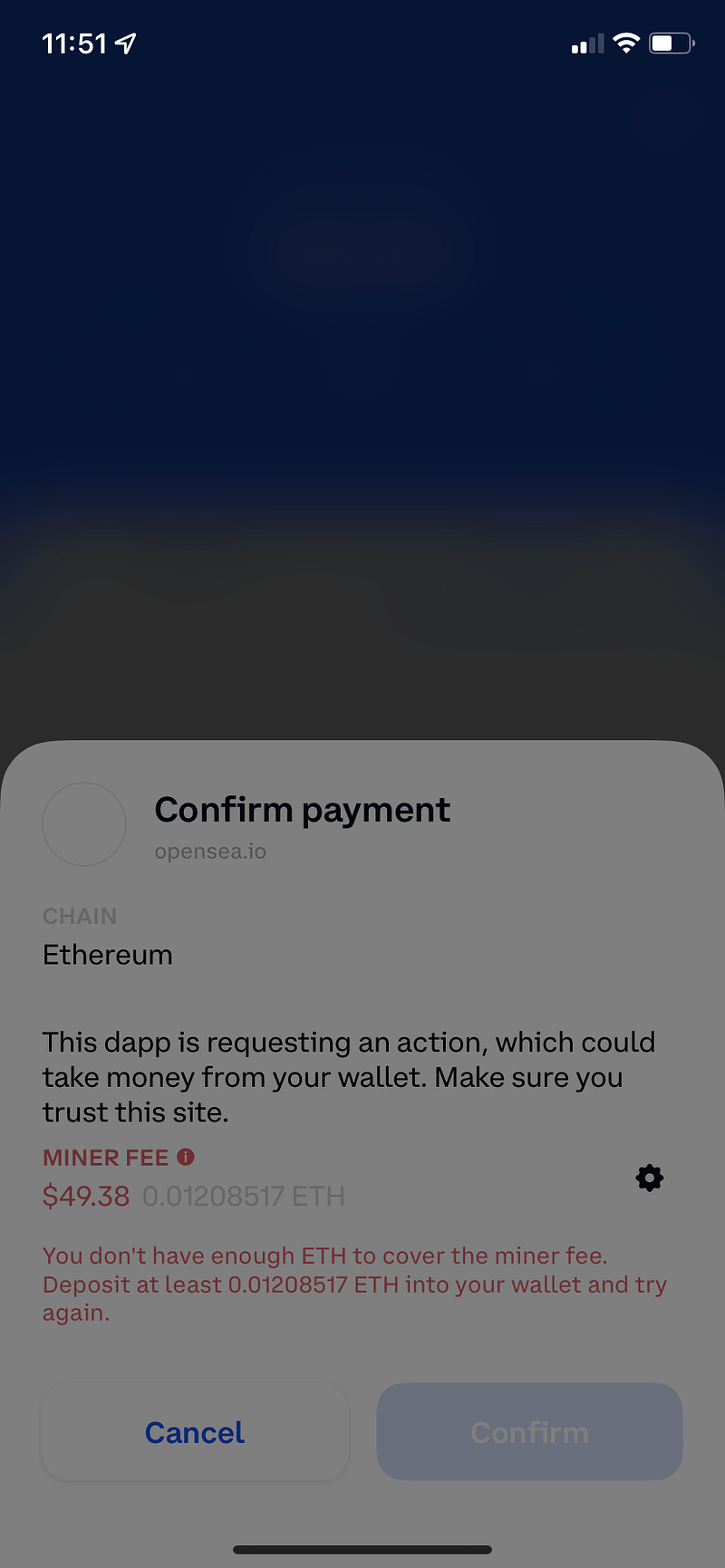
This locking requires mining effort with an accompanying cost, in the form of crypto coins. When I selected the “lock” button on my NFT’s preferences in OpenSea I then automatically got a pop-up on my phone’s Coinbase Wallet app telling me how much it would cost to lock my NFT. In this case, $49.38 via .01208517 ETH (Ethereum) via coins.
Secondly, I could list my NFT for sale on the open market via OpenSeas. One can set a “firm fixed price,” a rising market price where one sells “to the highest bidder”, or a declining market price where one sets a starting price which then declines to a minimum bid price.
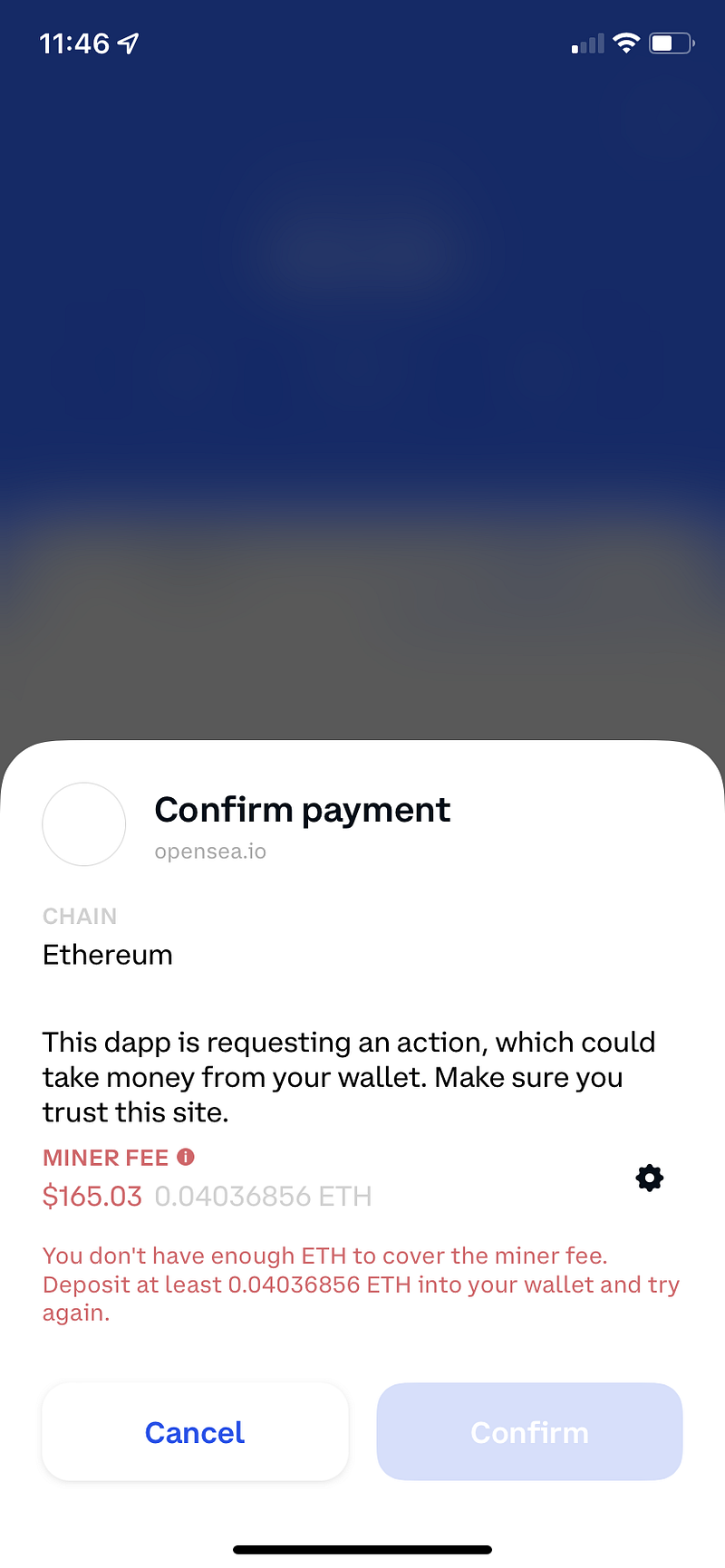
However, this selling costs money, again in crypto coins (this is why you need a “wallet” and an account mechanism to acquire funds in your wallet). Think of the account (Coinbase) as the bank, think of the wallet (Coinbase too in my case) as the safe deposit box where you place your coins. The fee to list my NFT for sale is 2.5% of the list price and one needs to transfer at least that amount of value in crypto coin to OpenSea to accomplish the listing. In my case, to list my NFT for $4,102.82 (the current market value for 1 Ethereum coin, the cost is $165.03 or .04036856 ETH).
Screenshots below depict the steps involved:
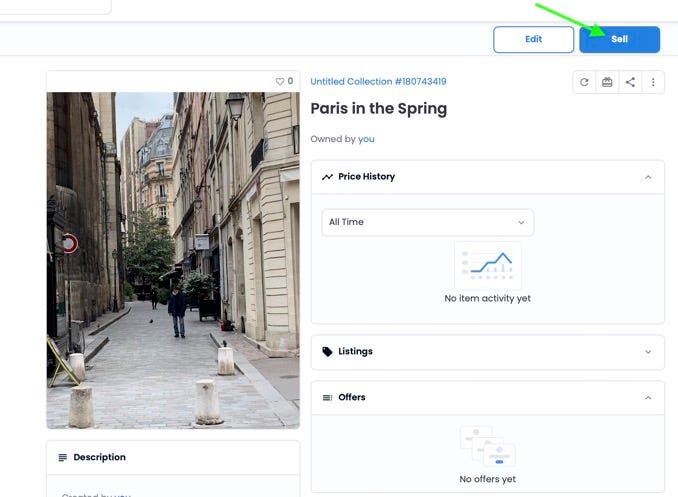
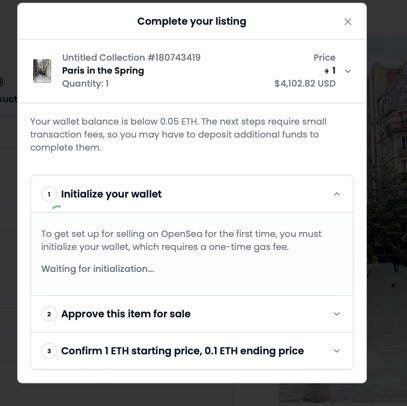
The above two actions on OpenSea resulted a automatically generated pop-up on my iPhone requesting I “confirm” the action (send ETH to OpenSea to pay for the cost of listing the NFT). Note I didn’t have enought ETH in my Wallet yet, as I hadn’t deposited coins from my Coinbase account to my Coinbase Wallet. This is another step I will need to take to complete the NFT listing.
Creating my first NFT, from scratch on OpenSea took 20 to 30 minutes. This includes creating my first digital wallet. I spent about 1 to 2 hours researching NFTs before starting the actual process. I already had a Coinbase account with accompanying crypto purchases. Creating that Coinbase account to make my first purchase (of Bitcoin) took me considerably longer than creating an NFT. I also did a great deal more research and exploration before buying crypto. Creating that Coinbase account month’s ago took me roughly an hour, with many stops and starts. I then waited a few months to make my first crypto purchase once I had the account, out of my own uncertainty and essentially fear of linking my bank account to my crypto account. I mitigated that to my own satisfaction by only linking a more minor balance debit-based sub-account to Coinbase.
From start to finish, assuming one already has the “picture” they want to NFT, I estimate the whole process can be accomplished within one 4-hour sitting or less. If you are like me you’ll start it, think about it, stop, start again, etc. In the end, it is relatively easy.
For comparison purposes, I easily spent over 10 hours over four days creating this post, i.e. writing and editing this article took much more thought and effort than creating an NFT, but was more fun and had no risk!
The biggest hurdle is diving into something for which you don’t fully understand how it works and throwing caution-to-the-wind by taking action. For that, it’s a personal risk vs reward assessment, as are all investments, even conventional ones. After all, one can still place their money under their mattress.

Summary — to create, list, and sell an NFT one must:
- Have an item to sell, i.e. the content.
- Have a cyrpto wallet, from which to facilitate the transaction.
- Have crypto coin to fund the transaction, i.e. it’s not free.
- Create the NFT.
- List the NFT for sale.
- Then, of course, have buyers interested in your product.
The NFT market is open, 24x7x365, decentralized, and secure. The only limit is your risk tolerance and imagination.
Terms/Definitions
Non-fungible — “not easy to exchange or mix with other similar goods or assets” https://dictionary.cambridge.org/us/dictionary/english/nonfungible.
Unique and non-replicable, not easy to change, one-of-a-kind.
To “understand what makes a thing non-fungible, it’s good to understand what the root word ‘fungible’ means. Fungibility refers to the interchangeability of an asset. Anything fungible is replaceable with something that is of an equal value. For simplicity, associate fungible with replaceable (or interchangeable). A basic example of something fungible is money. A $10 note is fungible as it can easily be replaced with ten $1 coins (or other denominations of equal value). Now, anything that cannot be so easily replaced is nonfungible. Real word objects that cannot be replaced with other items are nonfungible.” https://nerdschalk.com/what-does-non-fungible-mean/
Token — trade-able cryptoassets “that run on top of another cryptocurrencies blockchain” https://www.coinbase.com/learn/crypto-basics/what-is-a-token
Coinbase — “an American company that operates a cryptocurrency exchange platform. Coinbase operates remote-first, and lacks an official physical headquarters.” https://en.wikipedia.org/wiki/Coinbase
OpenSeas — “an online marketplace for non-fungible tokens.” https://en.wikipedia.org/wiki/OpenSea
Ethereum — “a decentralized, open-source blockchain with smart contract functionality. Ether (ETH or Ξ) is the native cryptocurrency of the platform. Amongst cryptocurrencies, Ether is second only to Bitcoin in market capitalization. Ethereum also allows for the creation and exchange of NFTs” https://en.wikipedia.org/wiki/Ethereum
Mining — “In cryptocurrency networks, mining is a validation of transactions. For this effort, successful miners obtain new cryptocurrency as a reward. The reward decreases transaction fees by creating a complementary incentive to contribute to the processing power of the network.” https://en.wikipedia.org/wiki/Cryptocurrency#Mining
Wallet — “A digital wallet, also known as e-wallet, is an electronic device, online service, or software program that allows one party to make electronic transactions with another party bartering digital currency units for goods and services. This can include purchasing items on-line with a computer or using a smartphone to purchase something at a store. Money can be deposited in the digital wallet prior to any transactions or, in other cases, an individual’s bank account can be linked to the digital wallet. A cryptocurrency wallet is a digital wallet where private keys are stored for cryptocurrencies like Bitcoin.” https://en.wikipedia.org/wiki/Digital_wallet
NFT — A non-fungible token (NFT) is a unique and non-interchangeable unit of data stored on a blockchain, a form of digital ledger. NFTs can be associated with reproducible digital files such as photos, videos, and audio. NFTs use a digital ledger to provide a public certificate of authenticity or proof of ownership, but do not restrict the sharing or copying of the underlying digital files. The lack of interchangeability (fungibility) distinguishes NFTs from blockchain cryptocurrencies, such as Bitcoin. https://en.wikipedia.org/wiki/Non-fungible_token`