
How to craft a killer brand name people remember forever
A step by step guide.

It started with a Yelp review.
Some LA Autoshop paid me five bucks to give them five stars and a quick blurb. I’d never been to the joint, but it was my first freelance sale. And, I put my entire being behind those 75 characters.
This tiny moment launched a six year (and counting) career in copywriting. I’ve worked on supplements, tequila, retail, eye care, foundations, nonprofits, pro sports teams, and everything else under the sun.
Along the way, I fell head over heels for naming brands and products. It’s like writing the world’s shortest poem. You must convey emotion, imagery, purpose, and value — in a handful of letters.
In the past six months, I’ve named an SDK for a disruptive healthcare brand, a resale program, a merger of creative life consultants, a suite of digital solutions for a leading eye care brand [launching 2024], and formed my own independent naming studio.
Here’s everything I’ve learned, and the step by step process I’ve used to successfully name a handful of brands.
1. Draft a naming brief.
You absolutely need a naming brief.
Anyone can sling a few dazzling words together and call it a day. But…does it clash with a competitor? Does it make sense to your audience? Does it work tonally with your brand strategy?
The brief highlights your goals and objectives. Making sure you avoid common pitfalls and keep the project running smoothly.
Consider including:
- A description of the brand strategy (mission, vision, TOV, etc)
- A description of the naming objectives
- Name criteria — do they prefer a short name or a long name? Do they want an acronym? Do they want a made up word, combination of words, or one known word?
- Competitors
- Target audience(s)
- Themes or words to avoid — if they are an international brand, names may require a linguistic screening
- Domain name requirements — does it have to be .com? Or are they open to other suggestions that may be more widely available?
- Trademark screening criteria
- Rounds of naming — THIS IS CRITICAL
Remember…naming is a highly subjective game. People will brings egos and opinions. The founder may love a name the CMO hates. And vice versa.
The brief keeps your team aligned, your project on track, and holds your client accountable.
2. Generate name ideas.
This is the fun part.
Search the far flung corners of the internet. Pull out a Thesaurus. Mash words together. Ask Chat GPT for unique spellings of words you fancy. Google bird species, odd sounding fruits, colors, poems, obscure cities, whatever.
Write down anything and everything you find, keeping the core values in mind. I recommend coming up with at least 300 ideas.
Do not edit them down. You may lose some of your favorites later on and need to go back to the bank.
If you’re working for an agency, involve different types of creatives (and personnel) in the process. Comments from Account Managers and Designers have inspired some of my favorite concepts.
Here’s a few spectacular examples to get the creative juices dripping from your fingertips:
- Sadderday
- Mid-Day Squares
- Rolling Stone
- Slack
- NASA
- Virgin
- Snapple
- Supreme
- Glonuts
- SCi Fi Foods
- Oatly
- Off-White
- Dad Grass
- Day Job
- Cosmopolitan
- FFUPs
- Flings
- Pzaz
- Erewhon
- Spotify
- Lucky Saint
- Skims
- Last Crumb
Some are named after cocktails. Some after people. Some are edgy. Some aren’t. Some are invented from scratch. Some simply describe their product.
No name is a bad name at this stage.
3. Narrow down the list, asses risk.
This is where heartbreak happens.
You come up with a kickass group of names. They’re sweeter than honey. Sticky on the mind. And, sadly, 60+% of them will be unavailable.
I recommend rolling your top twenty through this quick screening process:
Google [name option]+ relevant keywords:
Say you’re naming a supplement company. I’d do [name option] + health, [name option] + supplement, [name option] + wellness.
Lean on product/company directory sites like Thingtesting and Crunchbase for more focused results. I’ll also do a LinkedIn company search. If 300+ companies pop up, I’d consider the name a wash.
Check GoDaddy:
Flow your names through GoDaddy for domain availability. This is critical in finding something affordable and credible.
Run names through the TESS database:
Every client I’ve ever worked with wants to trademark their name. Search through both the US classes and the IC classes.
Check IG handles:
Go through the process of making fake social accounts on Instagram. LinkedIn allows companies to have overlapping names with different urls but Instagram and Twitter will need unique handles.
Yes, it’s tedious.
Yes, it’s time consuming.
But, don’t be lazy because…
The worst scenario is having a frustrated client come back to you because they can’t own the name they just fell in love with.
There are potential workarounds if you absolutely adore an overused and abused name.
- Think about unique ways to spell it. Lift = Lyft.
- Consider incorporating a meaningful location.
- Slap studio, workshop, collective, Co, etc on the end.
- Double up on letters.
- Add the client’s last name to the word.
5. Present your most interesting, ownable, and promising ideas.
You have a few options here.
I’ve used “creative territories,” or buckets with themes. If you have twelve names to present, you could create four buckets. Each territory includes a short write up and rationale, tying back to elements of the creative brief. If you have the resources, it can be helpful to put names on a simple mockup — a business card or a t shirt.
Include a write up for each name, along with potential watchouts.
Here’s an example:
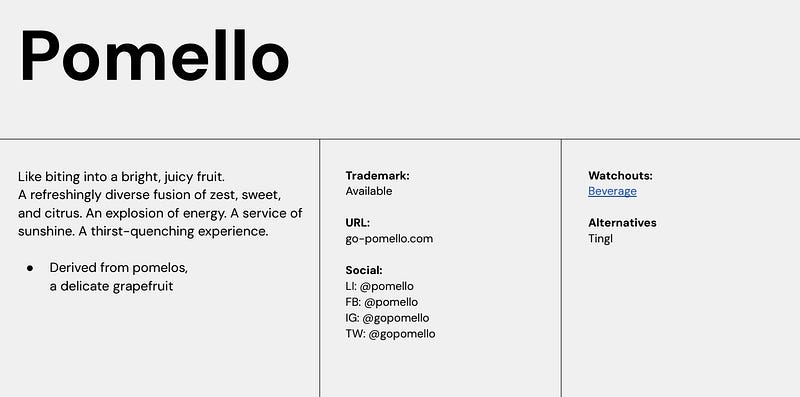
For the name above, the client described their services as “bright and refreshing,” so using a fruit with those qualities made sense — even though the name at a glance may not evoke those same feelings.
The best advice I can give is to make it fun and keep it heavily tied to their strategy. Even if the name feels random, you can sell it in the writeup.
*Optional
It may be helpful to include an appendix at the end with the longer list of names you vetted. Or you can include a handful that didn’t make the cut.
5. Shortlist your final three. Pitch again. Pick a name.
Every name carries risk. Some clients are more open to it than others.
When naming a sub brand for a global organization, the client was extremely aware of words associated with their competitors. We had to wait long periods of time for their legal team to review.
But, when naming a small product for a startup, the client was open to pretty much anything. They ended up picking a name right after the second round of pitching.
Ultimately, the final decision is on them. The best you can do is guide them to your recommendation. Have them write each name down. Say them out loud. Use them in phrases like “Hey, we’re [brand name].” Think about the name in digital versus print. On a shirt, an app icon, or a website banner.
Imagine this name in as many contexts as possible.
Once a name is decided, they can proceed with application filing.
6. If all else fails, give this thing some air.
You will have an immediate reaction to words. So will your clients.
A name evokes a different image, emotion, and connotation from each person. It’s perfectly fine if everyone isn’t aligned after round one. Or round two.
You need to let them marinate for a few days (at the minimum). Remind your group they’re in this for the long haul. We want a name that stands the test of time.
Hope this helps.


