
How to conduct a user interview for your user research
Are you someone who loves researching but not sure how to conduct interviews that convert? It’s not that difficult when you have a plan in place and an established set of goals you want to achieve through it.

“To find ideas, find problems. To find problems, talk to people.”
— Julie Zhou, former VP of Product Design at Facebook
User interviews are conducted at an early stage of app development. It allows you to empathize with your target audience, so as to step into their shoes and gain insights into how best the app can fit into the lives of its potential users. This requires us to understand a typical day in our users’ lives, the tasks they choose to prioritize that need more time and attention, the goals they must achieve at the end of the day, and the features you must include in your product to enable them to achieve these goals in the most efficient way possible.
Introduction
I curated this blog to guide you on how to conduct a semi-structured User Interview and the best Data Analyzing methods to help convert your findings to quantifiable information, and proceed to the next stage of your user research process. In order to understand the process better, at each stage, I have provided examples of the interviews and research I conducted for a Note-taking application.
Note-taking has been an integral part of every human’s life for collecting, organizing, and sharing notes, be it hand-written or digital, personal or professional, recreational or goal-oriented. It can be used for a plethora of things such as drafting out a timetable, organizing a product process, journaling, creating a reminder for an event, quick notes in meetings, and so on.
Objective
The aim is to get qualitative insights into the current workflows of your target audience and pull out details that would inform the features of your app. This can be done by framing 2–3 specific questions you want answers to, then establishing the goals you want to ultimately achieve. This will serve as a guide for you to further frame your interview questions. Example,
Questions to be answered :
- Why do working professionals take down notes?
- How do they feel about their current note-taking options?
- Where are the pain points in that process?
Goal to be achieved :
- Increasing efficiency and organization in both work and personal life.
- Promoting work-life balance.
- To stay on track and not miss out on important tasks.
Target Audience
It is important to establish who you are developing the application for and the categories your users fall under. The processes following this step will require you to structure everything around your users. This will keep you from deviating while conducting your research.
Eg: Target audience for the Note-taking app: Working professionals - Designers and Developers (Busy lifestyle with heavy workflows)
Research Methods
There are numerous methods by which a user interview can be conducted and analyzed. The 3 major types of interviews are:
- Structured,
- Semi-structured
- Unstructured
The preferred interview method at an early development stage is a Semi-structured interview.
As the name suggests, it has a good amount of structure when it comes to creating an interview guide where you establish the objective questions as well as a pre-defined set of interview questions. At the same time, the semi-structural part of this method enables you, the interviewer, to have open-ended questions that let the user answer in-depth. This allows for asking the user probing yet non-leading follow-up questions based on their answers, hence empathize with your user and receive insightful information to direct your user research process.
The research and analysis methods I have chosen to explore for this blog are:
- Qualitative Analysis
- Thematic Analysis
- Affinity Diagrams
Briefing the Users
Before the interview begins, remember to brief your interviewees about the interview objective and goal. This will help them ease into the interview session and open up about their experiences. You must also take their consent to record the interview for your future reference. This is a sample of how the introduction can be structured:
Hi! I’m Dev, a UX Designer. I am currently in the beginning stages of developing a note-taking app. I am conducting this user interview as a part of my user research project. I would like to ask you a few questions regarding your experience when it comes to jotting down notes, either in a work environment or for personal needs. You are not obligated to answer questions you aren’t comfortable with, and you can ask to stop the interview at any given point. There are no right or wrong answers! Do you have any questions before we begin?
Interview Questionnaire
This is the stage where you re-affirm the objective questions in mind, then curate a set of questions that seamlessly take the interviewees through the process. This can be made easier by grouping questions into sections that address each of your objective questions.
A. Getting to know the user:
Ease the users in and establish the user persona to you: - Where are you from? - Are you currently studying, working, or both? - Can you take me through a typical day in your life? - What are the apps you use on a regular basis?
B. User preferences:
General questions - preferred apps, current methods, pain points: - What are the top 2 apps you like and why? - Do you think it is important to make notes for yourself? - What is your current note-taking process like? - Can you share your most frequently used note-taking apps and why? - What are the difficulties/inconveniences in that process?
C. User personal life:
Your goal-specific concerns in users’ personal life - requirements, current methods, priorities, short-comings: - How much in advance do you plan your day out? - How do you keep a track of the tasks you have assigned for yourself on that day? - When you get overwhelmed with personal life and work goals, how do you organize your mind?
D. User professional life:
Your goal-specific concerns in users’ personal life — requirements, current methods, priorities, short-comings: - How often do you have a meeting in a week? In a day? - When points are discussed in a meeting, how do you jot down the pointers - Are you assigned work on a day-to-day basis or a weekly schedule? - How do you or your office currently plan out, organize, and prioritize your tasks? - Do you face any problems while using your current medium and methods?
E. Closing out the interview:
Areas that give scope for improvement and user suggestions: - Do you have any specific features in mind that you think will help improve your note-taking process? - Are there any other ideas or thoughts you can think of, that I might find valuable? - Can I follow up with you if there are any further questions we might have? - Do you have any questions for me?
Interviews
To put the theory to practical use, this is an example of the interviews I conducted that led to my research findings, along with a brief description of each interviewee to establish empathy. Read on…
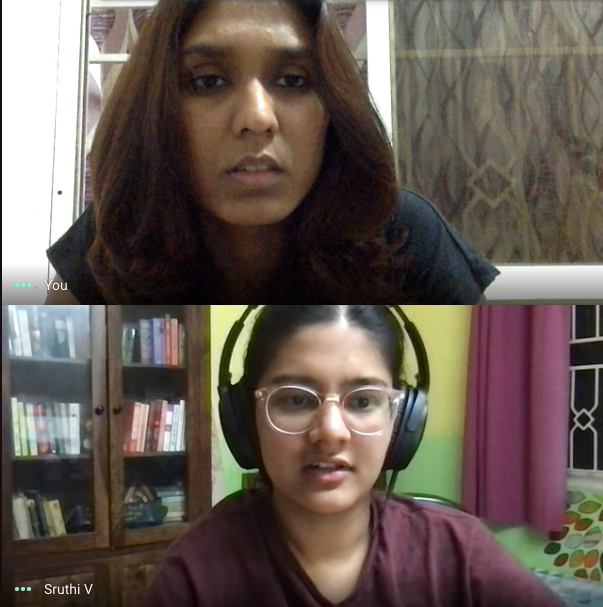
Interviewee 1 - Sruthi (Software Engineer) Sruthi is a Software Developer with a busy lifestyle where she juggles her work and personal life efficiently. She kick-starts her day with mindful yoga, clears her notifications, and powers through her work emails. She makes sure to spend time reading her favorite novels and write detailed reviews. Her musical side thrives through violin and Carnatic music.
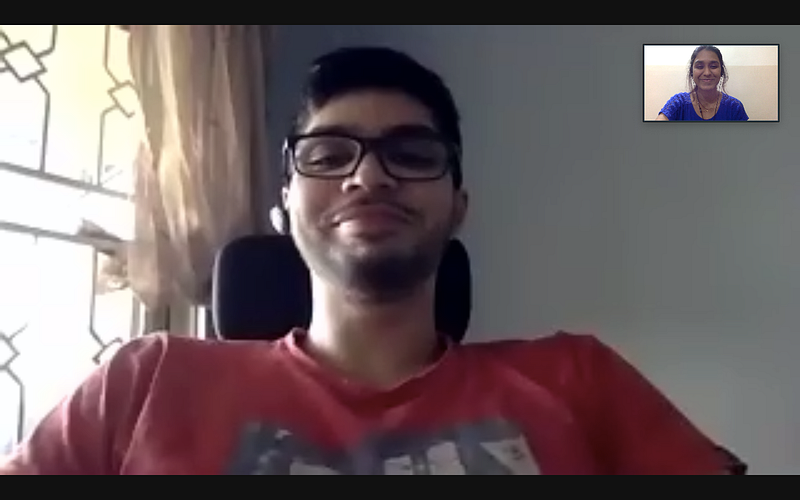
Interviewee - 2 Ankit (Freelance Developer) Ankit is a Freelance Developer working on personal and external projects. His day starts off with reading the news and browsing through the crypto market. Aside from being a full-stack developer, he churns his creativity with his electric guitar. He plays a lot of basketball and enjoys watching his favorite basketball team, the Lakers rule the court!
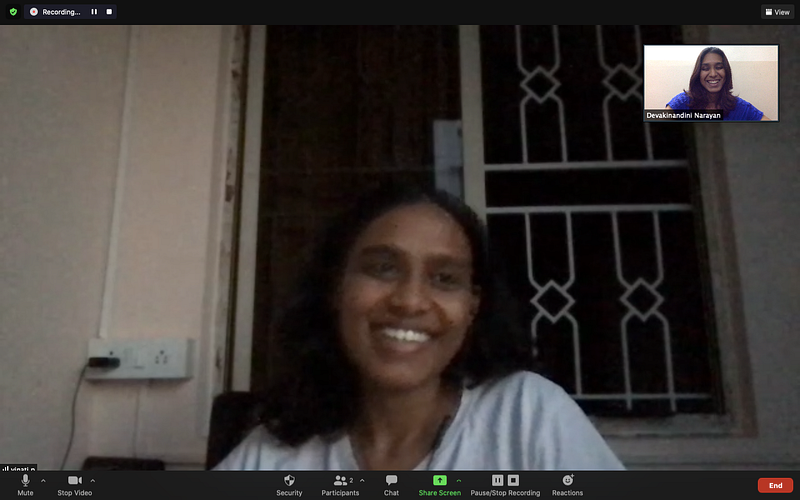
Interviewee 3 - Vinati (Visual Designer) Vinati is a Visual Designer, who views the world through colored lenses. Her creative outlets are cooking exotic dishes from scratch, experimenting with typography, and exploring different mediums of paint. A typical workday includes 3 meetings, active collaboration on design projects, and working progressively towards yearly goals all while thinking out of the box to solve real-world problems.
Conclusion
This marks the end of the User Interview session. Kudos on successfully interacting with potential users (even more if interacting with humans is not your idea of a pleasurable experience :p) The next step is the heavy work, analyzing all the data received from the users and the observations you personally made along the process. Read the blog How you can Interpret and Analyze a User Interview to understand the appropriate methods to use and a guide to conduct it yourself.