avatarJason Lai

Free AI web copilot to create summaries, insights and extended knowledge, download it at here

2888

Abstract

Principle is a way to structure your whole argument. It is a “top-down” approach, meaning you start with your final conclusion and work your way down to the specifics.</p><p id="5e7c">It usually involves 3 levels, as shown below.</p><figure id="87a8"><img src="https://cdn-images-1.readmedium.com/v2/resize:fit:800/1*jA_8_UZsXnEcnAvv1c260g.png"><figcaption>The Pyramid framework. Photo by the author</figcaption></figure><p id="64a9">The “pyramid” part comes from the fact that you start with a singular conclusion, then expand downwards into the supporting arguments and details. Like a triangle pyramid.</p><p id="9f94">This might sound counter-intuitive at first. You may ask, how are you to persuade someone if you start without any supporting arguments or evidence?</p><p id="90ea" type="7">“Start with the key ideas and, in a hierarchical fashion, form the details around these larger notions.” — John Medina</p><p id="2b65">In the fast-paced business world, every second counts. To persuade the other person in the shortest time, you should start with a crystal clear conclusion.</p><p id="1b1c"><a href="https://hbr.org/2018/07/the-leaders-calendar#how-ceos-manage-time">According to a study presented in Harvard Business Review</a>, CEOs only spent an average of 6% of their time with rank and file employees. They will not have the time to hear you ramble around.</p><p id="66a0">Even if you are not presenting to a CEO, you will have to present your ideas in the most straightforward and persuasive way for it to grab the other person’s attention.</p><p id="a314">By starting with the conclusion, the audience can make better sense of your following arguments and how those support your conclusion. They see the bigger picture first. It helps them to make the connections between your conclusion arguments better.</p><p id="670b">Then, you move onto your smaller supporting arguments. These concern different factors which all point towards the single conclusion which you have already given.</p><p id="4be4">Lastly, you talk about the specific details that reinforce each of your supporting arguments.</p><p id="61d2">This may sound simple enough, but there is one significant issue we cannot ignore:</p><p id="ae7a"><b>How can we ensure that our supporting arguments are complete enough and do not have any remarkable shortcomings?</b></p><p id="6fa7">Here is where our MECE principle comes into play.</p><h1 id="edd0">The MECE principle — simple categorization</h1><p id="f4c1">MECE is a principle that helps you to categorize your arguments so that it covers all the problem areas without repeating each other.</p><p id="c4b8">MECE stands for “<i>Mutually Exclusive, Completely Exhaustive</i>”.</p><figure id="4c9f"><img src="https://cdn-images-1.readmedium.com/v2/resize:fit:800/1*MFXIG7q432oq3nfjQp93Kg.jpeg"><figcaption>Photo by <a href="https://unsplash.com/@neonbrand?u

Options

tm_source=unsplash&utm_medium=referral&utm_content=creditCopyText">NeONBRAND</a> on <a href="https://unsplash.com/s/photos/talking?utm_source=unsplash&amp;utm_medium=referral&amp;utm_content=creditCopyText">Unsplash</a></figcaption></figure><p id="cf9a"><i>Mutually Exclusive</i> ensures that different arguments will not overlap with each other at all. One thing can only fit within one category at a time.</p><p id="39ac">Imagine that you have two circles. When they overlap, it forms a Venn diagram, which is not mutually exclusive. <i>Mutually Exclusive</i> is when they do not overlap.</p><p id="4477">Thus, when you are considering the merits of each argument, changing one will not affect the other argument, since the components of the arguments are exclusive from those in the other group.</p><p id="5003"><i>Completely exhaustive</i> means that the arguments compose almost all issues and problems in hand or at least the most significant issues.</p><p id="8e7f">This leaves little gaps to counter your argument as you would have considered almost all aspects of the issue.</p><p id="72b5">The difficulty in meeting this criterion means that you will need to check your arguments repeatedly before presenting it to make sure it is indeed <i>completely exhaustive</i>. This saves time for both the presenter and the audience.</p><p id="889e">When used correctly, the MECE principle can be extremely powerful.</p><p id="edcd">You will have a set of arguments that do not change even if you decide that one supporting argument might need some changes. This is because they are <i>mutually exclusive</i> from each other.</p><p id="1780">Your set of arguments also tackles the main issues and problems involved in the issue as they are <i>completely exhaustive</i>.</p><h1 id="2142">Putting it together</h1><p id="5c57">So how do you combine the Pyramid Principle with the MECE principle?</p><p id="e691">This part is easy once you have mastered the two.</p><p id="cf67">You can use the Pyramid Principle as an overarching structure of your argument — start with the conclusion, move onto the supporting arguments, finally the supporting details.</p><p id="240a">Then, apply the MECE principle. You make sure that each of your supporting arguments fulfills the MECE principle.</p><p id="ca7d">In the end, you will have an argument that flows seamlessly while also being really comprehensive.</p><h1 id="0a27">Final words</h1><p id="09e1">You may not turn into Harvey Specter immediately, but using these two principles will definitely bring you a lot closer.</p><blockquote id="b07f"><p>“Don’t raise your voice. Improve your argument.” — Harvey Specter</p></blockquote><p id="cf33">The two principles help you see more clearly and formulate better arguments. Use it not only when you are pitching an idea, but also when you are solving a problem yourself.</p></article></body>

How to communicate with great precision

The Pyramid Principle & the MECE principle. You will soon talk like Harvey Specter.

Photo by Alvin Mahmudov on Unsplash

Late in the evening, you’re sitting on your couch watching “Suits”. You put another popcorn into your mouth while wondering how on earth does Harvey Specter speak with such precision.

His speech is so articulated. It is clean, short but conveys his messages perfectly. He did not use a lot of words. His argument seems flawlessly structured — and you, while not a lawyer, were still able to follow up to his message comfortably.

What if I tell you that you can imitate his way of communication starting with 2 simple concepts?

Let me present to you: The Pyramid Principle and the MECE principle.

The concepts that can turn you into Harvey Specter, or Don Draper, whoever you like more.

Their origin

Both ideas were first proposed by the same person, Barbara Minto. She was the first-ever professional MBA hire that the global prestigious consulting firm McKinsey & Company had made.

After working there for 10 years, she wrote the book The Minto Pyramid Principle: Logic in Writing, Thinking, & Problem Solving. It was quickly crowned as one of the essential reads for any aspiring consultant and others in the business industry.

In the book, she outlined her method of structuring and thinking that she used when working for McKinsey & Co.

There, she mentioned the framework that we will be talking about today: The Pyramid Principle as an overarching structure to present your ideas, and The MECE principle to categorize your thoughts.

The Pyramid Principle — an overall structure

Photo by Jeremy Bishop on Unsplash

The Pyramid Principle is a way to structure your whole argument. It is a “top-down” approach, meaning you start with your final conclusion and work your way down to the specifics.

It usually involves 3 levels, as shown below.
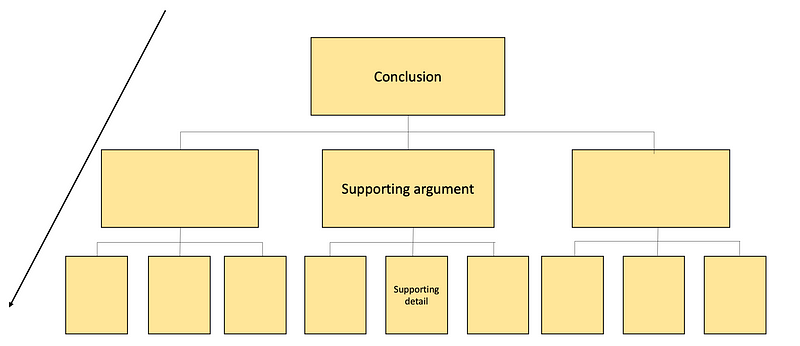
The Pyramid framework. Photo by the author

The “pyramid” part comes from the fact that you start with a singular conclusion, then expand downwards into the supporting arguments and details. Like a triangle pyramid.

This might sound counter-intuitive at first. You may ask, how are you to persuade someone if you start without any supporting arguments or evidence?

“Start with the key ideas and, in a hierarchical fashion, form the details around these larger notions.” — John Medina

In the fast-paced business world, every second counts. To persuade the other person in the shortest time, you should start with a crystal clear conclusion.

According to a study presented in Harvard Business Review, CEOs only spent an average of 6% of their time with rank and file employees. They will not have the time to hear you ramble around.

Even if you are not presenting to a CEO, you will have to present your ideas in the most straightforward and persuasive way for it to grab the other person’s attention.

By starting with the conclusion, the audience can make better sense of your following arguments and how those support your conclusion. They see the bigger picture first. It helps them to make the connections between your conclusion arguments better.

Then, you move onto your smaller supporting arguments. These concern different factors which all point towards the single conclusion which you have already given.

Lastly, you talk about the specific details that reinforce each of your supporting arguments.

This may sound simple enough, but there is one significant issue we cannot ignore:

How can we ensure that our supporting arguments are complete enough and do not have any remarkable shortcomings?

Here is where our MECE principle comes into play.

The MECE principle — simple categorization

MECE is a principle that helps you to categorize your arguments so that it covers all the problem areas without repeating each other.

MECE stands for “Mutually Exclusive, Completely Exhaustive”.

Photo by NeONBRAND on Unsplash

Mutually Exclusive ensures that different arguments will not overlap with each other at all. One thing can only fit within one category at a time.

Imagine that you have two circles. When they overlap, it forms a Venn diagram, which is not mutually exclusive. Mutually Exclusive is when they do not overlap.

Thus, when you are considering the merits of each argument, changing one will not affect the other argument, since the components of the arguments are exclusive from those in the other group.

Completely exhaustive means that the arguments compose almost all issues and problems in hand or at least the most significant issues.

This leaves little gaps to counter your argument as you would have considered almost all aspects of the issue.

The difficulty in meeting this criterion means that you will need to check your arguments repeatedly before presenting it to make sure it is indeed completely exhaustive. This saves time for both the presenter and the audience.

When used correctly, the MECE principle can be extremely powerful.

You will have a set of arguments that do not change even if you decide that one supporting argument might need some changes. This is because they are mutually exclusive from each other.

Your set of arguments also tackles the main issues and problems involved in the issue as they are completely exhaustive.

Putting it together

So how do you combine the Pyramid Principle with the MECE principle?

This part is easy once you have mastered the two.

You can use the Pyramid Principle as an overarching structure of your argument — start with the conclusion, move onto the supporting arguments, finally the supporting details.

Then, apply the MECE principle. You make sure that each of your supporting arguments fulfills the MECE principle.

In the end, you will have an argument that flows seamlessly while also being really comprehensive.

Final words

You may not turn into Harvey Specter immediately, but using these two principles will definitely bring you a lot closer.

“Don’t raise your voice. Improve your argument.” — Harvey Specter

The two principles help you see more clearly and formulate better arguments. Use it not only when you are pitching an idea, but also when you are solving a problem yourself.

Productivity
Work
Self Improvement
Life
Advice
Recommended from ReadMedium