
How to Communicate with Cats
Just talk, listen, and pay attention
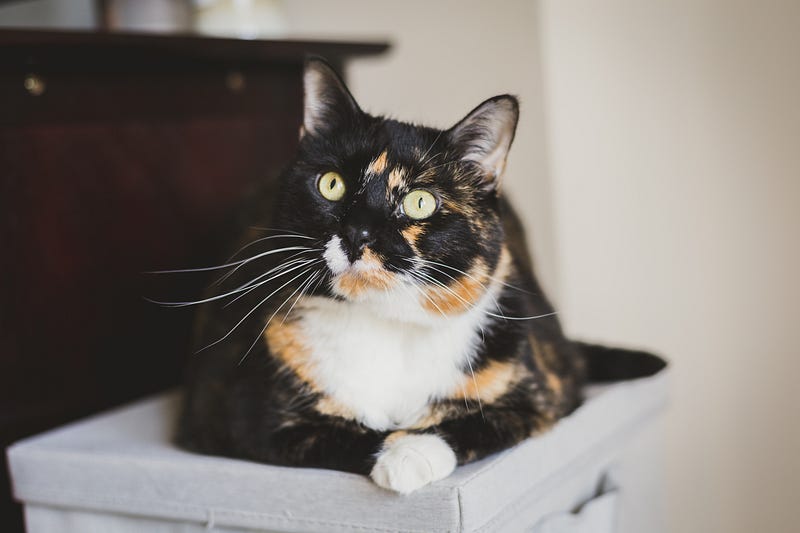
Our cats, brilliant little scoundrels that they are, have trained us to understand what they’re telling us, even without words.
This isn’t actually unusual. All cats have the potential to communicate with humans — if humans care to listen.
I’ve never understood people who have a cat but don’t interact with it. What do they think it is, a prop, to be ignored unless they suddenly need it for some reason?
“Oh, that? That’s just the cat.”
Trust me, there is no such thing as JUST a cat.
Bella is a quiet kitty, a woman of few words. When she does meow, it’s usually because she suspects someone’s going to open a bag of Greenies, and it always startles me a bit because it’s such an infrequent occurrence.
It’s a sweet sound, soft and meek, and it belies the fact that, while Bella is indeed sweet and soft and meek, she has a stubborn streak a mile wide.
Bella wants what Bella wants.
Bella loves Blue Mousie. The thing has been around for years — a semi-generic but reasonably well-made felt mouse with a long tail that you can get at just about any pet store. She loses it periodically, batting it under a sofa or a sideboard or sometimes the refrigerator, but we inevitably find it weeks later during one of our frantic pre-company cleaning sessions, and Bella and Blue Mousie are reunited.
She gets ridiculously excited when this happens.
Bella loves to be close to her family. If she feels like the peeps have been neglecting her, she’ll send us a message. Blue Mousie (or in its absence, the second-rate White Mousie) will suddenly appear in strategic places around the house, indicating to us where Bella wants us to go.
- The entry to the living room, if she wants us to sit on the couch with her.
- The bottom of the stairs to my husband’s third-floor studio, if she feels he’s been working too long.
- The foyer, just inside the front door, if we’ve been out of town.
- The dining room, if she’s trying to lure me out of the kitchen.
This isn’t a coincidence, folks. It’s a form of communication, proven out over the course of a decade.
When we notice the mouse, she runs to sit proudly beside it, waiting for us to acknowledge her kill.
This is an important part of the process.
“Oh Bella, you’ve brought us a mouse! What a mighty hunter you are. Thank you for contributing to the family food supply. We’ll be able to eat for a week!”
While I’ve never met another cat who used stuffed mice to communicate, research does show that cats have developed a complex system of meows, body language, and actions that allow them to express affection or tell us what they need.
Vocalizations can mean anything from a standard greeting (short meow) to a demand for something (long, drawn-out mrrrowwwww) to an indication of excitement or frustration (rapid teeth-chattering — one of our cats used to do this while bird-watching).
A cat holding its tail straight up with a curl at the end (as our Buster usually does) is thought to be happy, while a tail tucked under the cat’s rear indicates fear.
Other forms of body language, such as rubbing against us to mark us as their own, are used in communication as well.
We practice the “blinky kiss” in our household, looking at the cats while slowly opening and closing our eyes. The cats then return the motion. Sometimes they initiate the process, and it would be impolite not to respond, as this gesture is thought to indicate comfort and affection.
Be aware, though, that direct eye contact is considered rude in the feline world.
Bella’s brother Buster has always been extremely talkative. You can have a full-on, back-and-forth conversation with him. He’s a rascal with the voice of a pipsqueak. His robust frame and unapologetic cattitude make his high-pitch voice unexpected and amusing.
Buster’s all about routine. Our cats are on scheduled meals due to medical issues, and Buster starts begging for food an hour before mealtime on the dot. He knows when we’re supposed to scoop the litter boxes at night (he likes to participate in this process) and will start pacing in circles around us to communicate that it’s almost time.
If he feels we’re getting too far off schedule, the circles will gradually get smaller and smaller until he’s standing directly in front of us, at which point he looks up and meows, loudly and pointedly.
“Meep meep mrOWWWWW!”
It’s a good thing he keeps us on track, otherwise, nothing would ever get done. Silly, inept humans.
Cats communicate differently with people than they do with other cats. It’s rare to hear a cat meow when greeting another cat — they don’t need to. But a cat will howl from another room to get its owner’s attention.
Our little old lady Emily is nicknamed Squeak, so you can imagine what her meow sounds like. I feel deeply honored when she tries to groom my hair, as this is apparently a sign of love and trust. Grooming is a behavior typically used between a mother cat and a kitten.
Actually, studies have yet to prove anything about cat social behavior, other than vocalization, that indicates they think of people as much different from other cats. Obviously they recognize we are bigger than they are but, according to cat behavior expert John Bradshaw in a National Geographic interview, “Putting their tails up in the air, rubbing around our legs, and sitting beside us and grooming us are exactly what cats do to each other.”
Bradshaw goes on to say that “cats behave toward us in a way that’s indistinguishable from (how) they would act toward other cats. They do think we’re clumsy: Not many cats trip over people, but we trip over cats.”
The cats we’re honored to call family have always communicated with us, because from the very beginning, we’ve paid attention to them. We’ve talked to them consistently and intertwined our lives with theirs. We recognize that cats have different personalities and emotional needs, and we tend to those needs as much as we care for them physically.
Cats are not one and the same — seen one cat, seen them all. They’re unique beings, not ordinary in the slightest.
In return for our care, our cats connect with us and comfort us. They gaze into our eyes with complete trust, purr while making biscuits on our soft bellies as they would their mothers, snuggle against us and chortle-snore while they sleep. And then, somehow, all is right with the world.
Sources:
National Geographic — What Are Cats Trying to Tell Us?
National Geographic — What Do Cats Think About Us?
Cat Whisperer — How To Communicate With Your Cat
Want to stay in touch? Click here to sign up for my weekly-ish email newsletter!
Kathryn Dillon is a 40-something Cleveland Heights, Ohio-based author, rekindling her passion for writing after a 20-year hiatus. She resides with her husband and their three very spoiled cats in a ridiculously large 1910-built home that they are slowly attempting to renovate. She is a product manager by day and holds an MBA from Roosevelt University and a BS in Magazine Journalism from Ohio University. She believes life should be lived to the fullest, and particularly loves baseball games, craft beer, rock concerts, art museums, and the symphony, not necessarily in that order.


