
How to Climb Up and Down Mount Fuji in One Day
Climbing Mount Fuji up and down in one day is not recommended—but it can be done
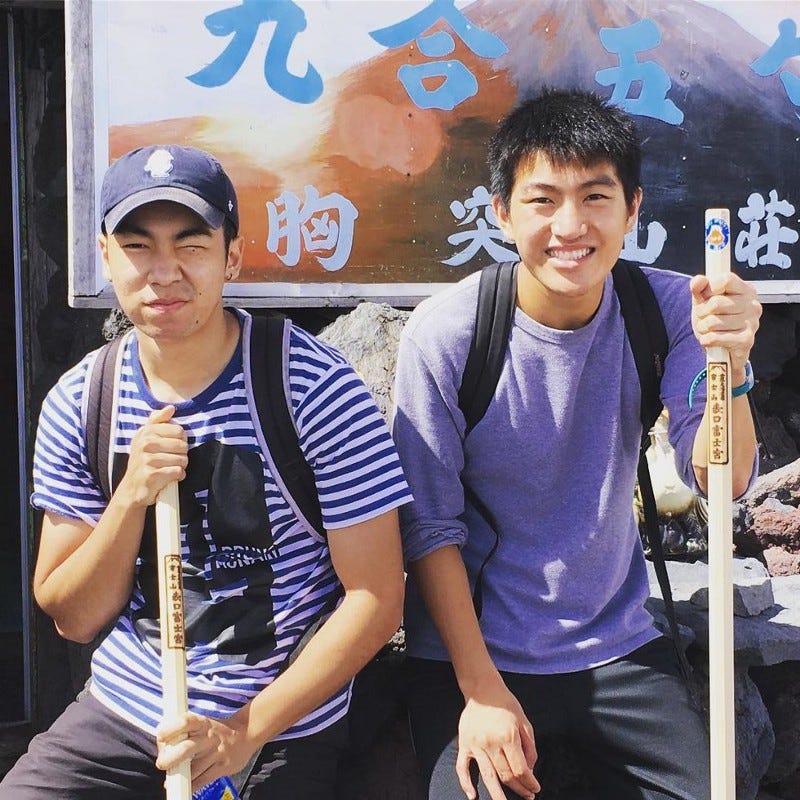
In the summer of 2017, my friend Dan and I climbed up and down Mount Fuji in a single day. I was in Japan for the summer, and how could I not spend two and a half months in Japan without climbing Mount Fuji?
Climbing Mount Fuji up and down in one day is not recommended. But we only had the weekend off and had one day to take the challenge. We couldn’t stay on the mountain overnight or take much time to “enjoy the scenery.”
Of course, we were both fit 20-year-olds, so our invincibility complex was at an all-time high. We worried about a lot of things, like altitude sickness and not being able to make the last bus in time, but fortunately, we avoided these problems.
We started climbing the mountain at around 11 a.m. and finished our climb down the mountain at around 7 p.m. We made it up Mount Fuji in less than two hours, and then made it down the mountain in a little more than four hours.
On average, most climbing guides estimate that it takes 5–6 hours from the 5th station, which is the most common start point. The most common trail is the Yoshida Trail, and you’ll see a fair amount of people on that trail. We hiked about 5,000 feet up from the 5th station to the summit of the mountain (which has a summit of 12,388 feet)
Preparation
Before Dan and I set off, we talked for about two weeks about when we should go, how we would get to Mount Fuji, and other important details of the climb. We decided to go to a certain station, to take a certain trail, and to bring food and water to last us the whole day.
However, there were other aspects of the trip we didn’t exactly plan well. We didn’t decide to stay overnight. We took the earliest train we could to get to Mount Fuji in the morning, and we didn’t even check the weather.
There’s a healthy balance between rigidity and spontaneity, and we certainly chose more of the latter than the former in our trip. We have no regrets doing so.
Assess Your Fitness
There are a lot of breaks on Mount Fuji. It is a hike like any other hike, so assess how well you can hike all your past trails and extrapolate those results onto your Fuji climb. I am an avid runner and Dan exercises a lot too, so we had no doubts about our ability to make it up and down on that day.
We had both trained in and spent time in the mountains before and were lucky to have never suffered any altitude sickness. We passed a lot of people on the way up.
Because of the altitude, we contemplated whether we should bring more equipment like oxygen masks for climbing, or even better shoes or remote hiking equipment.
Instead, we climbed in tennis shoes, t-shirts and shorts, and took some water.
We were both also young and had just entered our 20s, so feeling invincible certainly helped us. I’m still in my early 20s, and at 23 I think we could still do it based on how much we both exercise, but I am no fool to how age can do a number on you.
Some people climb Mount Fuji for the milestone and bucket list challenge rather than for the experience itself (which I certainly don’t recommend)—either way, you should expect to be challenged. But at some point, you might have to just do it and see what happens.
Get There As Early as Possible
I lived in Nagoya at the time, staying there over the summer while working in an organic chemistry lab at Nagoya University. My friend lived in Tokyo, so we agreed to meet at the Shin-Fuji station from the Tokaido Shinkansen, Japan’s bullet train.
The earliest the train would get to Shin-Fuji was 10 a.m. on that day. We were really cutting it close since most people choose to arrive a day in advance and hike in the early morning. But I worked late at the lab the night before and took a YOLO attitude.
And if something went awry that day, we would have to just find a place to stay overnight and go back the next day. We didn’t make many plans.
When the train stopped at Shin-Fuji, there was a long line of people waiting to get off the train. I waited for them, but the line wasn’t moving. Then, I heard an announcement that the train was about to start moving to the next station.
I had made a huge mistake — the line standing in the aisle wasn’t getting off the train — they were standing just because there weren’t any seats! I quickly got my backpack, ran to the door while saying “sumimasen,” which means “excuse me” in Japanese, and got to the door. It closed just as I was trying to get off, and so I missed my stop.
I was also cheap—I didn’t pay for a data plan while I was in Japan, so I had to wait for the next time I was on wi-fi. My friend was already at Shin-Fuji, and I texted him at about 10:30 a.m. telling him I missed my stop. I had to go back on the Shinkansen, leaving him waiting at the station for about an hour until I got back there.
To climb Mount Fuji in one day, it’s better to get there early, and certainly to get off at the right train stop. Don’t do what I did. The earlier you get there, the better your chances are for reaching your goal.
Include Someone Who Can Speak Japanese in Your Group
It is difficult to navigate Mount Fuji when you have an emergency, and even more difficult when you don’t know the native language. Dan, luckily, is Japanese-American, so when we needed help or directions, he was able to ask strangers.
Going down the mountain, for us, was a disaster. We decided to go down the mountain a different path than we went up. Of course, we were still behaving as tourists at Mount Fuji, so when we came to the summit, we took pictures.
We had gotten up the mountain in less than two hours. Surely, going down wouldn’t take as long as going up, right? Since we had so much time to spare, I suggested to Dan that we go down a different trail — the Gotembra trail, which went back to the same 5th station that we came up at.
It turned out that this was a completely different 5th station, and that going down was significantly more difficult than going up. We fell several times as we tried to run down the trail, and we weren’t making the time we needed to get to the bus before it departed. It was way too steep and dangerous, so we had to watch our footing. Apparently, it is actually the most difficult trail of the four Fuji trails, with very few huts.
On that trail, we diverged to a different trail, the “Osunabashiri”, which we believed (through the signs) to be the fastest way back to the station. Even though that would be a faster way back, it was also incredibly challenging. In Japanese, Osunabashisi means “Great Sand Run,” which was an accurate name for a trail that literally filled our shoes with sand as we tried to run down.
We fell dozens of times trying to get down faster. And we weren’t making good time and were about to miss the last bus back to Shin-Fuji at 6 p.m., so we were screwed. We weren’t going to make it home that night, and we prepared ourselves to make accommodations, wherever we could find them, that night.
Luckily, as we started to give up on making it back in time, Dan and I started conversing with two middle-aged Japanese women. I didn’t know any Japanese, so Dan was my interpreter. They told us about a bus that would take us back to the Shin-Fuji station, and led us there.
Without their help—and Dan’s ability to speak Japanese—we still would have survived. But we wouldn’t have climbed the whole mountain in that one day.
Do What You Know and Don’t Get Arrogant
Trying to take a different trail down than going up was a big mistake of ours. It nearly got us stranded. It was simply youthful ignorance, and I regret that we chose that route because it ended up being a detrimental decision for both of us. We should have gone down the same way we went up.
With the risk we ran of missing the bus back, we probably shouldn’t have spent 45 minutes at the summit taking pictures to post on our Snapchat stories.
But we did. We went up, basked in the praise of fellow climbers who were wondering how we climbed so fast without stopping. We climbed up the mountain and climbed down, and believed ourselves to be unstoppable in our goal for the longest time.
The trails were not only different in terms of where they ended up, but in terms of their terrain. We realized pretty quickly that the Yoshida Trail is much more popular than the Gotemba Trail for good reason. There’s an actual trail that has steps and that’s paved on the Yoshida Trail. The Gotemba Trail is on another side of the mountain, and it was sheer arrogance and stupidity to think we would take that trail and be going to the exact same station we came from.
Take Breaks, Sparingly
We weren’t going full throttle the entire time. Despite how quickly we were able to go up the mountain, we took plenty of breaks. We stopped at tourist shops at various rest stations to just take in the experience. We didn’t buy much memorabilia, but at one rest station bought the cool walking sticks (that you see in the photo above). Those sticks helped to keep us from falling on the way down multiple times.
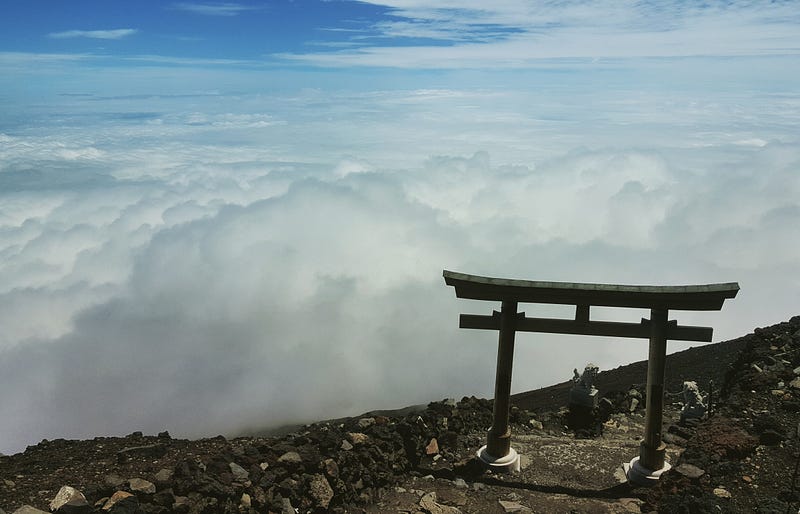
We don’t regret spending 45 minutes at the top, even though in retrospect it may have been a bit foolhardy. How many more times are we going to climb Mount Fuji? Maybe once or twice the rest of our lives, if we’re lucky. We’re not the kinds of tourists who overdo pictures, but we put aside those reservations when we were at the summit of Mount Fuji. There was a special kind of feeling to be able to be above all the clouds and see them below you — as well as looking down from the summit and realize that you’ll probably never be at that altitude again.
I never felt as invincible as looking down from a cliff at the summit.
Have Fun
My advice is to make it more about the experience than the milestone.
At the end of the day, if you have the luxury and privilege to travel in the first place, Mount Fuji is a must.
We were unconventional climbers — all we went in with were a pair of shoes, food and water, and some money in the case of an emergency. You probably want to prepare much better than that.
But if you are limited on time and resources, just do it. After all, staying at a hut on the mountain overnight is somewhat expensive. At night, there tend to be much bigger crowds than the day. We got lucky with good and warm weather, too, but we certainly got colder and shivered a bit when we hit the summit.
Without the crowds, fortunately, you can just go at your own pace, stopping at various stores and talking with others throughout. We encountered a lot of people, but not so many that they would take up the whole path. All we really brought were tennis shoes, clothes, food, and water. We treated it casually, like any hike, and perhaps that’s what allowed us to gain the accomplishment of climbing Mount Fuji in just one day.
It was more than just a climb, but a way of reuniting with a close friend. Dan and I didn’t just climb Mount Fuji, but we caught up after not seeing each other for almost three years since high school.
We were tired at the end, but we weren’t too tired, and we had a lot of fun and a good time doing it.
We didn’t do a lot of the planning a lot of people might do — we just did it, oblivious to the overnight recommendations of many travel guides. And while that could have been dangerous, climbing Mount Fuji in one day is also possible, and a bit of a challenge.