
How To Choose Work That You’re Good at and Makes You Happy
How do I find a job that I love, stay excited about and highlights my best skills?

What is occupational wellness?
“Contributing your unique gifts, skills, and talents to work that is personally meaningful and rewarding” (Stoewen, 2017).
- Using your talents and skills to create joy
- Visualizing the future
- Picking a job where you can bring your skills, passions and personality to the table
- Being ready to try new skills (Grand Rapids, 2021).
- Work-life balance
- Co-worker relationships
- Stress management
- Participating in stress relieving activities when off work (Roddick, 2016)
Why is Occupational Wellness important?
This is important to me because I believe that human beings were created to work. I see so many unhappy people going around with their heads hanging down, feeling defeated.
We were created to use our skills to give meaningful contributions to causes that we are passionate about.

It’s not only about having a career, volunteering or providing for your family. It’s about finding out your greatest skills so that you can identify what you were created to contribute to the world (Coleman, 2019).
Photo citation: (Bauso, 2019)
Here are some healthy vs. unhealthy examples of Occupational Wellness that can give you a better picture of how it looks in everyday life.
Healthy Practices:
- Getting enough nutrition, sleep and exercise so that you can perform well at work
- Putting your best into your work
- Developing skills that will help give you more of an edge at work
- Keeping an open relationship with boss and coworkers
- Looking for ways to make more money doing what you love
- Getting higher education when needed to reach career goals
Unhealthy Practices:
- Allowing a boss or coworkers to give you work that is outside of your job description or that you are unqualified to complete
- Staying in a work environment that is super negative or where they hold different values than you
- Staying in a low paying job that you don’t like
- Staying in a high stress, but high paying position that is causing stress at home
- Not maintaining a healthy work-life separation
Now that you have an idea of how this translates to real life, let’s bring it down to earth even further. Check out the SMART Goals infographic below for more information about how to turn your dreams into Goals.
How do I choose the right career?

Photo citation: (Ekrulila, 2018)
- Talk to friends and family that know you very well. Make a list of your skills and talents. Consider hard and soft skills.
- Make a second list of the things you love. What kinds of things do you do in your spare time? What can you sit down to do and hours pass by without you realizing it? What makes you smile or excited to talk about? Is there a cause that you love?
- Rate each item on both lists. Take the top three items from each list and circle them.
- Calculate your monthly spending needs. For example, if your family spends $3000/month, that is $36,000/year. Make sure to include any debts or payments. Include 25% for taxes, 10% for Giving and 10% for savings. The $36,000 now turns into a minimum of $60,000 per year. That will be your minimum income goal when looking for jobs. If you in an entry level position, you may need to cut down your family’s spending and recalculate your minimum income to bring the numbers down.
- Research jobs that match those six items. If you are coming up short on jobs, extend the list to the top 5 or the top 10.
- Cross out any jobs that do not meet your minimum income needs or require qualifications that you don’t have.
- Make a list of the jobs with higher qualifications that you are interested in. Set a career goal to start getting training to meet those qualifications in a set number of years. Make sure that your career track includes income increases.
- Apply and schedule interviews. You may need to get your foot in the door by volunteering in the field you’re interested in.
- When you research companies and go for interviews, make notes of the atmosphere. Are people talking to each other and smiling? Is it a positive atmosphere or are people yelling? How does leadership treat the teams under them? What are their values and do they align with yours? Do they communicate in a healthy way?
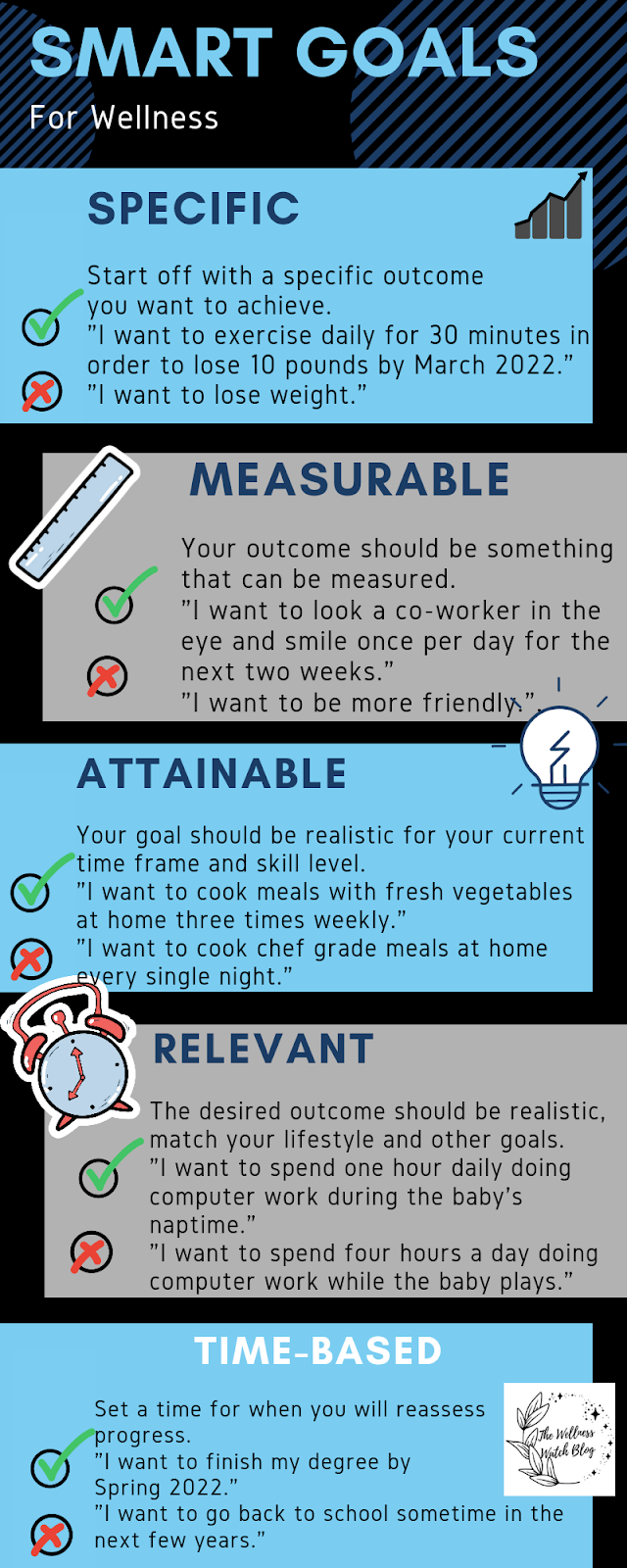
SMART goals citation: (Mind Tools, 2016)
How do I become healthy?
- Work in an environment that is positive and challenging, engages your passion and highlights your skills.
- Take note of your performance review or ask your boss for feedback. Set goals to improve on those weaknesses.
- Ask your boss if there is a way that you can bring more skills to the company and have a career track to move up.
- Determine if you need more education to reach your dream career or if you just need specific skills training.
- Work towards getting a higher income so that you can pay off your debt, retire well and give generously (Coleman, 2019).
Tips to Take Home
Don’t settle for mediocrity in your job or your life. Take the time to choose what you want to do, who you want to be, and where you’re going.
If you’re a stay-at-home parent, Occupational Wellness applies to you, as well. Your viewpoint has to be, “what am I born to contribute” rather than “what job should I have?”
Infographic: Created by Author with information from Mind Tools (2016).
When you have that mindset, your whole viewpoint on life changes. Instead of, “I have to stay home and change diapers all day”, it’s “I’m training this kid to have an awesome character and social skills so that as an adult they can be a powerhouse in whatever career they choose.”
Your contribution could be as a writer for your church newsletter, helping people organize their homes, helping cook healthy meals for your kid’s school or standing in as a role model for kids that don’t have anyone.
Change your image of what a vocation should be from Career to Contribution.
Interested in more? Check out my newest freebie: 25 Promising Signs of a Healthy Relationship.
Click here to sign up for my email newsletter and get this free checklist.
Resources
Coleman, Ken. The Proximity Principle: The Proven Strategy That Will Lead to the Career You Love. Ramsey Press, The Lampo Group, LLC, 2019.
Grand Rapids Community College . “Seven Dimensions of Wellness.” Seven Dimensions of Wellness, 2021, www.grcc.edu/faculty-staff/human-resources/professional-development/wellness/seven-dimensions-wellness#:~:text=Occupational%20Dimension,your%20attitude%20about%20your%20work.
Mind Tools Content Team By the Mind Tools Content Team. “Smart Goals: — How to Make Your Goals Achievable.” Time Management Training , 9 Mar. 2016, www.mindtools.com/pages/article/smart-goals.htm.
Roddick, Marjie L. “The 8 Dimensions of Wellness: Where Do You Fit in?” Good Therapy Blog, 14 Sept. 2016, www.goodtherapy.org/blog/8-dimensions-of-wellness-where-do-you-fit-in-0527164.
Stoewen, Debbie L. “Dimensions of Wellness: Change Your Habits, Change Your Life.” Canadian Veterinary Journal, Aug. 2017, pp. 861–862. National Center for Biotechnology Information, U.S. National Library of Medicine, www.ncbi.nlm.nih.gov/pmc/articles/PMC5508938/.