
How To Channel Your Thinking to Action
Great minds discuss ideas; average minds discuss events; small minds discuss people
An easy read and blue print book to revolutionize your thinking and affect your life forever when you follow the blueprint.

Reading motivational books will get and keep you on track as you apply the discussed principles. “Change your thinking, Change Your Life”, JOHN.C MAXWELL
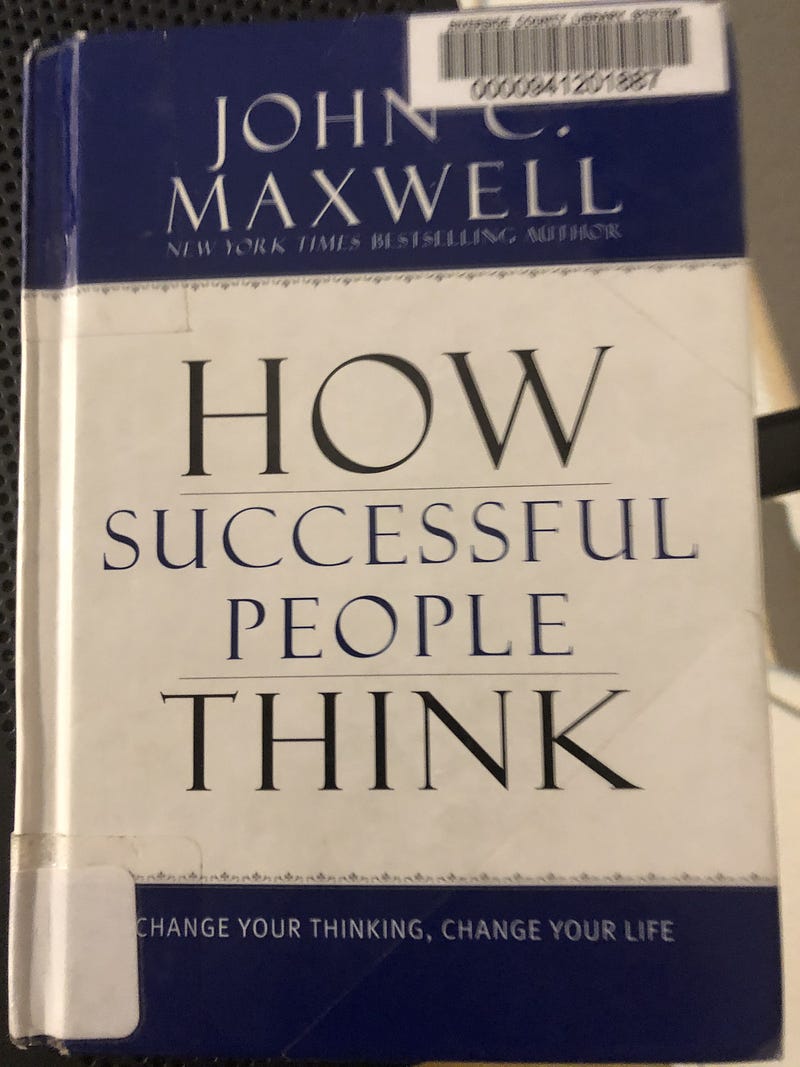
While on vacation, I had the pleasure of leisurely reading Mr. Maxwell book and it was such an eye opener in so many ways. There were tons of morsel that were perfect for my journey and others alike.
Starting with his introduction, his words were profound. Loved the words that about the success and demands of a good thinker. He stated, “A person who knows how may always have a job, but the person who knows why will always be his boss.” As you see in this statement, taking your thinking one step further provides dividends far beyond just knowing how. It is in the “why” that makes the difference in your success level. Also love that good thinkers solve problems and always possess hope for a better tomorrow. These forward thinkers are rarely deceived. Amen to that. With these thinkers, the glass is always half full and never half empty.
Successful thinkers have one thing in common, how they think. Another thing that separate a successful thinker from a unsuccessful thinker, is their thinking processes. Successful thinking can be taught and learned. Like Mr. Maxwell championed changing your thinking will inevitably change your life.
In his book he provided reasons and why one should change their thinking and steps in obtaining forward thinking. Changed thinking requires the following:

Step 1. Changed thinking is not automatic and doesn’t happen over night. It is definitely a process for all. To discover a good idea, it must be searched out. Becoming a better thinker, requires work and consistency.
Step 2. Changed Thinking Is Difficult and hard work. Thinking in general is difficult and most don’t like to do it. Use any method applicable to assist you in improving your thinking process.
Step 3. Changed Thinking Is Worth the Investment, this is one of the few investment that can revolutionize your life over a period of time doing it.
Ways to become a better thinker, exposure is the key
- Expose yourself to Good Input
- Associate yourself with good thinkers
- Make a point to think good thoughts
- Application of good thoughts is required
- Use your emotions to create continuous good thought
- Just like exercising, good thinking must be repeated
Just like yoga, you need a specific place to perform it, the same holds true for your thought processes. Going to a designated place to expect, generate, shape good thoughts, stretch your thoughts, land your thoughts, and fly your thoughts is crucial.
Characteristics of a Good Thinker:
- Seeing the big picture thinking (This is having insight or being insightful)
2. Open up to the full potential of focused thinking
3. Discover and enjoy creative thinking (brainstorming)
4. Be realistic in your thinking or thought process
5. Strategize when thinking
6. Make possibility thinking paramount
7. Embrace the benefit of reflective thinking
8. Be opened and question popular thinking
9. Participate in shared or group thinking
10. Unselfish Thinking gives much reward in the thinking process
11. Enjoy the return of Bottom-Line thinking
Each chapter in his book expounds on the above characteristics of a good thinker. This book is written in a manner that is not only easy to read and comprehend but teaches how to follow each chapter in becoming a better and successful thinker.
There are lots of antidotes, quotes and references to other books, writers and great thinkers with in his book. These great thinkers are from varying background and/or profession. Each one of these people referenced are successful thinkers in all aspect of their thinking.
The reality is that they each was not born successful thinkers but have cultivated the art of successful thinking thereby being successful in their endeavors. Keep in mind there must have been failures, but failure is not the culprit but given into the failure and not moving beyond it is the culprit. A problem remains a problem if you don’t solve it, otherwise it becomes a solution.
Some of the famous quotes that are enclosed in Mr. Maxwell book are as following:
“Think like a man of action — act like a man of thought.” Henri-Louis Bergson, French philosopher
“Great ideas need landing gear as well as wings.” C.D. Jackson, Author
“The value of life lies not in the length of days, but in the use we make of them; a man may live long yet live very little.” Michel Eyquem de Montaigne, French essayist
“He that is everywhere is nowhere.” To get things done, you need focus.” Thomas Fuller
“He did each thing as if he did nothing else.” Charles Dickens
“Concentration is the secret of strength in politics, in war, in trade, in short in all management of human affairs.” Ralph Waldo Emerson
“Creativity is pure-gold, no matter what you do for a living.” Annette Moser-Wellman
“Highly creative people are dedicated to ideas. They don’t rely on their talent alone; they rely on their discipline. Their imagination is like a second skin. They know how to manipulate it to its fullest.” Annette Moser-Wellman
“Strategic Thinking is really nothing more than planning on steroids.” Miguel de Cervantes
“Strategic thinking is like showering, you have to keep doing it.” Olan Hendrix
“If you don’t want to get into positive thinking, that’s ok. Just eliminate all the negative thoughts from your mind, and whatever’s left will be fine.” Bob Rotella, Sports Psychologist
One of the most amazing stories in Mr. Maxwell’s book was about a lady named, Frances Hesselbein who was a practitioner of bottom line thinking. When Ms. Hesselbein was ask to be the National Executive Director of the Girl Scouts of America, I very much appreciated her approach in bottom line thinking. She asked the following bottom line questions, “What is our business”” , “Who is our customer?” and “What does the customer consider value”? With these question she identified the Girl Scouts bottom line, “We really are here for one reason: to help a girl reach her highest potential.” “When you’re clear about your mission, corporate goals and the operating objectives flow from it.”
From this bottom line, she created a strategy, reorganized the national staff, created a planning system and set up management training. By the time Ms. Hesselbein left the Girl Scouts it had become a first-class organization. She moved on to more successful accomplishments and was refereed to by President Clinton as such, “She has shared her remarkable recipe for inclusion and excellence with countless organizations whose bottom line is measured not in dollars, but in changed lives.” Nothing more need to be said to confirm the ultimate effect of bottom-line thinking.
In conclusion, I have included enough morsels for each of you to feast on but to enjoy the entire pie you must read this book, “How Successful People Think.” Mr. Maxwell’s book is the perfect blueprint to change your thinking as you change your life.
EP McKnight a writer, teacher, stage playwright, fitness coach and constant dreamer. She is a GCU doctorate student in Performance Psychology, Graduate and Undergraduate in Educational Psychology and Communications at Fordham University New York, New York. She’s on Facebook, Twitter, Instagram, LinkedIn and you can read more of her on www.epmcknight.com


