
How To Change When All Other Efforts Fail
Nearly every adult I know has something about themselves that they would like to change. This manifests in every diet effort, New Year’s Resolution, Couch-to-5k, savings plan, and much more. It’s a beautiful thing. A very distinct, human thing. Why? I think Daniel Gilbert explained it best in his book, Stumbling On Happiness, when he wrote,
The human being is the only animal that thinks about the future.
I’ll add that we’re also the only animals who can identify and act upon the need for personal change. Because, as Gilbert suggests, we think about the future and want something better. To be stronger, smarter, wiser, kinder, happier. All of the above.
This desire to change, to have a better future, eventually leads to a desire for personal growth. We don’t change for change’s sake. We do it to become a better version of ourselves, free of the old problems and bad habits.
Where does this work begin? When we hit rock bottom?
Sometimes. But more often, our change efforts have a less-distinct starting point. They just emerge through our exposure to new, welcome influences.
For example, we might see someone make a big transformation and we revel in their newfound happiness and health. It inspires us. We start thinking about our own potential changes. Then we gradually start doing something that leads to real effort.
Or we see it from the other end: we encounter people who have failed to grow (e.g., friends from our youth who have become shadows of their former selves; older people who have turned bitter and petty) and we realize we don’t want that to happen to us. So we start doing something about that, too.
After a few fits and starts, we realize that change ain’t easy. Growing ourselves takes real effort. That’s when we look for some kind of help.
Over the past seven months, I’ve highlighted the best resources I’ve found to help us when we reach that point. A few notable examples come from the Heath Brother’s book Switch (book review here) and William and Susan Bridges’ book Transitions (book review here).
These books offer some of the best methods I’ve found to help create and manage change in every facet of life. There are tools and tactics galore. When people get serious about this work, these books are where they should turn.
But remember: success isn’t guaranteed. So what do we do when these laudable, excellent resources fail to bring about the personal change we seek?
We ratchet up our effort. We move to the biggest, most powerful method of all.
We attack our immune system.
Wars of the Self
Let’s begin with the notion of a psychological immune system. Because there is such a thing. In the review of Daniel Gilbert’s aforementioned book, I tried to describe the concept as best as I could. It’s such a fantastic way of thinking about our behavior. To borrow a quote from the author,
A healthy psychological immune system strikes a balance that allows us to feel good enough to cope with our situation but bad enough to do something about it.
The point here is that this psychological immune system is a driver of sorts. It controls our speed. It keeps one foot on the gas (for creating change) and one foot on the brake (to ensure we don’t create too much change).
When Gilbert mentions the system’s tendency to make sure we feel “good enough to cope” with something, that feeling is a brake pedal that prevents us from leaping into some drastic behavior. When he mentions the tendency to feel “bad enough to do something,” it’s the system’s gas pedal pushing us into a more sensible form of action, where “sensible” is defined by our own mind.
In other words, our psychological immune system tries to protect us from self-harm and loss. It does a noble job. Because every change we seek to make is not only a beginning but an ending, too. We hate endings, we hate loss, and this system is specifically designed to help avoid those things.
How does this relate to self-improvement and personal change?
When your change efforts continue to fail, it’s because you’ve reached the maximum speed that your psychological immune system will allow you to progress. To gain any additional progress, you have to override that system.
Consider it from the words of Robert Kegan and Lisa Lahey in their book An Everyone Culture.
We believe the mind, like the body, has an immune system — a beautiful, intelligent force of nature that works continuously, beyond our awareness, with one purpose in mind: to protect us and keep us alive. And like our body’s immune system, our psychological one can occasionally misread reality and mistakenly see danger that’s not really there.
As a side note, Kegan and Lahey explored this idea with fantastic depth in their previous book, Immunity To Change. They used their findings to inform the work found in An Everyone Culture and the ideas transfer beautifully to adult development in the workplace as well as at home.
That said, when we see this stubborn, internal resistance to change, it’s akin to a person’s physical immune system rejecting a perfectly-healthy organ transplant. The change you seek is alien, foreign, and the psychological immune system can’t help but treat it as a threat.
So again, you have to override it. You have make an even deeper change than you expected.
To do that, Kegan and Lahey have designed what I believe to be the absolute best, most difficult, most effective method for fostering bedrock personal change. It’s quite powerful, like jet fuel, and must be treated carefully. You can’t use it alone. Not at first. But if you do the work with genuine honesty and with trusted partners, you will set a course for success. And you’ll stir up some things inside yourself, via the psychological immune system, that you probably didn’t even know were within you.
So imagine me offering this tool in a small glass container. Visualize the glass having a stenciled set of red letters that read “Use In Case Of Emergency.” Because this works; it really works; in ways you can’t anticipate.
The Immunity To Change Map
Our authors unpack the full concept in Chapter Six of An Everyone Culture. This chapter is thirty-two pages long. It serves as a distillation of the previous book Immunity To Change, where the concept is broadly introduced over a span of three hundred and forty pages.
I cannot do justice to the idea within the confines of this humble article. Instead, I can link to a free resource, introduce the basic graphic worksheet below, and feature a couple small highlights in the effort of piquing your interest. So here’s the worksheet:
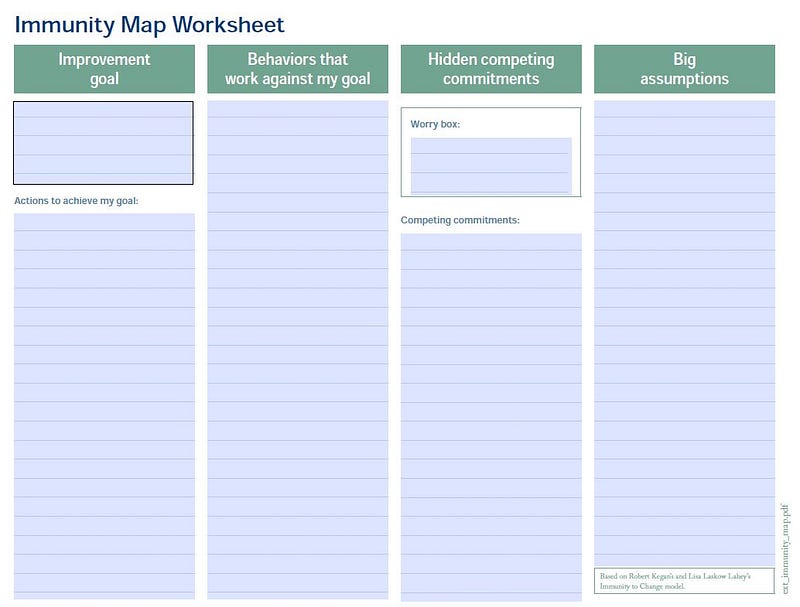
You can download a pdf version at the link provided above. But here it is again just in case.
Looks pretty simple, right? Just a few columns and headings and seems to be pretty intuitive. You need a goal. Okay. My goals is to lose weight.
You then need to list behaviors that work against your goal. Fair enough. So for me, eating Twinkies is a behavior that works against my goal to lose weight. And the action to achieve that goal is to stop eating Twinkies. Hooray! I’m halfway done!
This is so easy.
Harder Than You Think
But I had mentioned before that this tool shouldn’t be used in solitude. You need to engage other people in this. Because the real truth about our stubborn resistance to change is that we likely have too audacious of a goal to start (and thus need to shrink the change) or we don’t have a clear goal that can really truly motivate us.
More importantly, the goal itself, in this exercise, shouldn’t be about an endpoint or destination. This is wildly counterintuitive to anything we typically read. Usually, the focus in change efforts is all about boiling down our work into S.M.A.R.T. goals for continuous improvement. But again, I’m assuming a different context here. In these instances of stubborn internal resistance, your psychological immune system laughs at all those tricks and tactics. You’ve already tried those things. You’re past the point of all those things highlighted in the resources I provided above.
This effort has grown into something more difficult. It is about improvement, forward motion, rather than absolute arrival. As our authors write:
[Your goal] should be about getting better at something, and not itself be a result or an outcome. ‘Being less controlling’ is not an improvement goal; it is a result or an outcome. ‘Getting better at being less controlling’ is OK, but ‘Getting better at giving more control to others’ is an even better example of an improvement goal , because it names what you can do to become less controlling.
That probably sounds very nuanced and it is. And I could go on for many pages about the art and science of writing a goal statement. It’s quite boring stuff! But this is why you must engage other people in this process. They can help give you permission to set an improvement goal by helping you see what behavior you should stop doing. More importantly, they’ll likely give you a sense of what behavior they’d like you to start doing.
Depending on the situation, be it for work or home, friend or family, ask questions like: What improvement would help us have a stronger relationship? What can I do to be a better member of the team? With all that you know about my habits, how can I become healthier?
These are just sample questions. Illustrations. The idea here is to explore your motivation for change by learning what others would want to see with that change. Make no mistake: it’s still you that must change but it’s these other people who can give you insight into how.
Also, bear in mind that this isn’t mere information-gathering. You’re searching for a new, better way of framing your change effort. One reason why so many change efforts fail is because we’re just not excited about it. We don’t feel anything other than rote obligation. So our authors wisely suggest the following:
[Your improvement goal] should feel quite important to you, so that you imagine its realization — if you can achieve it — as personally valuable, desirable, or powerful.
Personally speaking, nothing sparks those feelings more than when I get validation from others that this goal or effort is right, true, and useful to them. We tend to have plenty of internal motivation within ourselves (after all, here we are reading this material) but that isn’t enough to override the psychological immune system.
Reasonable Fear
For all the work that these first three columns require, it’s the last two columns that truly test your mettle. I’ll only cover this briefly but I sincerely urge you to explore this further in the resources linked above and, of course, in this information provided by this beautiful book.
When you define your hidden, competing commitments, you effectively unearth your psychological immune system. You find the ways in which that system has been applying “the brake” on your change effort. As our authors would say, your “immunity to change” is discovered.
But what are these competing commitments? How do you identify them?
It’s relatively easy. You start with “the worry box” trace back to the behaviors identified in Column Two that work against your improvement goal. As our authors write:
In the worry box, name the fears and worries that come up when you imagine doing the opposite of each thing you listed in Column 2.
So in my simplistic example of eating Twinkies, you ask yourself: why am I afraid of stopping? Frankly, the reason I am afraid of stopping any bad eating habit is because I’m afraid I will lose one of the remaining sources of immediate happiness. It’s got nothing to do with weight loss. It is the emotions and the affective forecasting that keeps telling me I’ll be miserable.
Seen in this light, we come to understand why we’ve been resistant to change. It’s a very logical, rational thing that our mind is doing to keep us happy. As our authors explain:
A central idea in the immunity to change practice is that we do not merely have these fears; we sensibly, even artfully, protect ourselves from them. No one wants to feel fear or worry.
Seth Godin has advised you stop avoiding the fear and dance with it instead. And like so many of his beautiful, cryptic messages, it can lead one to wonder … how do you dance with fear? Kegan and Lahey give us the answer. You use this process.
Assumptions, Both Good and Bad
Next comes the most illuminating part: you must unveil the core beliefs and values that have led you to this place of fear. In the case of eating habits, I can tell you that my fear of losing food (Twinkies) as a reliable source of happiness is derived by my central assumption that food makes me happy, that there is no other reliable source of happiness, and that I have a sweet tooth, and that I love sweet things.
None of that is an absolute, unchangeable fact about me. It’s just a hard-wired assumption that I’ve fostered my entire adult life after years of living very poor without any reliable diet. The whole thing goes quite deep!
And this might seem like so much structured navel-gazing but remember: this is our chance to really find out what is fueling our psychological immune system. It isn’t just the fears; it’s the deeply-held assumptions that justify those those fears.
There is a tremendous amount of insight from the authors on how to really explore and test those assumptions. Trust me: you’ll get it only partially correct the first time around. We tend to overgeneralize or be a little too vague. Also, it’s important to know that some assumptions are absolutely justified and should be respected!
For example, some people are afraid of heights. Why? Because they know, deep down, that one false step could mean death. That is literally true. The underlying assumption, however, is that this false step is deemed more likely than it really is. So many people fight against their immunity to change, and overcome this fear, by undergoing exposure therapy. This type of therapy helps people test those assumptions and find the truth and the fiction within them.
So again, testing these assumptions is very important. I highly recommend that you work with a trusted partner and use the tools the authors provide in their book.
And if that’s a bit too difficult, then start by talking to others who don’t operate with your assumptions. Simple methods of surrogation, a’la Daniel Pink’s insights in this transcript from a Tim Ferriss podcast, can help. Someone out there doesn’t eat Twinkies or any desserts of any kind. I can talk to that person and find out why it’s easy for them. I can also find out if they have any other way of deriving pleasure from food. Then I can see what, if anything, about my assumptions are justified or sensible.
Conclusion
I feel like I should mention the fact that I don’t actually eat Twinkies. It’s just an example. Not that I don’t like them. But I’ve moved past them.
Also, I should mention that this process is far more involved and nuanced that I can explain here. So again, try everything else first. Shrink the change, work through your sense of identity, try small experiments, make a pledge with a friend, put a wager on changing a behavior by X date for Y result. Do all those things from all those books I’ve highlighted in past work.
Then, when that fails (as it occasionally does), give yourself a gut-check. Do you really want to change? Do you really want to grow? If so, this is the next step to take. When done right, it will get you there. Not by changing behavior but by changing your paradigm, tackling your fears and assumptions, and rewriting your psychological immune system.
It’s work worth doing. When the circumstance dictates it. And the growth that comes afterward is beautiful. If there’s anything that leads to a true adult transformation, I think this is it.


