
How to Calculate the Bid-Ask Spread Percentage
“We offer the lowest and tightest spreads! Enjoy zero commissions on all your trades if you sign up now”
Says every broker ever. But how can every broker offer the “tightest” spread…when all their market makers are competing in the same arena?
Of course I know it's a marketing gimmick, but have you ever wondered how to calculate the bid-ask spread percentage?
Fret not because it will be exactly what we will be talking about here.
To preface, the bid-ask spread is one of the most important costs that frequent traders have to take into consideration. It's not just all about trading commissions guys, there are many other hidden costs too! And the bid-ask spread is one of the most insidious. This is why knowing the bid-ask spread will aid you in understanding the true costs of all the purchases and sales you make in your portfolio.
To easily calculate the bid-ask spread percentage, simply take the bid-ask spread and divide it by the sale price. For instance, a $100 stock with a spread of a penny will have a spread percentage of $0.01 / $100 = 0.01%, while a $10 stock with a spread of a dime will have a spread percentage of $0.10 / $10 = 1%.
Now that you know how to calculate it, let’s dive into why it is important — beyond just the fact that it's eating away at your money.
The bid-ask spread exists because, at any one point in time, the stock market is composed of many buyers and sellers. When two different parties agree on a particular price at any one point in time, a trade goes through on the automated broker. But how exactly do these prices flash on your screen and how exactly do they go through?
To facilitate efficient trades, financial institutions take on the role of market-makers for stocks, posting two different prices, a lower one at which they’d be willing to buy the stock, and a higher one at which they’d be willing to sell it.
The highest price at which a market-maker will buy the stock is known as the bid, while the lowest price among those willing to sell is called the ask. The interval between those two prices is the bid-ask spread.
For highly liquid stocks (liquid being stocks that have huge volume and are frequently traded within a day), the bid-ask spread can be extremely small. For example, the shares of perhaps one the most popular index funds in the world, the SPDR S&P 500, typically trade with a bid-ask spread of a penny per share. Here’s a look at the typical price action for SPY in a day.
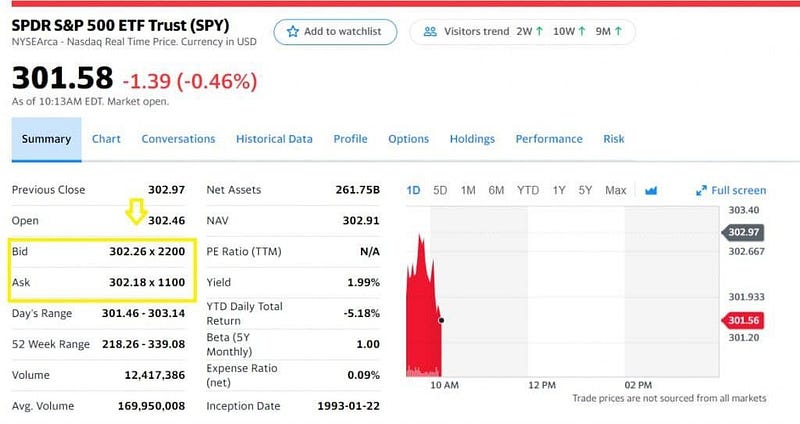
This is also exactly why highly liquid stocks such as the FAANG stocks or popular indices such as the QQQ/SPY are commonly touted as traders’ playgrounds and are commonly used as textbook examples or practice grounds for new traders trying to master the art of trading.
However, for stocks that happen to be illiquid, the spread can be as wide as a few dollars. Since you’ll rarely buy and sell a stock at exactly the same moment, it can be hard to understand the impact that the bid-ask spread has (unless you are a serial day trader of course). One easy way to think about it, though, is to assume that the real current value of the stock is halfway between the bid and the ask. If you buy 100 shares of a stock with a spread of a penny, then the added cost from the spread will be 100 x $0.01 x 1/2, or $0.50. For a larger transaction of 1,000 shares on a stock with a bid-ask spread of a dime, the cost is much higher: 1,000 x $0.10 x 1/2, or $50.
This quickly adds up when you are making multiple trades within a single trading day itself. And over time, can eat away at the profits in your account more than commissions ever could. The bid-ask spread percentage gives a good indication of how liquid a stock is and how much danger there is in using market orders to buy and sell shares for your portfolio. Thus, knowing what constitutes the bid-ask percentage and knowing how to use it can make all the difference between a profitable trader and an average one.
Like what you are reading? Follow us here and here for more! — Marcus