
How to Buy Better: The Power of Purchase Scheduling
The story of our purchase tracker, where we want it to go, and why we think it’s worth building
The Problem
Big purchases are challenging because:
- We struggle to reflect on them
- We purchase for the wrong reasons
- Big purchases have an out sized impact on our budgets.
Reflection
Big purchases are useless to reflect on after the fact, but hard to reflect on in advance. Thanks to their size, we don’t make big purchases often. I don’t buy a new standing desk every week. Thus, reflection afterwards doesn’t lead us to better decisions. Front-loading reflection is the ideal, but how do you reflect on a purchase you haven’t made? Since reflecting beforehand is unclear, default to knee jerk buys.
Wrong Reasons
Much of our mistakes start with the fact we buy to increase happiness. The problem? Unless our purchase fixes a clear problem, we grow used to our new purchases. Our happiness is like a buoy — always trying to return to the same level. Only by solving a long term problem (like being unable to stand and work) do we impact long term happiness.
Outsized Impact
Another aspect is big purchases have unusual impacts on our budget. They are some of the riskiest things we do, yet often we give them the least amount of thought. That concert you impulse bought tickets for? That couch you decided you needed to have?
Another aspect is big purchases have unusual impacts on our budget. They are some of the riskiest things we do, yet often we give them the least amount of thought. That concert you impulse bought tickets for? That couch you decided you needed to have?

Levers
- Ease of Input
- Ease of Reflection
- Visualization
Solution Built
The long term solution is a web app to act as a central place for perspective purchases. As it stands, your “Wish Lists” drift around a thousand services, from Amazon to Apple. Even if you choose to shop only at Amazon and only have 1 wish list, that list is not well visualized. Nor is it there for anything other than making you buy more things. The ideal is a calm, centralized location to reflect on purchases before you make them.
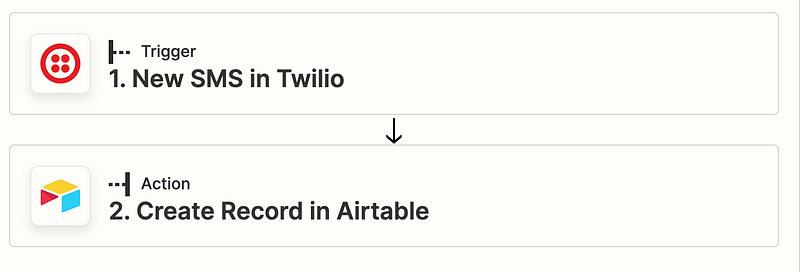
While I’m working on the web app, I’m using no code tools to build a temporary solution. At Jimmy & Neil Have Problems, we call something like this, which can be built in under an hour, an alpha. Airtable is my database and texting (via Twilio & Zapier) is my input mechanism. So far, the solution works well enough, as I’m able to share a URL via text to Airtable from my phone as I browse.
Levers Pushed By Solution
Input
Short Term
I used Zapier, Twilio, and AirTable as it was the quickest path to the required features. Using Twilio means I get iOS’s built in sharing capabilities. Thanks to Siri and the share-ability on web pages, input is easy for low effort. The fact that Messages is on my laptop means I can also send things to AirTable from my computer as well. For now, this is more than enough.
Long term
Long term, I’d love the input to be via a web clipper Chrome Extension. A Chrome Extension would be a 90% solution as a large majority of my shopping is done from my computer. Clipping price, name, and URL would be sufficient.
Ease of Reflection
Short Term
Reflecting on your purchases before making them should be seamless and easy. In my first version, I do not have an explicit way of making this happen. What I’ve found in working with my setup is that my budgeting app serves as an informal form of reflection. When I set the status of a purchase to saving in AirTable, I start a savings category in my budget. Seeing it on my budget prompts me to reflect throughout the months of saving. Do I need it? Could that money go elsewhere? Is there a cheaper way to test the use case?

Long Term
Down the road, I’d love to use spaced repetition to help me remember the purchases I’m considering. Periodic reminders prompting me to reflect on the purchase I’m considering. I’m hoping that I would find interesting time based data here. Did I want to buy it only for a couple weeks? Why? Is my desire durable across time? Tracking data like this across time is what might help us start to better understand our buys.
Reflection best done together, yet many of our big financial decisions are solo. There’s so much research out there showing we don’t make good decisions alone. In the final version of the app, other users could to rate your perspective purchases, suggest alternatives, and more.
Visualization
The ideal for visualization is to allow for better prioritization, reflection, and clarity. Centralizing purchases in one places creates the opportunity for new types of visualizations. AirTable supports a couple of them, including a kanban view seen below. My ideal visualization though, is purchase scheduling.
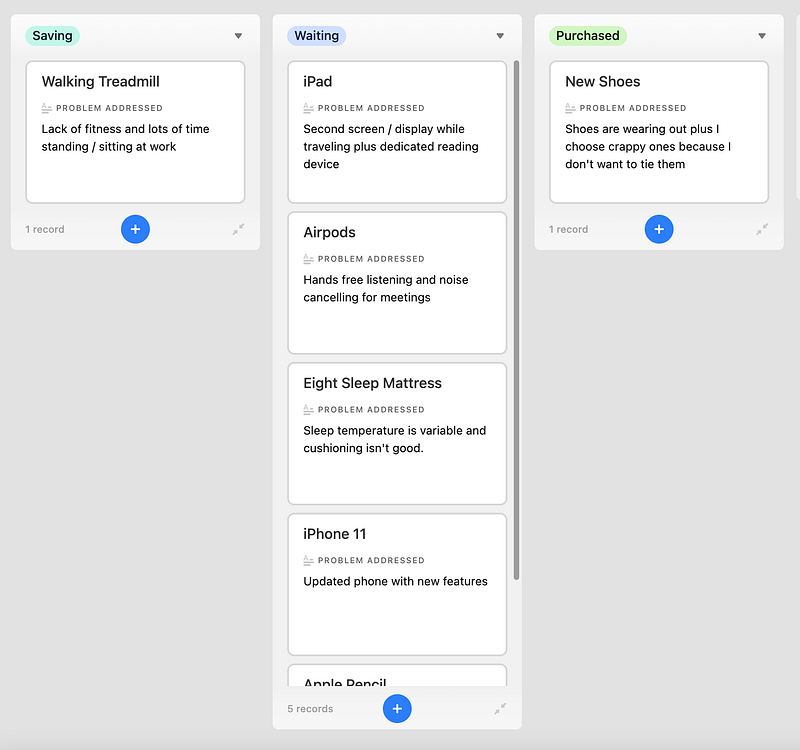
Scheduling purchases is a huge unlock for visualization and beyond. What if our budget wasn’t about money, but time? Thinking about buying things in time helps us visualize them in the context of our lives. Yes, I want an iPad, but a treadmill should come first since I’m not in the best shape. Yes I want a new MacBook Air, but I don’t want to spend 9 months saving for it. Prioritizing becomes thoughtful and easy, no longer a victim to whim.
Should We Continue?
Based on the utility of the Airtable, YNAB, Twilio, and Zapier setup, this is worth continuing. Especially since my MVP solution requires so little upkeep. It took about 30 minutes to setup in total and requires little to no maintenance.
As for the web app, it’s worth continued work for professional development purposes. I’m on the fence about whether this needs a dedicated web app at all. Could a Chrome Extension / Zapier combination get me further, faster? But, for the sake of learning, I’m going to continue working through the project.