
How to Build Your Positive Framing Muscle
Strengthen the quality of your life by changing your inner soundtrack

As a Hollywood studio executive, I learned how important music was in the framing of a story. Music could change the same collection of events in any movie from a comedy into a horror show.
For me, a movie never came to life until the film was in a scoring session. The sometimes-flat energy of film took on active life when films like Flashdance and Footloose were in the final stages of post-production and music was added and mixed.
As new scientific and psychological evidence indicates, the way we frame past events and current events is much like a soundtrack in film. That framing can make our lives a comedy or a horror show.
Framing has everything to do with the quality of our lives.
Failure is an opportunity. ~ Lao Tse
Fight or Flight: The Catastrophic Mind
Have you ever had a nightmare that made you shoot right out of bed? The “instinct” that emerges is most likely a vestige of humankind’s early development as hunter-gatherers, approximately 70,000 years ago. We had to run like hell from ancient predators, including cave bears, hyenas, and even eagles.
It is the ADRB2 gene in humans that encodes our tendency for this fight-or-flight response into the very fiber of our bodies. The associated release of adrenalin may even be tied to superior athleticism in certain athletes. Even though we have little use for ADRB2 in today’s culture, it can still muddle our mind with that “sky-is-falling-head” or what is known as the Catastrophic Mind.
With the mindfulness trend, we focus our energies on the wellness and alertness of the brain. But consciousness is more than just the mind—it is the entire body. Our being is wired into not only our head, but our five senses and our very muscles and skin. We are beings with embodied consciousness.
When this fight-or-flight response is in full flush, our hearts beat wildly, and anxiety is pushed all the way down to our toes. That’s part of consciousness, and that’s what, in part, positive framing wrestles with: evaluating the situation rationally and considering alternatives that promote a more measured response.
The Greatest Score Never Heard
As a Hollywood studio executive, I learned early about positive framing in dealing with artists. I discovered the ethos of great artists was often troubled and frail and that it was important to deliver outcomes with positivity.
The brilliant John Barry, the composer of Out of Africa and The Lion in Winter, wrote the score to a Paramount movie, Golden Child, starring Eddie Murphy. The score was majestic, powerful, and iconic. I remember hearing it against picture on the scoring stage on the Paramount Lot. My eyes pooled with tears. It was one of the greatest scores I had ever heard.

But when we previewed the picture, the audience so loathed the score, they singled it out as the biggest negative in the movie. Eddie Murphy was a comedy icon, and the audience wanted a lighter tone to the story. I had to call John Barry, a man whom I had admired since childhood when I heard his score for Born Free, to let him know we were abandoning his score (which we had also paid a fortune for).
“The audience wants a score that follows the star they know as a comic,” I said. There was silence on the other end of the phone. “I understand,” he replied.
John Barry had spent four months on the score, and we were throwing it out. I did not tell him that the audience hated the score, as that would have been negative framing and emotionally damaging. Rather, I told him the audience desired a score that represented the tone of the star.
That’s the thing about framing. Both positive framing and negative framing are true. But by accentuating a positive approach, it presented a perspective that was more easily absorbed by John. His music framed the Eddie Murphy movie as a drama, but the audience came to see an action-comedy.
Positive Framing vs. Negative Framing
Recent evidence discovered in clinical trials conducted in the Netherlands at the University of Groningen suggests that physical activity can be more effectively promoted to older adults with positive messages about the benefits of activity rather than with negative messages about the risks of inactivity.
For example, there are two ways at looking at Tai Chi, one of my favorite disciplines, and both are true:
Tai Chi (positive framing) is a physical activity program in which you make fluent movements. Tai Chi is focused on improving your body awareness. By increasing your body awareness, you will become more relaxed and flexible. You will perform daily tasks more easily.
or
Tai Chi (negative framing) is a physical activity program in which you make fluent movements. Tai Chi is focused on body awareness. Not listening to our bodies carefully will lead to increased stress and stiffness. It will be more difficult to perform daily tasks.
In two recent university studies, older adults who received positively framed messages about the benefits of physical activity increased their exercise engagement significantly over their peers who received negatively framed messages about the risks of failing to exercise more.
Studies have also shown that negative framing will generate unnecessary anticipatory anxiety. Positive framing reduces stress, which inhibits the attention directed toward the seemingly adverse event or condition.
Positive framing simply gives you better outcomes.
Effects of Positive vs. Negative Framing
The fact is, you can view anything from at least two different frames, and both frames are true. Positive framing just happens to be healthier and more conducive to happiness. Positive framing does not produce the same fear that negative framing does—which, as science indicates, we are hardwired to respond to with a stress reaction thanks to our genome with ADRB2.
In his wonderfully succinct book, Focus: The Hidden Driver of Excellence, psychologist Daniel Goleman breaks down the effects of negative framing versus positive framing:
Negative Framing
Slows down brain coordination
Makes it difficult to process thoughts and find solutions
Hinders creative ability
Decreases activity in the cerebellum
Impacts the left temporal lobe (fear factor), affecting mood, memory, and impulse control
Positive Framing
Synapses (areas connecting neurons) increase dynamically
Increases mental productivity by improving cognition
Intensifies ability to pay attention, to focus
Improves ability to think and analyze incoming data
Improves ability to solve problems quicker and enhance creativity

Framing and Your Inner Voice
But what about your own self-talk? In the course of the day, your consciousness frames thousands of past, current, and future events and circumstances.
Framing is not about what is fact. It’s about how those facts are described.
Positive framing allows us to move forward with gusto; positive framing is about gain.
Negative framing often stops us in our tracks—it’s about loss.
The brain science is clear — focusing on negative thoughts doesn’t take us anywhere positive. We throw ourselves into a neuro-chemical anxiety soup and are forced to paddle-on.
At a functional level, being focused on negative thoughts actually slows down brain processing speeds — which is why, for example, when you are upset it’s harder to put your thoughts together and harder to find a positive solution to a problem.
Through framing, a negative outlook might very well become your negative outcome.
An Example of Positive Framing
Musician and thought leader, Sean Lennon, son of John Lennon and Yoko Ono, brings up an example of positive framing with music historian, Eliot Mintz:
I asked one of my relatives to send me photos of an event we had together, and I expected just a couple of pictures and instead, I received like a thousand photos in a Dropbox file. My immediate instinct was to think (and this is just a superficial example) “Oh, why did you send me so many pictures, it’s such an annoyance, I just wanted 2 pictures.” You can get annoyed at the person. Or I could say, “How nice that you sent me more pictures because of what I expected because now I can select out of the thousand the best 2 shots which I wouldn’t have been able to do if you had pre-selected them for me. It gives me a level of control and detail that is a gift.”
Building the Positive Framing Muscle
It’s impossible to say that positive framing comes naturally. However, we do know that it provides us with a deeper sense of well-being, which means less stress and less fear.
That’s why we have to practice routinely so it becomes a habit. To build muscle, we need repetition, discipline, and some willingness to stay at it. Anyone who has ever worked abs knows that exercise is rewarding but not always fun. The same is true for working the “muscle” of positive framing.
Here is the methodology I used to transform myself into making positive framing part of my ethos:
1. Look for personal examples.
Think of those negative events that turned out to be a beginning or catalyst for positive change in your own life. Delve into your own experience for specifics; especially consider situations where there a was a sense of upheaval in your life.
In my case, I recalled how I had lost a job, and how that led to new and different opportunities that helped shape me into a more satisfied and a more complete human being (less of a workaholic).
Spend some time to make some notes and develop a dozen or so cases where adverse situations brought about better circumstances.
Once you have a set of personal examples, then positive framing isn’t an abstract exercise anymore, but something real. You can feel it and you can connect with it as an ongoing practice.
2. In demanding circumstances, recall your personal examples.
Shit happens. In the midst of it, try to remind yourself how tough circumstances led you to new vistas.
How do you remind yourself? Find a trigger that will help jog your consciousness to reconsider positive possibilities.
My trigger is a stone I found in Spain. I carry it my pocket to remind me of the times I’ve overcome adversity and grown. I hardly think about it anymore, but it’s always there in my pocket to remind me that I stand on solid ground—and to consider a positive reframing of the current situation, whatever it may be.
Personal recall became my default reflex because I retrained my consciousness to know there were always active gains in challenging moments.
3. Change out your adjectives and nouns.
This is crucial! That old adage “As a human thinketh, so the world is formed” has a lot of wisdom in it.
Words have incredible power over the psyche. With a pencil and pad, I made lists of words I used to negatively frame either people or circumstances. Then I searched for replacement words that had less of a pejorative spin I could use in positive framing.
Then, I put these substitutions into my dialogues. These new words were used not only with others but also with myself.
Initially, I had to be extremely aware of these replacements during every conversation. But the forced habit grew into a new behavior pattern. Here are some of them:
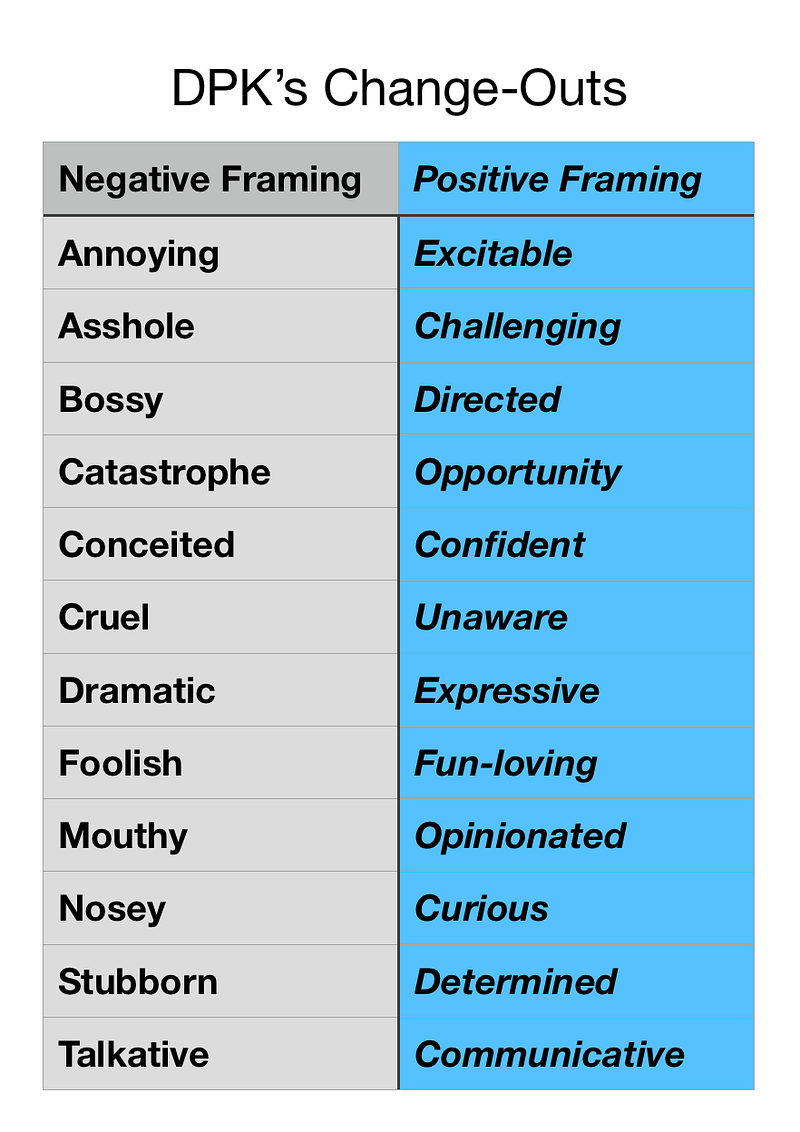
I found this new framing not only affected my sense of well-being (I was calmer), but I found that people around me were treated with more respect. I didn’t trash talk. Instead, I aspired to elevate. I liked it. People liked it. My community grew in warmth.
I wasn’t being dishonest. I was just speaking through another lens. To myself, I was no longer an asshole. I was cool.
Make your own list of negative descriptors you hear in your head and create more positive alternatives. Keep this list where you can review it often (for example, before you begin responding to the day’s emails) and develop the practice of reframing with your new words and phrases.
4. Take stock before bed in the events of the day.
Every night, I sit with a pad of paper and reflect on the day. I write down at least three things that I found positive in my waking time and why I am grateful for them.
This not only supports bringing meaning and body to your day’s activities, and keeps you focused on positive possibilities, but it is also a great way to slip into your sleep period.
Such reflection helps lead to what I like to call “body calm,” in which you go to sleep in peace rather than ambiguity, or worse, confusion.
Conclusion and Final Thoughts
The challenge is this: How often can we positively frame or re-frame events we instinctually frame negatively that lead us to that awful catastrophic mind?
Of course, there are certain tragedies and losses that cannot be positively framed. However, in 90% of the things that happen to us, we choose how we view them.
The methodology is to cumulatively compile these positive frames until you have built a new “muscle,” just as you would in traditional exercise. Repetition, practice, and staying at it are the key components to help raise the bar on the quality of your life.

As many of you who read me here on Better Humans know, I am a student of Joseph Campbell, the mythologist. Recently, I heard an archived audio conversation between Joseph Campbell and New Dimensions radio host, Michael Toms. In this conversation, Campbell speaks about the ultimate positive framing when he references Frederic Nietzsche’s concept of the love of your fate.
I actually made my first meme (below) with Campbell’s words because it had never been published in print before. More importantly, since it stirred me, I knew it would touch others.
In sharing it with my friends on Facebook, I discovered it produced several thousand shares and circled the world in a mere few hours. I now have the honor of sharing my teacher’s words with you as well.
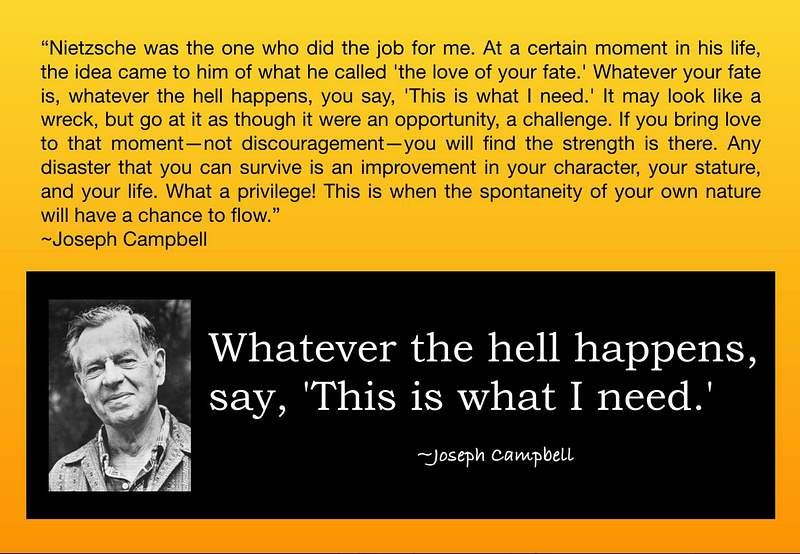
We live in challenging times. While Campbell’s words have no chords or notes, there is still a beautiful music in his thinking—like how music frames a story in film.
In turn, it is my hope this piece about positive framing helps shape your own story.


