How to Build Killer Prompts for Chat GPT
The Ultimate Guide to Level Up Your Chat GPT Prompts

In this article, we are delving into the singular formula indispensable for mastering prompts on Chat GPT and Gemini.
Prompting stands as a pivotal skill to acquire, yet the query remains as to why certain prompts yield outputs of a generic nature, while others furnish precisely what is sought.
Subsequent to this realization, I have dedicated countless hours to partaking in prompt engineering courses and integrating the acquired knowledge into my daily endeavors.
In this exposé, I am divulging the six fundamental components that constitute a well-crafted prompt, enabling you to employ this formula consistently to generate outputs of superior quality. Initially, it is imperative not only to comprehend the six constituents — Task, Context, Exemplars, Persona, Format, and Tone — but also to acknowledge the hierarchical significance among these elements. To elucidate this point, let us consider a straightforward example:
“I am a 90-kg male give me a 4-month training program.”
The first part comprises Context (I am a 90-kg male) followed by the Task (give me a 4-month training program). The rationale behind elevating the task in the hierarchy is that even if solely the task is provided without the context, a degree of meaningful output ensues:
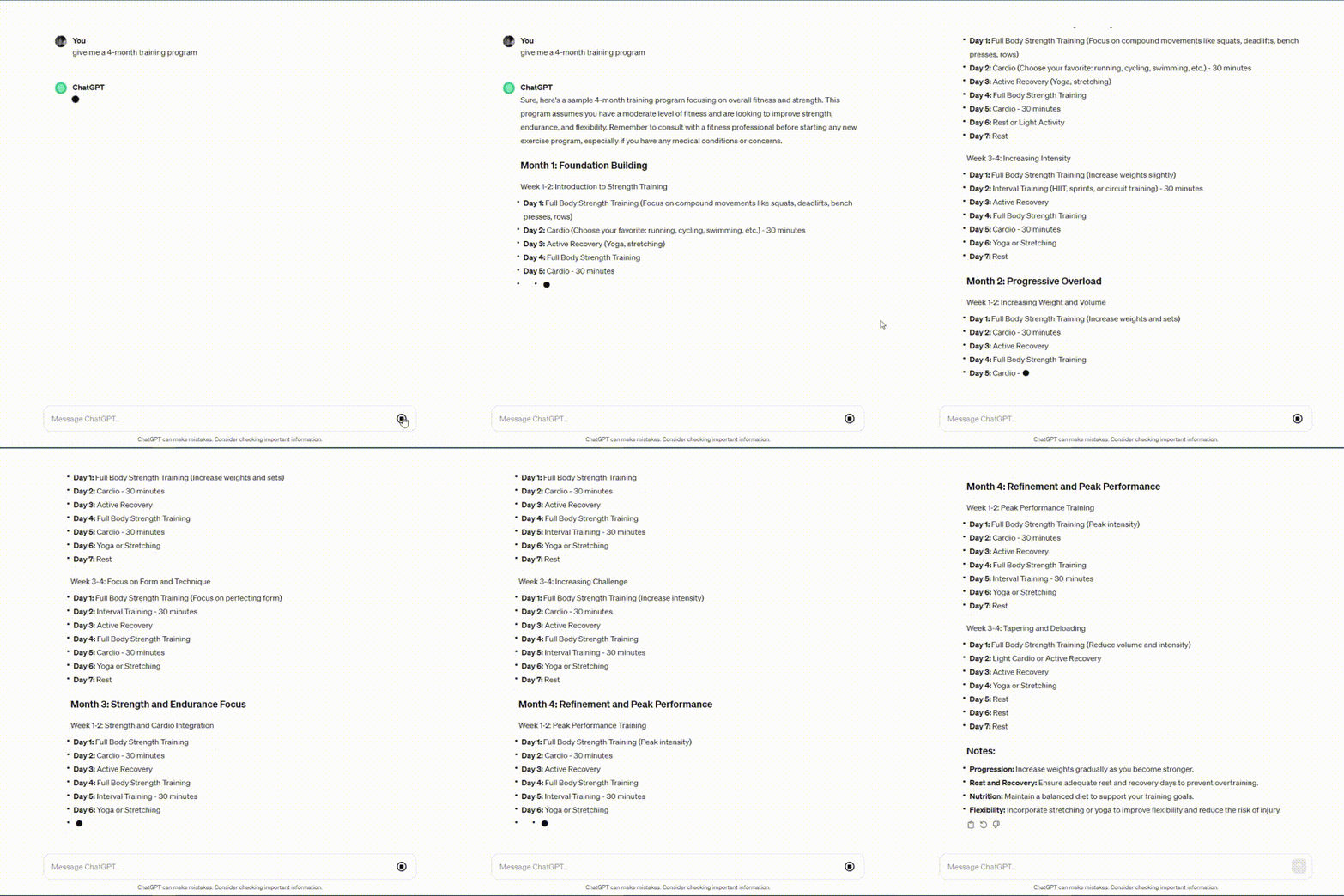
Conversely, presenting solely the context without the task yields little outcome:
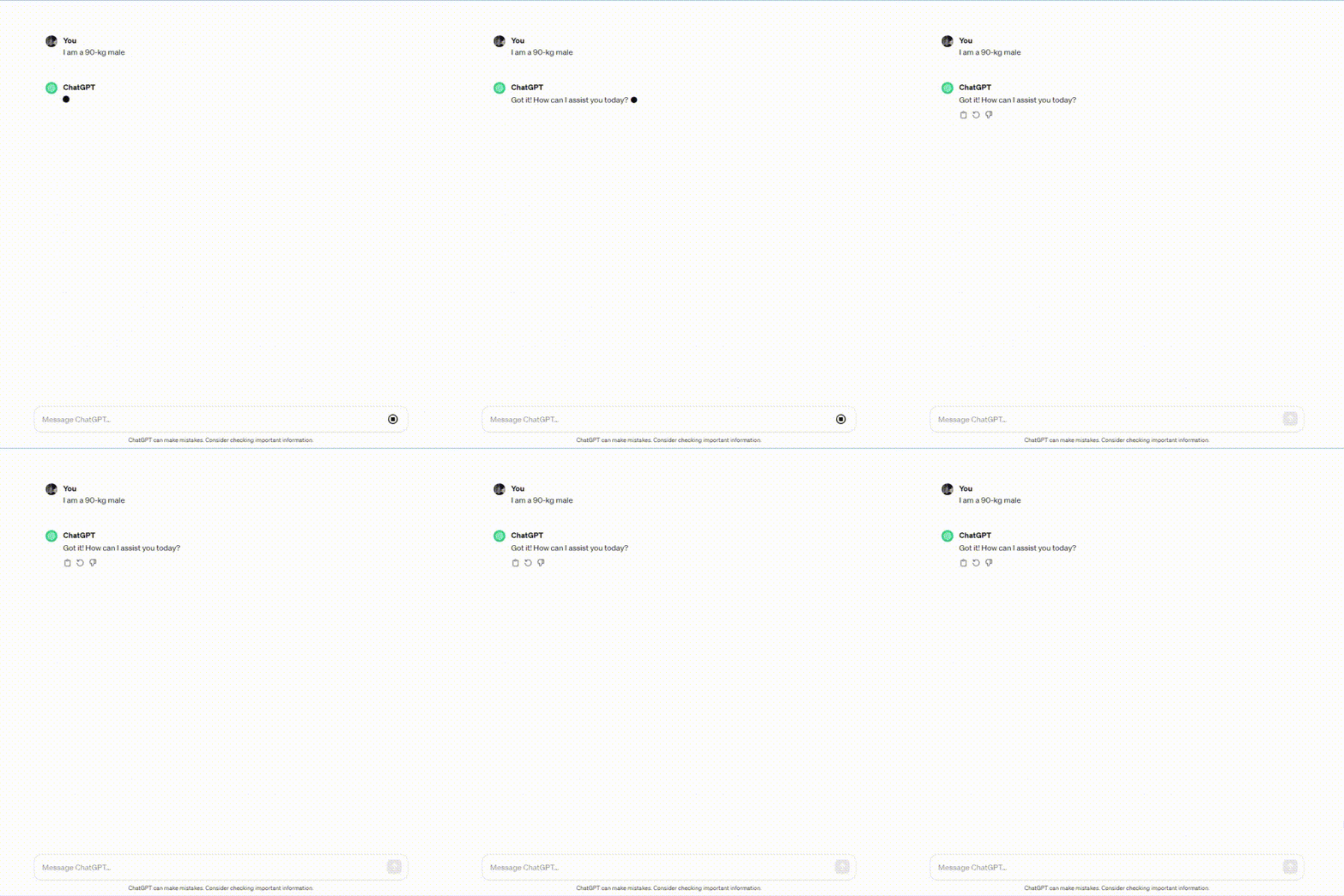
To elucidate further, the inclusion of a task in your prompt is mandatory, relevance of context and exemplars is important, while the incorporation of Persona, Format, and Tone is deemed beneficial. When formulating your prompt, it is advisable to adhere to this mental checklist.
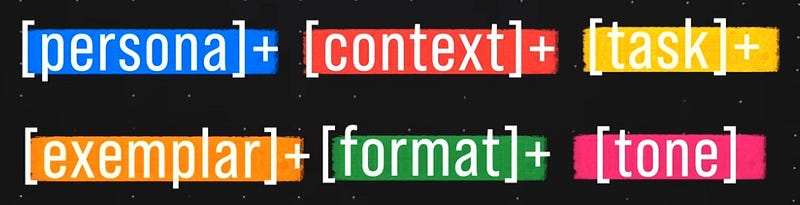
This formula is intended to serve as a constant prompt to include just the right measure of pertinent information when crafting prompts. As you’ll see next, not every prompt necessitates all six components to produce a commendable output.
Let us now dissect each foundational component with specific illustrations commencing with the Task.
— Task
The guiding principle here is to always initiate the task sentence with an action verb:
✔️ Generate
✔️ Provide
✔️ Author
✔️ Analyze
and clearly articulate the desired outcome. It could encompass a straightforward task such as:
“Generate a 3-month training program”
or a multifaceted 3-step task like:
“Analyze the following user feedback, disclose the top three insights, and categorize the feedback based on the team responsible for follow-up”
— Context
Moving on to the second component, context, proves to be the most intricate as there exists an ostensibly infinite array of information that could be provided. Hence, I have discovered that posing these three inquiries proves immensely beneficial in ascertaining the optimal amount of information required to elicit a favorable response from Chat GPT:
✔️ What is the user’s background?
✔️ What does success entail?
✔️ What is the prevailing environment?
Returning to the workout scenario, we now present:
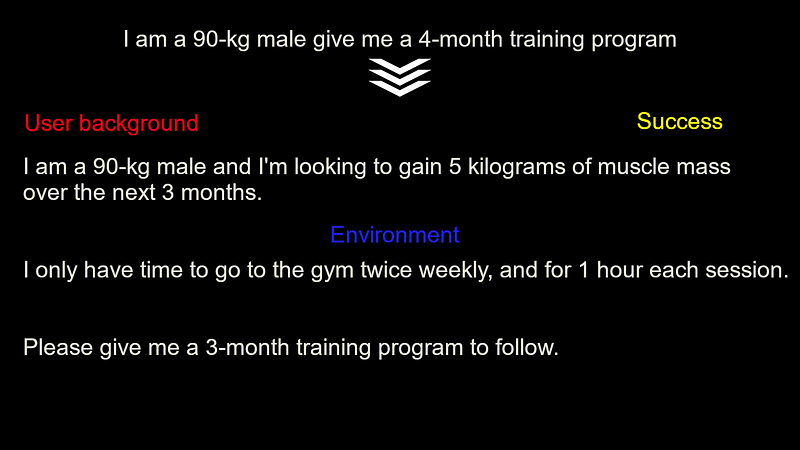
Admittedly, additional background information could have been included. However, the essence of maintaining efficiency with Chat GPT lies in offering just adequate information to confine the myriad possibilities.
— Examplers
Transitioning to the exemplars component, which essentially refers to examples, research on large language models (LLMs) has demonstrated that integrating examples within the prompt significantly enhances output quality.
Starting with a simple example, think of a party written bullet point from a resume.

which is actually best practice by the way. So actually do this in your resume.
Commencing with a basic illustration, consider the following resume bullet point:
“I decreased the Company expenses rate by 10% by educating the Company staff on new saving methods, resulting in $100,000 rising income annually.”
This structure can be employed to request Chat GPT to rephrase the aforementioned bullet point.
Additionally, a more intricate example for interview preparation could entail soliciting Chat GPT to devise a response to an interview question:
Based on my own resume write me an answer to the interview question: “What’s your biggest weakness?” Use the STAR answer framework: Situation, Task, Action and Results. Here is my resume for reference:
OBJECTIVE
…
PERSONAL INFORMATION
…
PROFILE SUMMARY
…
EDUCATION
…
EMPLOYMENT HISTORY
…
Responsibilities:
…
RESEARCH
…
TRAINING
…
AWARD
…
PROFESSIONAL MEMBERSHIP
…
SKILLS
…
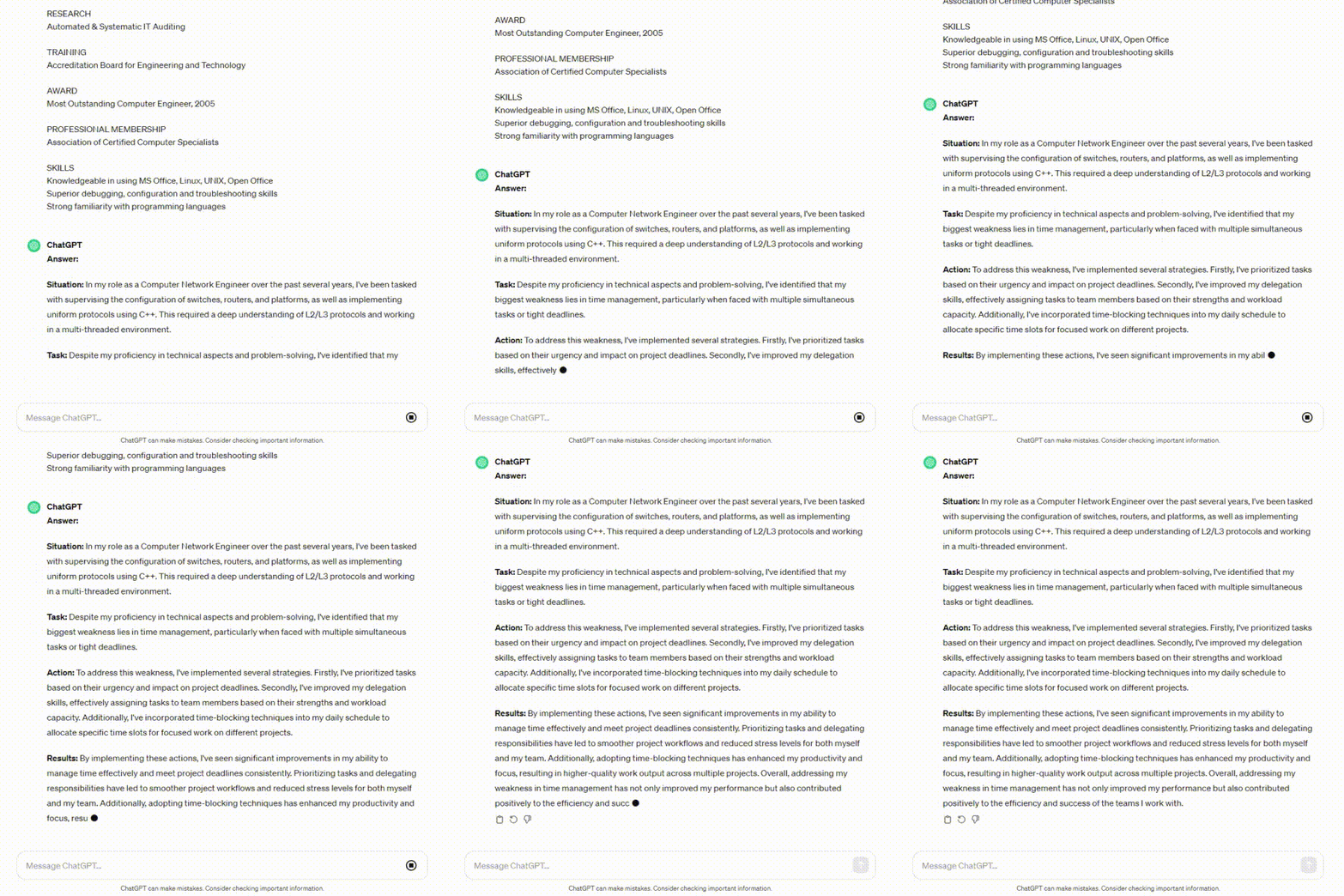
Here, instead of presenting a comprehensive interview response as an example, the STAR framework serves as a structural example for Chat GPT to follow.
The final example involves the creation of a job description. By providing context about the vacancy and instructing Chat GPT to reference an existing job description, the resulting output will adhere to the same structure and employ professional language, thus saving considerable time.
You are a hiring manager in he marketing team responsible for writing the job description for a B2B product marketing manager job opening.
Your team primarily focuses on increasing brand awareness for Spotify’s advertising platform with the goal of acquiring new advertising partners,
Please draft the job description using the format of the existing job description below:
Full job description:
…

The primary lesson here is that while exemplars are not obligatory for every prompt, integrating a pertinent example or framework substantially enhances the output quality.
— Persona
Transitioning to the Persona component, this essentially entails defining the ideal persona for Chat GPT and Gemini, someone whom you wish to have immediate access to for addressing the task at hand. Aka in simple words, who do you want the AI to be.
You’re an experienced psychologist with over 25 years of experience…
You’re a hiring manager looking for [position] on your team…
You’re senior sales manager in [company] responsible for…
Additionally, it is noteworthy that specific individuals can be named; however, optimal results tend to be achieved when the individuals are sufficiently renowned, such as Elon Musk
Act like the legendary investor Elon Musk…
or Mark Zuckerberg
You’re the master entrepreneur Mark Zuckerberg…
— Format
Moving on to the fifth component, Format, if you want to achieve an outstanding end result, the best tip is to close your eyes and visualize what exactly you want your final outcome to look like.
Supposed I have a bunch of feedback on an Instagram post and I don’t want to read each sentence so I asked Chat GPT to take all the feedback and output a table with three headers, the original feedback, the team responsible for following up, and priority.
We collected user feedback in Simplified English after an online event we run. Please categorize the user feedback based on which team needs to follow up: Marketing, Sales or Product.
Output in table format with column headers: Feedback, Team, Priority.
Here is the user feedback:
Marketing Team: 1. “Loved the event! The promotional emails were spot on.” 2. “An excellent social media presence leading up to the event.” 3. “The event graphics were eye-catching and drew me in.” 4. “I found out about the event through an ad, so marketing did their job well.” 5. “The event hashtag was trending — awesome job getting the word out!” 6. “I appreciated the reminders leading up to the event — kept me on track.” 7. “There was a lot of information on the event landing page and it was easy to navigate.” 8. “The event website could use some optimization for mobile users.” 9. “I enjoyed the post-event email with a summary of key takeaways — nice touch!” 10. “It was a simple and hassle-free process to register for the event.”
Sales Team: 1. “The event did not provide me with answers to some questions I had regarding pricing.” 2. “It was an informative sales demonstration, but I wish more emphasis had been placed on the benefits of using the product.” 3. “I’m interested in purchasing, but I need someone to follow up with me about custom solutions.” 4. “While attending the event, I spoke with a sales representative who seemed unsure of some of the features.” 5. “The sales team was friendly, but I didn’t receive a follow-up email after expressing interest.” 6. “I tried reaching out to a salesperson after the event, but didn’t receive a response.” 7. “My specific needs were not addressed in the sales pitch, which seemed a bit rehearsed.” 8. “I was hoping for more personalized recommendations from the sales team.” 9. “The contract terms are unclear to me, so I am still undecided about purchasing.” 10. “The sales team seemed overwhelmed during the event, which made it hard to get attention.”
Product Team: 1. “The product demo was clear and comprehensive.” 2. “During the demo, I encountered a bug which needs to be addressed.” 3. “I have some suggestions for new features based on what I saw during the event.” 4. “The product looks promising, but I’m concerned about its scalability.” 5. “During the demo, certain features that I had expected were not available.” 6. “The product interface was intuitive and user-friendly.” 7. “I appreciated the deep dive into the product’s technical specifications.” 8. “The product roadmap shared during the event got me excited about future updates.” 9. “If you could provide me with more information about the product’s integration capabilities, I would appreciate it.” 10. “Overall, the product seems solid, but I have some questions about data security.”
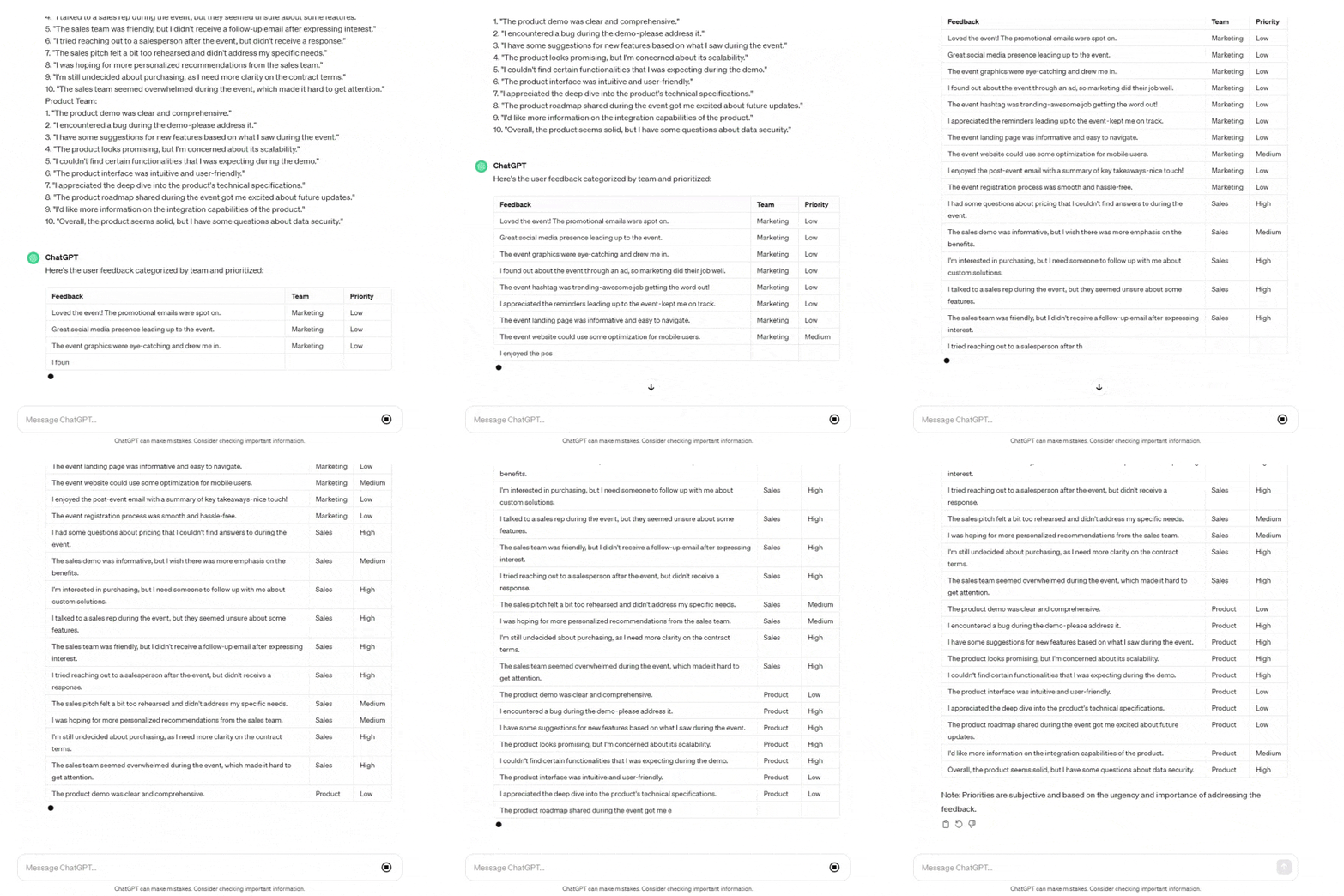
Now I can copy this directly and paste it into a Google sheet server parity and filter by team.
Other prevalent formats include emails, bullet points, and code blocks, however, paragraphs and markdown are deemed particularly advantageous for professionals, offering a concise and structured format suitable for various contexts. For example:
“Provide me with the three key takeaways from an extensive industry report and subsequently summarize by topic using H2 section headers. Take the following report as an example:”
— Tone
In terms of Tone, it is crucial to determine the desired tone– be it casual, formal, witty, enthusiastic, or pessimistic. While recalling an extensive array of adjectives and adverbs can be challenging, a recommended approach is to convey the intended emotion to Chat GPT.
For example:
“As I write this email, I am trying to make sure I don’t come across as too stiff and clingy so that I can be taken seriously. I would appreciate if you could provide me with a list of five tone keywords I may include in a prompt for Chat GPT”
By specifying the desired tone, such as “clear and concise language” and a “friendly yet confident tone”, one can effectively guide Chat GPT in tailoring the output accordingly.
Combining all these elements into a comprehensive prompt, consider the following example:
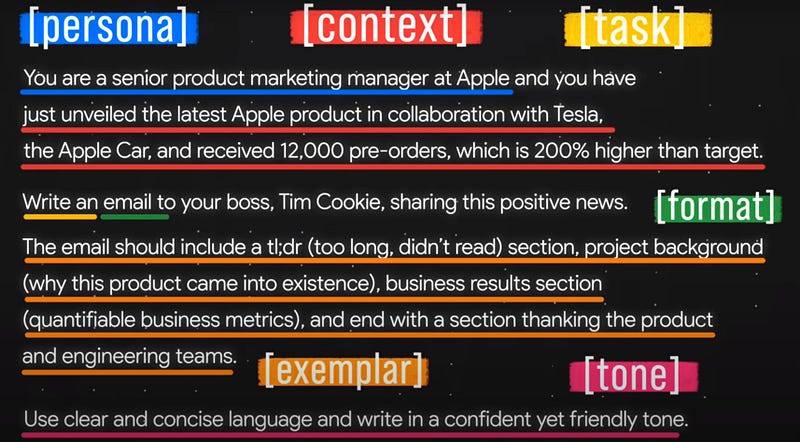
By providing a structured prompt of this nature, one can ensure a tailored and specific output, as opposed to a more generic prompt yielding a less refined result.
Takeaway
In the realm of AI-driven communication, crafting effective prompts is paramount to harnessing the full potential of Chat GPT models. The perfect formula for constructing these prompts involves a delicate balance of specificity, contextuality, and engagement.
By mastering the formula described above, creators can enhance user interactions, foster meaningful conversations, and optimize the utility of Chat GPT applications.
Embracing this methodology empowers developers, writers, and businesses to unlock the true capabilities of conversational AI and deliver exceptional user experiences.

This story is published on Generative AI. Connect with us on LinkedIn and follow Zeniteq to stay in the loop with the latest AI stories. Let’s shape the future of AI together!


