
How To Build Happiness from Top To Bottom
What (other) governments are doing to create happier environments
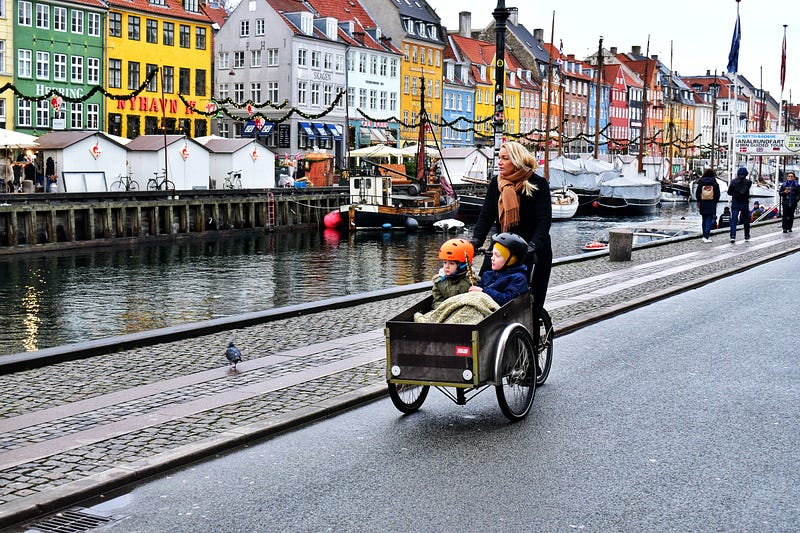
If you live in the U.S. and often find yourself stressed, overworked, or dissatisfied with your life, it’s (most likely) not you, it’s them.
This may come as a surprise, but somewhere on the way to providing “life, liberty, and the pursuit of happiness” the American government has taken the wrong turn. These days, we find ourselves with policies benefiting the rich rather than the common man, and the ideology promoting financial gain over well-being (and often confusing the two).
When spending a year in Denmark, voted the second happiest place on Earth (the U.S. landed at #19), I observed what a people-friendly government can do to actually provide happiness for its citizens. Since then, I’ve researched policies in Scandinavia and beyond to find similar results across the board.
It’s becoming more clear that GDP has little to do with a society’s happiness levels and the United States is a great example. Measuring well-being in dollars can only take you so far. Eventually, you’ll find yourself in a divided country full of struggling and anxious individuals, on the edge of a nervous breakdown.
City by city, state by state, we could revisit our policies and make them more people-centric, one by one, and watch the life satisfaction levels improve. There are places in the country that are already doing just that (looking at you, Boulder, CO) and the results are in.
Providing free healthcare
Free healthcare for all means having free time that’s not wasted on insurance plans, mountains of paperwork, phone calls, fights with insurance companies, and crying over medical bills. That’s the time that could be spent on family, friends, or hobbies. As simple as that.
Free healthcare also means having one less thing to worry about in life. And when you know that no matter what happens to you or your kids you won’t go into debt just to get help, you can enjoy life a bit more.
Every other developed nation has figured out this much. Why can’t we?
Developing pedestrian-focused cities
It’s well-known that physical activity improves not only physical but mental well-being. Yet if your entire life revolves around driving places it might be hard to find extra time to move. That’s why cities that invest in pedestrian and cycling infrastructure alongside public transport systems have higher life satisfaction levels.
This may come as a shock to many Americans, but being car-dependent does nothing to improve your well-being. However, if you were born into a car-obsessed culture, you might not know any better.
There’s an amazing YouTube channel that explains why North American cities benefit car manufacturers and not pedestrians and demonstrates how European cities are planned or re-planned to promote movement. I highly recommend Not Just Bikes to anyone who’s interested in urban design and its effects on people living in cities.
Providing access to healthy foods
Healthy food shouldn’t cost more than McDonald’s. Yet in the U.S. it does. Anyone who thinks this is normal or acceptable, has never traveled outside the country (understandably, since most people are too overworked and underpaid to afford such a luxury).
Even in London, the city known for its high cost of living, finding cheap healthy foods is easy, and junk food is never your go-to solution for a meal. Every supermarket chain sells ready-to-go healthy lunches for under five Pounds and the stores can be found every few blocks, even in the busiest and most expensive areas. Likewise, health-food chains like Itsu can be found all over London serving lunches for under ten Pounds and many as cheap as four Pounds. The list goes on.
My husband and I spent a few weeks in London last summer and it was the healthiest and cheapest eating out we’ve ever done. And if you travel across Western and Eastern Europe, healthy food options only become cheaper and more interesting.
Even in my husband’s native Denmark, one of the most expensive countries in the world, regular groceries are way more affordable than in the U.S. In the UK, and across Europe, many healthy foods are subsidized by the government, and affording them is never an issue.
Here, in the land-of-junk-food country, I’m disgusted by how few options are available to people on middle or low incomes, in both eating out and grocery shopping.
Those who eat well feel well, both physically and mentally. It’s not rocket science. Yet in the U.S. it might as well be.
Providing free or affordable education
Educated people make educated citizens who make better life choices.
Education shouldn’t be a point of struggle or a project to be saved up for 18 years. Quality education should be accessible to anyone who’s willing to study and not to the rich few. And begging for scholarships shouldn’t be the only way for lower-income kids to attend good schools or colleges.
Just about every government outside of the U.S. understands that free or affordable education is as essential for a country’s well-being as free or affordable healthcare.
Yet in America, we’re still fighting for the basics. Without the basics, happiness is for those who can afford it.
Providing maternity (& paternity) leave & subsidized childcare
Children are the future. Happy parents raise happier children who in turn make for a happier future. Yet another simple concept we struggle with in the U.S. As of today, we have the shortest maternity leave in the developed world followed by the highest rates for early childhood care and education.
While the rest of the civilized countries take it for granted that mothers need recovery time, dads need time to bond with babies, and both parents need affordable childcare, so they can return to work when they’re ready, we in America still expect our women to return to work broken, leaving their newborns with strangers, or forget about work altogether and become stay-at-home moms.
This barbaric approach leads to stressed-out parents, divorces, and fewer women in the workforce. None of these are happy scenarios.
Before we can talk about building true well-being, let’s look at what other countries have done to provide the basic needs of their citizens, leaving them more time and freedom to explore what happiness is.