
Book Notes | Practical Way
How to Build Atomic Habits: Tiny Changes, Remarkable Results
Atomic plan to build your new habits. What I learned from the book.
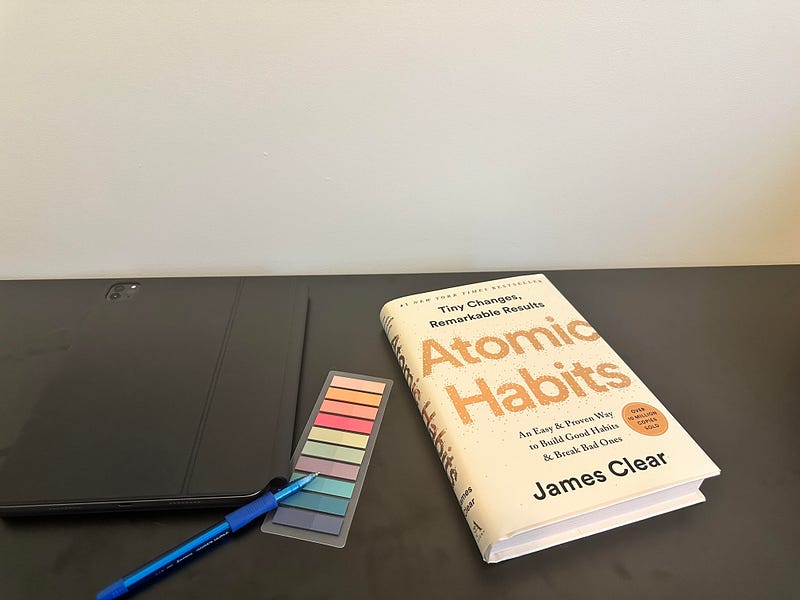
Here is my summary on building sustainable habits based on the book Atomic Habits by James Clear.
Atomic Habit is an excellent approach to changing bad habits and adopting healthy ones, demonstrating how tiny daily routines add up to compound over time.
Whenever we would like some change in life, almost everyone recommends significant changes that are not sustainable.
Let me be clear: they are not even doable initially.
It’s hard to develop solid reasons to change a bad habit to a good one. After reading the book Atomic Habits, I implemented tiny changes in my daily routines.
Here, I am going to share what I learned from the book.
Power of 1 % rule — Why do tiny habits make a big difference?
We believe that significant accomplishments need massive action.
However, even if we improve by 1% each day, we will be 37 times better by the end of the year, and conversely, if we fall by 1% per day, we will reach zero — the power of compounding.
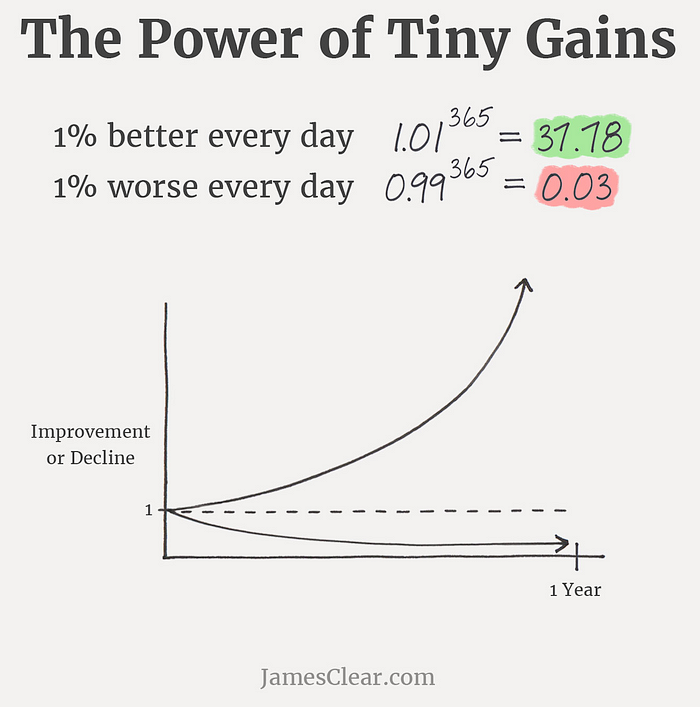
When we don’t see the consequences of our efforts, we tend to fall back into old habits.
But to foresee where we’ll end up, we need to grasp how our everyday decisions will compound 10 to 20 years down the road.
Don’t worry about goals; instead, focus on systems.
As James says in the book, “Habits are the compound interest of self-improvement.”
I think it’s pretty common that we do not see the tiny changes initially; at least, that’s the case with me, but we will see tremendous results if we keep doing it. Consistency is the key.
For example, if we start eating junk food each day and do not exercise, we can easily see the results within a few weeks or months.
On the other hand, if we start eating healthy food and exercising 3–4 times a week, we will see positive results.
As James says, the tiny good/bad habits accumulate in the end. If we choose good habits, time is our ally, and if we choose bad habits, time is our enemy.
Anecdotally, I can assure you that it takes time to build a good habit or change a bad one.
Focus on Systems instead of goals.
James tells us there are four problems with goal setting.
First of all, the winner or loser has the same goals. Everyone wants to win. Every athlete wants to win a gold medal. Therefore, it cannot be a goal if it differentiates people.
On the other hand, our progress has less to do with the goals we established and more to do with the strategy we followed.
Our life’s attention is constantly on our goals.
We create academic goals, get in shape, make more money, and do many other things.
The mechanisms that lead to those outcomes are known as systems.
We can still succeed if we neglect our aims and concentrate exclusively on our system.
The book’s core concept focuses on the total system rather than a single goal, which is also the deeper meaning of the word atomic: atomic habit refers to a bit of alteration, a marginal gain, or a 1% increase.
A tiny habit that is part of a more extensive system is referred to as an atomic habit.
Atomic habits are the building blocks of remarkable achievements, just as atoms are the building components of molecules. Here is an excellent quote by James.
“The purpose of setting goals is to win the game. The purpose of building systems is to continue playing the game.”
For example, from this medium writer blog, I do not have any deliberate goal but to share my ideas if it can help someone. I am not trying to write to get followers.
I love to write; it gives me a different perspective or clears my thought process.
I actually love the writing process:
Prewriting
Drafting
Revision
Editing
Publication
It’d be incredible if I could make some money, and I think it is sustainable as long as you have a few topics to write about. I would love to play the game like James said instead of winning it.
Identity-based habits
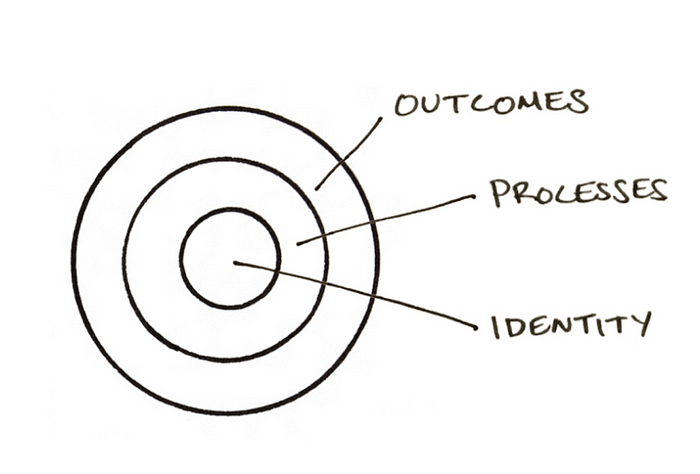
James tells us that we need to change our identity to solve problems at the system level (to build a habit of solving problems continuously).
I was having a hard time making a sustainable habit of going to the gym at least 3–4 times per week. I used to think that I was going to the gym to get rid of my tummy fat as soon as possible by following a rigid diet plan. Believe me, it did not work for a long time.
Now, I think from a different perspective: I am a healthy person; I need to go to the gym.
Therefore, I can eat healthy food; as you may know, when you hit a gym, it’s pretty hard to munch on junk food as soon as you do the training session. Then maybe one day I will look like The Rock, Dwayne Johnson.
How to build a sustainable habit?
Okay, enough with the tiny habits mantra; tell us how to build sustainable habits.
Again, James tells us there are four key mantras you can follow to build sustainable habits.
I also wrote another article on how to build sustainable reading habits: These 28 Reading Rules Transformed My Life. We can pretty much emulate the process but in a more technical way.
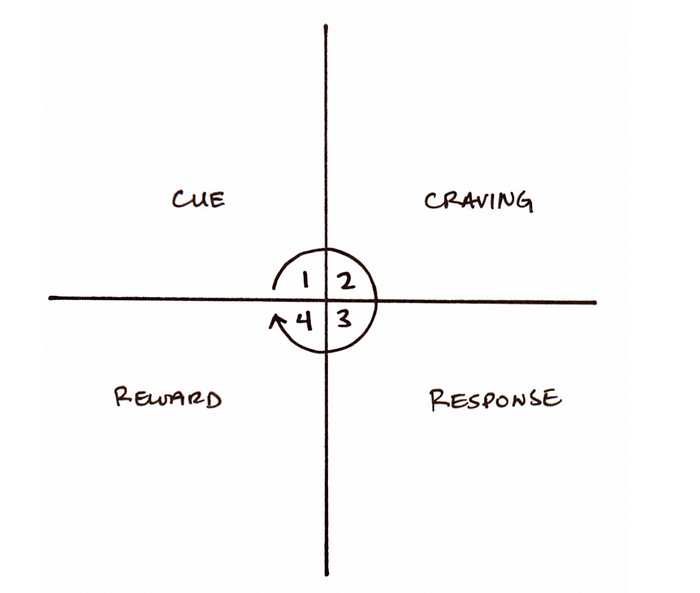
i) Cue means to trigger the action.
ii) Craving means motivational force.
iii) Response means the habit we perform.
iv) Reward means end goal.
Choosing a successful cue that triggers a specific and immediate action is imperative.
For example, let’s say you build a tiny exercise habit by doing five pushups each day.
You might say something particular like this — I will do five pushups during my break.
It might work, but it’s not really tangible.
James says we can make it more specific; I will do five pushups as soon as I close my laptop to leave for lunch. In this case, closing the laptop is a specific trigger.
Anecdotal: As you may know, we do not get enough sunlight in Canada; therefore, my physician suggested I take vitamin D daily.
I bought the vitamin D but kept it in the kitchen; I took it and then forgot for a few days.
After reading Atomic Habits, I literally moved the vitamin D tablets next to my laptop in front of my eyes. Over the past few months, I can say that I have never missed taking a vitamin.
As James said, you want to put fewer steps between you and the good behaviors and more steps between you and the bad.
Just imagine this: the environment helps you choose the good habits and reduces the cues of your negative habits.
As humans, we all expect a reward; that’s how we are wired.
Therefore, making habits attractive helps us to stick to them. One attractive thing I did was listen to audiobooks/podcasts while hitting the gym.
Lastly, reward yourself immediately after completing the task.
“What is immediately rewarded is repeated. What is immediately punished is avoided.” — James Clear
We can easily get a burst of dopamine by going through the McDonald’s or Starbucks drive-through or scrolling aimlessly through TikTok or Instagram, as you might observe that it makes us repeat these bad habits.
James said that to build healthy habits, try to attach some form of immediate gratification. Therefore, we can make the habit immediately satisfying.
James called these four things (cue, craving, response, reward ) the four laws of behavior change.
The bottom line
Habits are not a finish line to cross but a lifestyle to live.
We can transform our lives by continuously making tiny changes.
It’s the small habits.
How you spend your mornings.
How you talk to yourself.
What you read. What you watch.
Who do you share your energy with?
Who has access to you?
That will change your life. — Michael Tonge
I want to emphasize that the real change comes from the compound effect.
Book recommendation: If you love to read, here is another book to comprehend the power of compound effect — The Compound Effect by Darren Hardy.
Rule of 5: Simply doing 5 push-ups, 5 squats, 5 lunges, and a plank is massive.
Thank you for reading. I wish you a happy and healthy life.
As a new reader, please check my holistic health, productivity, and well-being stories reflecting my reviews, observations, and 30+ days of experiments (29 completed so far) to build a sustainable healthy lifestyle.
I also write about the general philosophy of life. For your convenience, here are the links.
Mental Health/Brain Damage, Hiking, Cofee (New Research), Technology, Healthy Lifestyle, Life Lessons, Productivity, Learning, Money
Disclaimer: My posts do not include professional or health advice. I only document my reviews, observations, experiences, experiments, and perspectives to provide information to create awareness. This post may contain affiliate links.


