
How to Build an NFT Marketplace and How Much It Would Cost?

Since the artistic CryptoKitties branded themselves as one-of-a-kind digital tokens, the concept of non-fungible tokens has reached a new high. Non-fungible tokens (NFTs) are tokens with unique values, and they cannot be interchanged for one another.
Where are people selling these NFTs? Well, the answer is that these unique tokens of almost anything are sold (mostly auctioned) at dedicated marketplace portals, which, when viewed without attention, look like an e-commerce website. Here, the only difference is that people sell digital tokens of assets for digital (crypto) currency.
There is a lot of skepticism associated with NFTs that their minting adds more to the already rising global temperature and other factors. Still, marketplaces such as OpenSea, Rarible, and SuperRare are seeing a huge influx of NFTs from creators every day and experienced some massive sales across the last 2 years.
If you plan to utilize the early days of NFTs to establish yourself in the virtual world by running an NFT marketplace, this blog can help you get some insights on how to start and how much you would spend.
Top NFT Marketplaces So Far
- OpenSea — General NFTs
- Rarible — General NFTs
- Foundation — General NFTs
- Nifty Gateway — General NFTs
- Axie Infinity Marketplace — In-game marketplace for the game “Axie Infinity”
- NBA Top Shot — Marketplace focussed on the NBA league based in the USA
- Decentraland — In-game marketplace for the game “Decentraland”
- SuperRare — General NFTs
“Think like an entrepreneur to launch your business effectively!”
How Does an NFT Marketplace Work?
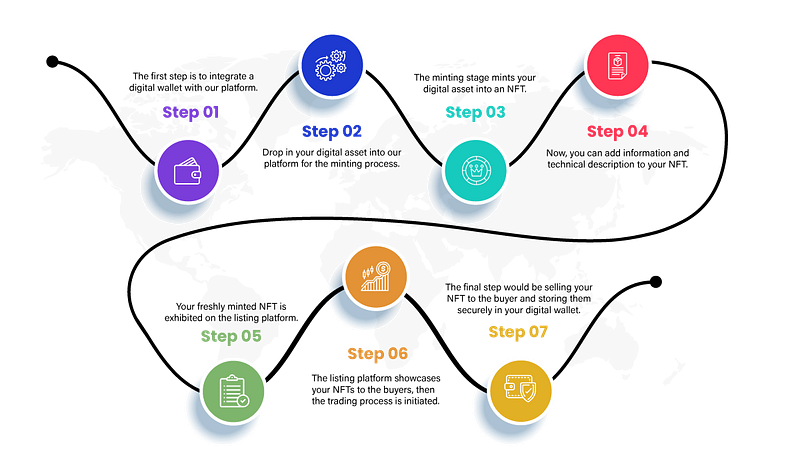
- Users create their accounts and link their crypto wallets on the marketplace portal.
- Creators mint their NFTs through the platform, put them up for sale, and wait until the auction starts.
- During an auction, buyers bid on the NFT piece, and the highest bidder gets the asset.
- The buyer pays for the asset through their wallet, and the asset is transferred to their wallet.
- The marketplace portal charges the creator while minting or deducting an amount during the final sale.
During transactions, the marketplace portal utilizes a digital protocol called “smart contracts,” which records all the information relevant to the transaction, such as the buyer and the seller, the asset sold, and the price paid for it. Such contracts prevent fraudulent attempts and provide credits for the creator forever.
Must-have Features of Every NFT Marketplace
- Storefront — It is similar to the front page of any e-commerce website, where you would list upcoming and trending NFTs. It also contains details of every NFT available in the portal, such as owner(s), value history, and description, if given by the seller.
- Auction Portal — This is an important portal as more creators would like to see their fame rise through an auction rather than selling their works for a fixed price. A live auction portal would contain the seller’s name, previous bids, deadline, payment method, and more.
- Search — The marketplace should have a search feature on its homepage so that prospective buyers looking for a particular NFT can easily navigate through their way to have a great user experience and satisfaction.
- Wallet — Your marketplace should also have a special wallet or integrate existing wallets into your portal. In this way, the users can easily buy, sell, and own their NFTs on their own wallets.
- Payment Mode — Although NFTs result from cryptocurrencies, a good NFT marketplace should have its reach beyond the crypto world. This can be easily achieved by supporting conventional payment gateways such as debit/credit cards, net banking, and wire transfer. Through such actions, you ensure that your user base is wider than just crypto enthusiasts through such measures.
- Support — Any marketplace portal should have a working customer support portal round the clock, particularly if your users live across the globe. In this way, you can win the trust of your users by helping them with their queries.
Steps to Build an NFT Marketplace
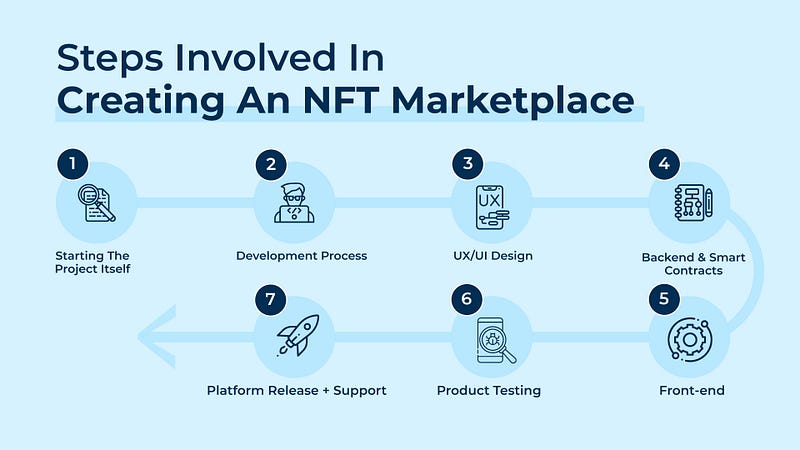
Choose Niche — Before starting to develop your own NFT marketplace, it is important to be wise by planning through. Initial planning involves the niche associated with your new venture. You would have to decide whether you are selling NFTs based on art, music, videos, sports, or physical assets. Also, you would have to decide upon whether you are selling NFTs on behalf of a celebrity, an influencer, or a game, or you are trading as a general marketplace to plan upon the prospective user base.
Work on The Design — It is important to plan on your design more than anything else as the process can be tough and enduring before getting satisfactory results. You can design your user interface (UI) and user experience (UX) using your in-house team or hire a firm that has experience designing such components. A great UI/UX promises greater user satisfaction and increases returning users.
Development is The Core — Building on a design idea is important, but making the whole portal work is different. Front-end development plays a key role in making your NFT marketplace platform seamless. Back-end development also plays a vital role as good work in the back-end ensures a secure and robust platform. It is essential to employ a reliable company that has pioneered the art, as hiring in-house developers with such experience is a tough task nowadays.
Deploy After Careful Testing — Testing is a crucial phase while developing software. The same stands with NFT marketplace portals too, as bugs, errors, and any other defects can hamper the smooth functioning of the platform. Such defects should be tested for and removed from the portal before deployment. Even after the launch, some support might be needed if any new bugs are detected or if some performance issues arise.
Cost to Build an NFT Marketplace
Generally, the cost to build an NFT marketplace depends on your preferences and requirements. Some might need an immediate solution so that they opt for white-label solutions, and some might like their marketplace to be brand new from scratch. It also depends on the customization levels that you require, such as features to incorporate or payment modes to be supported. Also, a huge factor determining your expenses for the project is the choice of experts you wish to work with. You can either employ in-house experts in every domain or opt for the services of a development company that has expertise in developing various kinds of NFT marketplaces.
Conclusion
In the ever-growing world of non-fungible tokens, it is evident that people are opting to delve into this world in one or the other way. Running an NFT marketplace can be effective and risk-free as you do not have to own any NFTs or be a creator. You can be a facilitator (of course, while supporting the principle of decentralization) and earn money through every sale. For developing such a platform, some companies can assist you well with every process associated with it, from the initial roadmap to marketing and customer support available at various costs, depending on your needs.


