
How to Build an Audience on LinkedIn
And the data showing it works.

Maybe you’re after a new job, and despair at sending your CV into the void.
Maybe you own a business, and are struggling to strike a chord with buyers.
Either way, to your audience — be it prospects or employers — you’re a noise blip, indistinguishable from other noise blips, at a time when everyone’s attention is compromised.
Founding editor of Wired magazine, Kevin Kelly, wrote of how, in the creator economy, you’ll only need 1000 true fans to make a living. It’s just as true on the business side.
So where do these fans come from? How does one build that community?
For consumer-facing businesses, it makes sense to build a following on TikTok or Instagram. But for B2B services, LinkedIn is where the clients are — and where you should be.
(Everything here is also true for folks looking to promote themselves. Each employee is like a tiny company, managing the value of their work.)
As a social network, LinkedIn’s got an edge: people take great care to come across as professional, so the network has built-in incentives to suppress our monkey instincts — rage, indignation, intolerance — that other platforms love to amplify.
But LinkedIn mostly shows content posted by people. (Unlike Facebook, LinkedIn company pages and posts are mostly a dud.) For effective marketing, at least one person needs to step up, and engage with audiences on the company’s mission.
That’s where it gets hard.
People will say: “I don’t know how to be popular.” They’ll say: “I’m not good at putting myself out there.” They’ll go: “I’m too humble for all this self-promotion.”
What they’re really saying is — it’s very uncomfortable to put yourself out there. It’s hard to know what’ll resonate with your audience, and it feels bad when you try and get ignored. Nobody wants to be visibly unpopular. Saying and doing nothing feels safer.
Thus, I was faced with a choice: Have my company fail because of discomfort, or bite the bullet and figure it out. With intent, I chose the latter.
But there were two problems…
One, my target audience didn’t know — and didn’t give a hoot — about my company’s mission.
FinText helps investment companies improve their marketing using Text Analytics, so their budgets are spent creating content their clients will actually want to read. Seems quaint?
Over the past decade, the active-management industry has been hit by a double whammy: first it was cheap passive-investing (think Vanguard), then the risk of platforms (think Schwab or Robinhood). To survive, traditional investment managers need to get better at telling their story.
But, as you can appreciate, not only did I need to reach a super-specific audience with personal writing, but make my posts interesting enough for them to come back for more.
(Most companies in the Natural Language Processing space fail epically here. They talk about their cool tech, never once pausing to wonder if their buyers even care. Let me tell you right now — they don’t.)
Two, I needed to get audiences to care without wasting all my time on social media. This was non-negotiable. Social media is a huge time sink, and real life is far more exciting than chasing vapid Likes.
And so — the experiment
In January 2020, I committed to a year-long effort to build systems that deliver solid LinkedIn performance with the people who matter.
Over the course of this year, I’ve published 111 posts. In total, they generated about 127,000 views. Some of the points I’ll be covering today are:
— WHICH content works well? — HOW MUCH do Likes (Claps, Hearts, whatever) help? — WRITING TIPS that work best? — ARE HASHTAGS any good? — HOW MANY views can you expect?
Which content works on LinkedIn? The evidence:
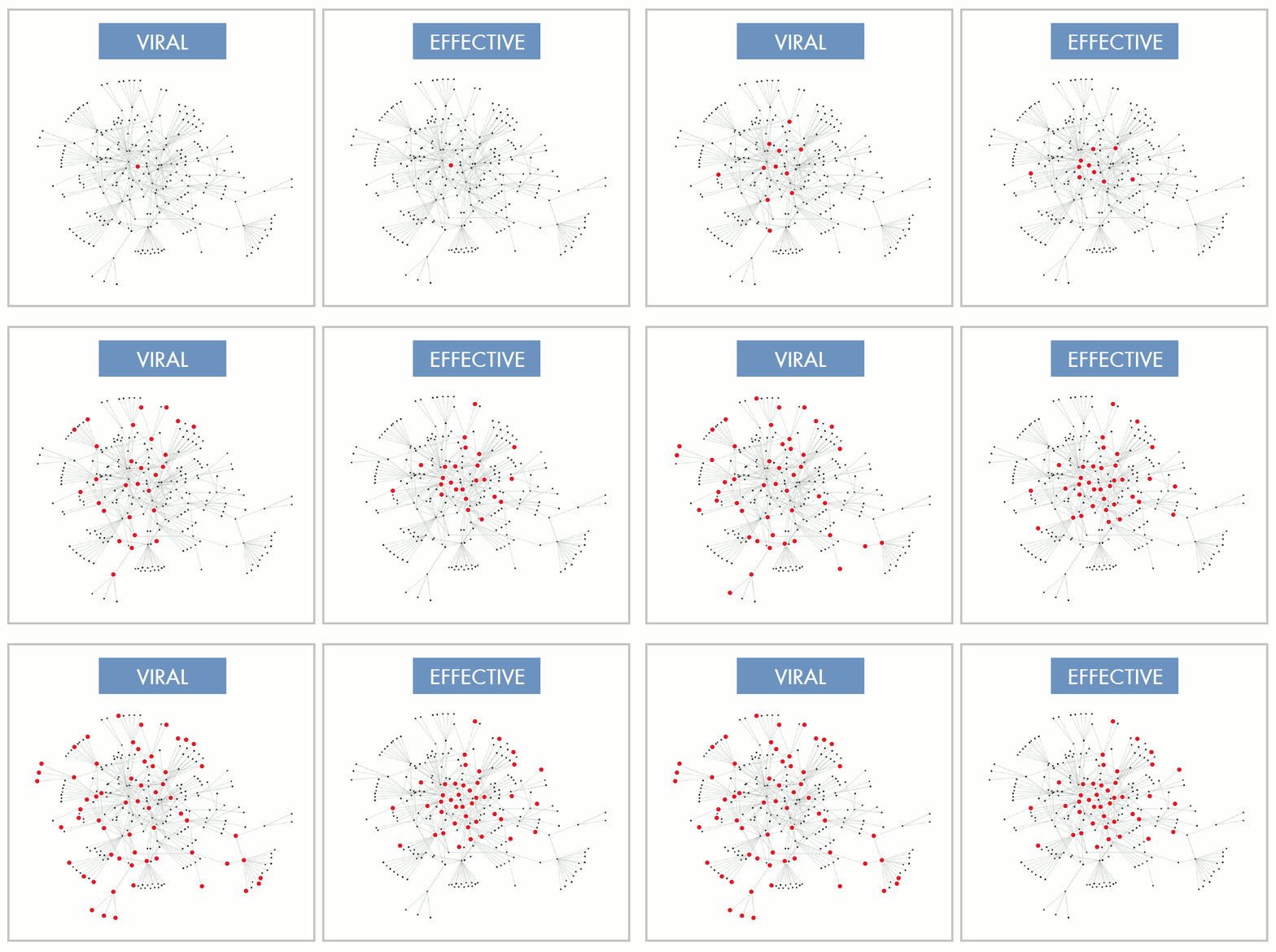
For a business, there’s only one goal — to build trust. Trust delivers attention. Trust leads to conversations. Trust results in opportunities. To build trust, I didn’t look for my content to go viral, but to stay contained in the relevant, highly interconnected network.
I’ve seen people build a large following by sharing cutesy memes and frothy posts. But a crowd of random people is never quite as good as a targeted audience of relevant professionals who consider you an expert.
Now, if we look at the views for each post, here’s what the graph looks like:
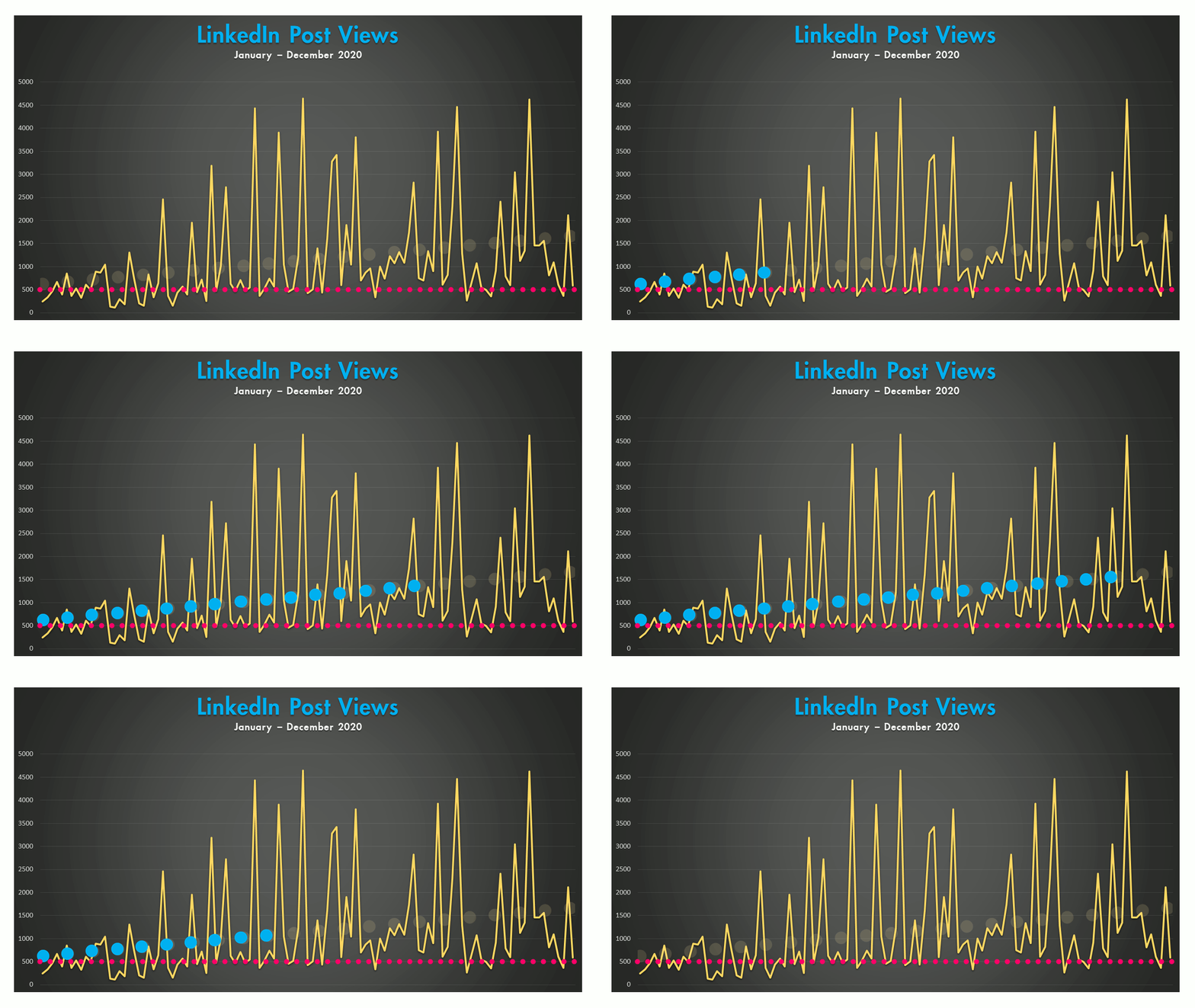
What you’ll notice is, there’re two lines:
As the BLUE line will have you believe, I wasn’t getting much traction initially, but steadily grew my reach over the year. (It’s the best linear line fitting the data.)
But it’s the RED line that baffled me. Like a gravitational pull, views kept reverting to ~ 500 views. In total, 40% of the posts hover around it. I suspect this has something to do with your follower-count:
Posts are shown to some percentage of your network, and — based on their initial success — are propagated further. It makes sense to tweak the algorithm so that BY AND LARGE, decently-performing posts would end up seen by an audience about the size of your follower count.
However, over the year, my audience doubled. And it took a long time to see the “baseline” shift upwards, which was often frustrating.
Don’t expect monotonic growth. Initially, I thought that, as I get better at engaging my audience, I’ll see a consecutive rise in views. In reality, having three or more consecutive posts with rising view-count was RARE.
Everyone wants to know: Do the best-performing posts have anything in common? After all, the peaks seem to show up fairly regularly, maybe there’s a common thread?

There was not.
However…When I looked at the worst performing posts, the trends come out thick and fast. Sharing someone else’s post gets really poor traction. Not a single shared post went above the red line. Posts whose media was a link performed only a little bit better. (Didn’t matter if the link was to an external article, or to a LinkedIn article.)
The other big finding was topics. Initially, I didn’t have a niche; regardless of topic, none of my posts got meaningful traction. But from some point on, nearly all of my worst-performing posts were when I went off-message, and talked about something that wasn’t “my main thing”.
Just as much effort went into these posts. Still, most got poor engagement. Even if they were seen, it wasn’t a topic people wanted to hear about from me.
This tells you real engagement is built through consistency. The only way to get there is work to make your next message better than the one that came before it — and focus on a topic that can become “your thing”.
Let’s Talk Vanity Metrics
It’s nice to get a Like. You feel validated. You get a hit of dopamine, and straight away want another one. Our monkey brain gets caught up in it.

All the while, none of it is ABOUT YOU.
Vanity metrics are not actually about the quality of your content. A Like is a signal that someone’s happy to be publicly affiliated with a point you’ve made. It’s a message people send out to peers and contacts.
It’s about THEM.
So in one sense, vanity metrics matter enormously: If none of your target buyers are Liking your posts, the marketing’s not working. Not because counting Likes matters, but because your message doesn’t resonate with target buyers enough for them to signal it’s important.
Most company posts get Liked by their employees, who feel good affiliating themselves with a strong brand. Big companies, with lots of employees, can delude themselves they’re getting great traction. More than the number of Likes, you should care about who is showing up.
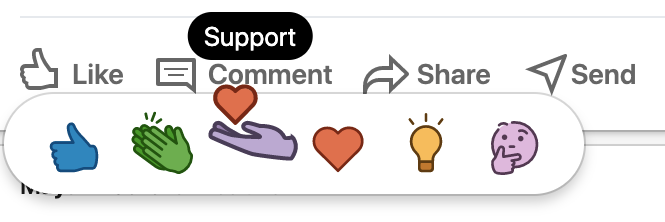
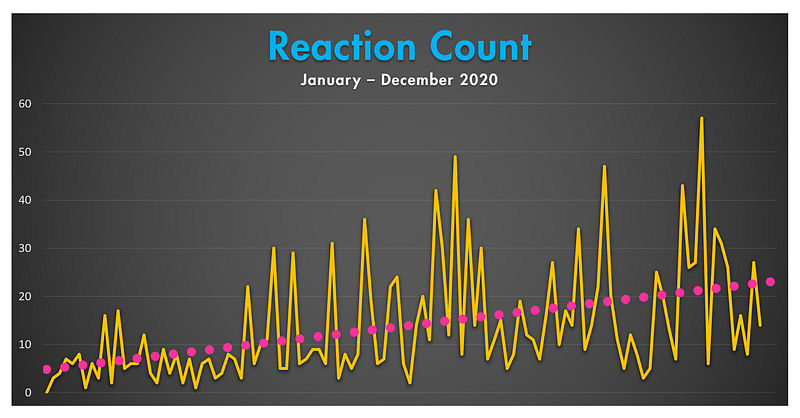
How about what they click? As people get to know you, they feel safer showing a wider range of emotions. A Like thumb is the safest; those who signal in other forms have usually been following me for a while. (This pattern differs for viral posts.)
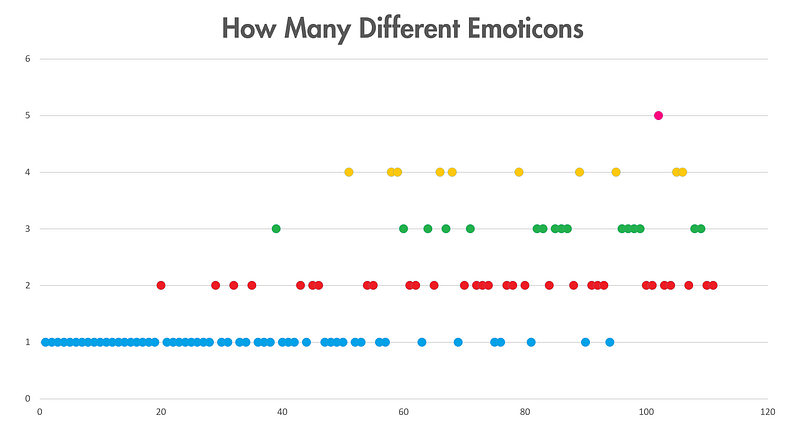
Generally, Likes are stickier than views: as you can see below, the upward trend in signals is more consistent compared with views. This is to be expected — if your messages start resonating with an audience, more of them will repeatedly signal their support.
Some Basic Stats
Talk less about yourself. Countless times, I’ve seen others share useful content, get great traction, then make the mistake of believing their audience cares about them.
No.
The odd personal share is fine, but people are scrolling to make their own lives better. Mindful of this, 77% of my posts this year used the second person — like “you” or “your”. Only 60% use “I”.
Length
Don’t be afraid of lengthy posts. Top 10% of posts by views — averaged152 words per post. Bottom 10% — averaged 94 words.
When extended to the twenty most viewed posts, their length averaged 159 words; the twenty least viewed posts averaged 110. You get the gist: meatier posts are often lengthier, but they deliver more value to readers.
I should add, I’m very mindful of which words I pick.
Through FinText’s research, I’ve seen how often financial content is far too complex, using 3- and 4-syllabled words at double their natural rate. At every chance, go for the punch, and choose shorter words.
Should you use hashtags?
Think of a hashtag as a semaphore — a flag, used to signal a message. Though I’ve yet to see any evidence hashtags help with traffic, I’ve found them very useful.
From the onset, I decided to pick a hashtag that’d align with our company’s mission, and use it as that flag. We debated several options, and finally chose #textanalytics.
Over the year, about 30% of my posts contained this hashtag. Over time, I started using the term in the body of the text as well. In conversations, I can tell people are growing comfortable with it, because they mirror it back to me. That’s one of the best signs your content is working.
Building a System
Corporate guff tends to perform poorly on LinkedIn. Companies love talking about who they are and what they do. But now turn the question around: do you, personally, choose to spend time reading corporate naval-gazing posts?
To stand out, each of your posts has to offer tangible value to your reader.
At first, that’s just plain hard. The odd good idea isn’t enough to sustain a regular posting schedule, and earlier we saw just how important it is to be consistent.
That’s why lots of people end up with a schtick: a type of post they’re comfortable doing over and over again. With most of these, the audience gets bored quickly.
Without experimenting and taking risks you’ll get pigeonholed into a content format. When people scroll past it, they assume they’ve heard all they need to hear from you.
But without a template, we’re back to the time-sink problem. Thinking up ideas and executing on them takes time and effort, both of which are in short supply.
For this reason, carefully consider how often you post, to set expectations. Initially, I’ve set a hard limit of posting at most three times a week. From there on, it becomes about building a system:
- Plan topics in advance. Tell a bigger story with multiple posts. Keep thinking of how to bundle and unbundle content. Personally, I don’t write anything unless I can think of at least three different ways I can use it.
- Find a way to tap into data. People on LinkedIn love data stories. Because of the previous tip, I have a strong bias for data that isn’t news-driven, to hit a longer shelf-life on your content.
- Stay on message. Initially it may feel like, who cares? It’ll be tempting to pile on to whatever’s buzzing right now. Don’t. Find a way to make your thing interesting and relevant and stick to it.
Summary
Here’s what I’ve learned this year about building trust:
- Figure out a niche. It’s a scary commitment, but it’s the most direct route to becoming known as an expert.
- Set view-count expectations so they roughly match the size of your following.
- Switch formats around. Audiences quickly grow tired of templates.
- If you’re going to track social signals, focus more on the who rather than the how many.
- Write long posts with short words.
- Add value every single time.
Did I get business out of LinkedIn? YES. YES. YES.
I also built relationships with people who stepped up to help, referred clients, offered advice, and taught me so much. In a year when everyone was stuck at home, I never felt removed from the industry, or short of opportunity.
(I’ve also spent time helping others, knowing full well there wasn’t anything directly in it for me. Knowledge exchange is rarely a zero-sum game. The more you do it, the more everyone benefits.)
Please remind yourself, it’s never about the Likes. Social networks profit from becoming a frenzied popularity contest, but none of it matters. What actually matters is the number of valuable conversations you’re having.
People who enjoy your content and find value in your work are more likely to want to talk to you. That’s where real business starts. It’s that simple.
By showing up consistently and keeping on message, my audience accepted it as “oh, that’s her thing.” What you end up building is social proof, which is essential to trust-building. This year I’ve learned — though it’s hard initially, it gets easier as you go.
It’s hard for a reason. For any person sticking their neck out to write, hundreds are quietly reading. Almost everyone battles the same internal adversary, the inner child afraid of getting it wrong.
That’s why, after all this, my top advice to you is to figure out what you care about, and start sharing why you think it matters to others.
Tell people stuff they don’t know. Tell them why they should care, even if just a little. That’s where you start to add value. ❤