
How To Build a Powerful Brand Story With an Expert’s 6-Part Framework
Donald Miller gave us an awesome roadmap to great brand stories — here’s a case study and how to use it

It is not unusual for a brand to complicate its story due to an extensive product line, tons of features, multiple distribution channels, and/or an enormous geographic spread. The good news is Donald Miller created a clear framework in “Building a Story Brand” that provides a solid roadmap. This article provides an overview so that you can quickly learn the benefits of the model.
The enemy for most brands is the noise they create. Not in the literal sense, but in terms of all the emails, web articles, social postings, ads, etc. The issue may be the lack of a consistent content strategy, or perhaps the marketing focuses on product features. Or worse, the copy sounds like everyone else’s. The answer, Miller says, is clarity and the Story Brand framework.
Here’s a rough sketch of Miller’s model:
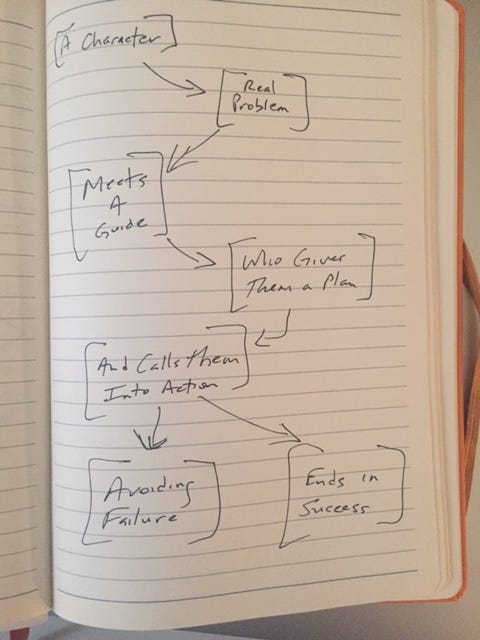
What I like about this model is that it’s based on the customer’s perspective, and it seeks to draw them in via a story structure that’s flexible. In a nutshell, it’s similar to the tried and true formula that many Hollywood movies use. Miller does a great job showing how this framework applies to everything from “Star Wars” to “The Hunger Games” (and far more). I plan to stay focused on one primary example so that you can easily understand the model. Afterward, I’ll share a compelling startup for rock stars so that you can engage directly.
The Framework
Let’s start by reviewing each concept.
The Character
As much as we would all like for the hero to be our brand, it isn’t. In fact, Miller shares some anecdotes describing the downsides. Trust me and just know that your customer is the hero of the story. You should also keep in mind that the Character might have some self-doubt, but the good news is that your brand (via a guide’s assistance) will solve the problem.
The Problem
The problem should be real, relatable, and the primary issue facing the Character. Also, the problem should have four levels — a villain, an internal need, an external need, and a philosophical component.
Here’s an example: Let’s say the main character is gluten-sensitive — which affects more than 20 million Americans — and is searching for a solution. The villain is definitely wheat and includes bread, crackers, etc. The internal need might be, ‘I want to feel better.’ The external need might be, ‘I want to get on with my life.’ Meanwhile, the philosophical statement might be, ‘It ought to be simple to resolve this problem today.’
The Guide
The Guide helps the Character solve the Problem, but it’s up to the Character to actually pursue and execute. As a result, the Guide must have two important characteristics: empathy and authority.
Again, let’s say you’re gluten-sensitive. If you search for a local nutritionist to guide you down a safe path for life, you’ll look for signs that confirm authority, such as testimonials, stats, and awards to prove expertise. That first appointment (or the process to set one up) should include some empathy to comfort you and confirm you’ve made a good choice.
The Plan
Ultimately, you’ll need an actual plan to succeed, and so the Guide’s plan may include an inspection of your fridge and pantry, discarding tons of bad goods, lists of products to avoid, recommendations of apps to use for grocery shopping and eating out, recipes, meal plans, and more.
Call to Action
Now, if the Character is actually researching and hunting online to find a reliable nutritionist and obtain a trustworthy plan, then in order for prospective customers to take a step in your direction, you’ll need to test a mixture of direct call to actions (also known as CTAs) and transitional ones. A direct CTA might be ‘buy now’ or ‘make an appointment today.’ A transitional CTA might include ‘watch this video’ or ‘download this free guide.’
Success
You’ll need to help the Character visualize success. Miller uses Men’s Warehouse as an example in that they constantly say, “You’ll like the way you look. We guarantee it.” Or, in the case of the Character with gluten-sensitivity, we could tweak the language and say, “You’ll like the way you feel.” Miller recommends that storytellers end the story with the hero winning, creating completeness, or experiencing some type of self-realization.
Winning might mean access or status (such as A-List within Southwest Airlines loyalty program), scarcity (VIP access at South By Southwest and only 100 tickets available), or a combination of elements (i.e. the American Express Black Card as it provides status, access, and has the ability to solve the scarcity issue). Creating completeness might seem vague, but if you learn how to live without gluten successfully, then you’ll feel better (and whole) afterward. Self-realization could lead to inspiration, acceptance, or even transcendence.
Think about Tom’s Shoes. Yes, I bought my first three pairs thinking about their unique one-to-one model and how they give back. It agreed with my soul. Others might buy Nike shoes and athletic wear because it gives them the inspiration to keep plugging away towards their goal (a marathon, a triathlon, etc). Miller’s recommendation to marketers and storytellers is to close the loop by showing the Character how they have now resolved those external, internal, and philosophical problems.
So let’s apply this Story Brand framework to a real brand…
Applying the Story Brand Framework to a Real Brand
A few brilliant friends of mine partnered to create Catch Group Travel. Here’s a screenshot of their home page:
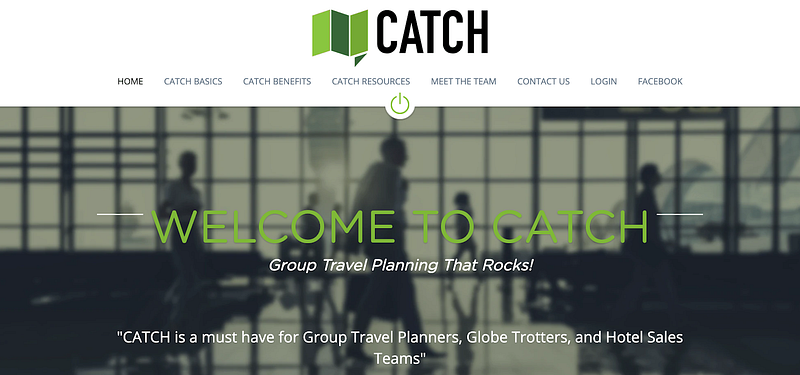
In two seconds, you know it’s a tool for people who plan and arrange group travel. But do you know who the major Character is, and do you fully understand the problem?
Slightly below the top portion of the website, the next screen reveals this is for Travel Planners and Hotel Sales Teams.
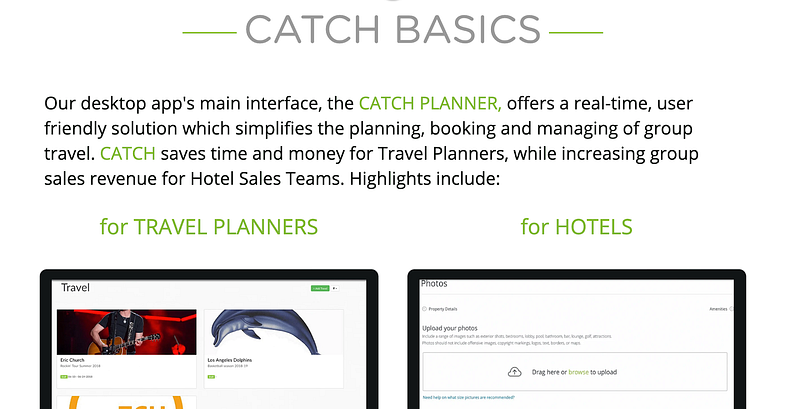
But aren’t we all Travel Planners? And why would I use this app for my family or company when Expedia, Travelocity, Kayak, and more already exist?
So here’s the back story…
My friend Jason owns an LA-based travel agency that primarily works with rock stars. Crazy but true.
Take Janet Jackson or Billie Eilish or your favorite band. A 50-city tour spanning a few countries and including an entourage of 150 to 200 people isn’t unusual for them.
Also, while Janet Jackson might stay in some exclusive luxury resorts, it’s possible that there are tiers in terms of hotels, planes (first class, business, private plane), and restaurants considering the size of the crew.
Apparently, the entire travel schedule with all the logistics was previously put into these huge binders (the villain) with actual dividers and pages of information. So, Jason partnered with a savvy tech friend (think Google background) to create an app to make all of this seamless and easy.
If they follow the Building a Story Brand model, the primary Character is a travel manager for a large group, but it could also be an up-and-coming rock star who wants a tour planned, like the Eagles. Ideally, one of their past famous stars would serve as the Guide in a short 60-second shareable video and say, “Do you and your mates want to travel like a real rock star? Here’s how we do it!”
The Problem includes a whole host of headaches, such as flight or hotel cancellations, the lack of VIP service for large groups, the band misses the show, and more. Then the internal need might be ‘reduce anxiety and remove all the emotional frustration,’ while the external need might be ‘why is the lack of a smart travel plan interfering with my tour.’ Regardless, if traveling is a barrier, then there’s a problem! Meanwhile, the philosophical statement might be ‘it ought to be simple to resolve this problem today via technology.’
While the current Catch website dives into the features and functionality of their solution, I agree with Miller’s Chapter on Building a Better Website. Catch should simplify the site greatly by realizing that most people just scan websites. They should stay more focused on the Character, the Problem, and the call to action to boost leads (which may be calls or emails). Also, while the current goal of the website is ‘schedule your demo today,’ they should consider earlier steps in the process (such as, call for a free consult) if they can’t clarify the Character and Problem.
Similar to many brands, Catch Group Travel needs to cut a great deal from its existing story in order to create clarity. In the end, you want the right targeted people to see mirror images in the Character and the Problem so that they respond to your call to action. Keep the gluten-sensitive example in mind, and you’ll be able to apply this model again and again.