
How to Build a Diversified Investment Portfolio

If you want to get started in investing, you absolutely must know what diversification is. It’s a basic concept that will enable you to reduce your risk with little impact on your returns. It also allows you to fine-tune the volatility of your portfolio.
I’m going to talk about all that in this article.
What is Diversification?
Diversification refers to the practice of spreading investments across different assets, sectors, regions, and investment types within a portfolio. The goal is to reduce the overall risk of the portfolio by not relying too heavily on a single investment or a small group of investments. A diversified portfolio includes a mix of assets that have low or negative correlations with each other, meaning their performance tends to move independently of one another.
There are many different ways to diversify. You can diversify by asset class, i.e. mix stocks, bonds, real estate, commodities, crypto, etc… This allows you to limit the risks associated with a specific investment.
There’s also sector diversification, which involves investing in different sectors or industries. For example, instead of investing solely in technology stocks, a diversified portfolio may include holdings in the healthcare, energy, finance, and consumer goods sectors. This diversification helps reduce the impact of sector-specific events on the portfolio.
Finally, there’s geographic diversification, which involves investing in different countries/regions. This strategy helps mitigate the risk associated with any particular country’s economic, political, or regulatory conditions.
Benefits of Diversification
The main benefit of diversification is that it reduces risk. For example, if two of your investments are negatively correlated, this means that when one loses value, the other gains. When the market is volatile, this risk reduction is all the more appreciated.
This risk reduction makes your equity curve smoother over time, as the average volatility of your portfolio is reduced. Its value fluctuates less markedly. It’s also less stressful, as you don’t have to endure big drawdowns.
Before Building a Diversified Portfolio
The first step in building a diversified portfolio is to define your objectives and your investor profile.
Do you like risk? If so, you’ll prefer riskier investments.
What is your time horizon? If you’re looking to invest for the next ten years or so, you’ll prefer growth-oriented investments, without worrying about short-term volatility.
Or maybe you’re looking for a balance between risk and return, in which case you’ll allocate your money evenly between risky and low-risk investments.
In short, there are as many investor profiles as there are people on Earth, so it’s up to you to clearly define your objectives and then diversify your investments as best you can.
Asset Allocation Strategy
First, find some asset classes you’re interested in and do some research to understand their characteristics. Here is a non-exhaustive list:
- Stocks: Stocks represent ownership shares in publicly traded companies. They offer potential for capital appreciation and dividends, but also come with higher volatility and risk.
- Bonds: Bonds are fixed-income securities issued by governments, municipalities, and corporations. They provide regular interest payments and return the principal amount at maturity. Bonds are generally considered less risky than stocks but offer lower potential returns.
- Real Estate: Real estate investments involve buying and owning properties such as residential, commercial, or industrial buildings. Real estate can provide income through rental payments and potential appreciation over time.
- Commodities: Commodities include physical goods such as gold, silver, oil, natural gas, agricultural products, and metals. They can provide diversification and act as a hedge against inflation.
- Cash Equivalents: Cash equivalents refer to highly liquid and low-risk investments such as money market funds, certificates of deposit (CDs), and Treasury bills. They offer stability and immediate access to funds but usually provide lower returns.
- Cryptocurrencies: Cryptocurrencies are digitalized assets. They can yield high returns, but are generally considered very riskyand volatile. They offer a lot of opportunities thanks to projects developed by the community of cryptocurrencies.
There are a lot more. For example, I think cars and watches also are asset classes, even though they’re a little more exotic.
Once you’ve defined your asset classes, you just have to spread your money among them, depending on their characteristics, and in a way that aligns with your goals (because the optimal asset allocation is only defined by your goals).
Then, among each asset class, you have a lot of investment options available. To make the right choice, analyze the options that interest you to understand their risk and return profile, fees and expenses associated, market trend, supply-demand dynamics, etc…
And of course, evaluate how each investment option contributes to overall portfolio diversification. Look for investments that have low correlations with each other.
Geographic and Sector Diversification
There may be high correlation between assets of the same country/region or sector. For example, because of the war between Russian and Ukraine, a lot of investments related to these countries have lost value, no matter the sector or the assets. So, to stay diversified, you need to choose investments linked to different sectors and locations.
When it comes to geographical diversification, start by identifying the countries that interest you. Take into account their economic stability, growth prospects, political environment, etc… You can use indicators such as GDP growth, inflation, interest rates…
Consider spreading your investments across developed markets, emerging markets, and frontier markets.
Regarding sector diversification, the principle is much the same. Start by identifying different sectors or industries that you want to include in your portfolio. Examples include technology, healthcare, finance, consumer goods, energy, real estate… As with geographical diversification, there are other factors you can consider when making your choice, such as sector growth, the competitive landscape, sector regulations…
Once you’ve made your choice, look at how these investments impact your portfolio’s risk and how they contribute to its diversification, by taking sectors and geographical areas that are decorrelated. For example, if you choose several European countries, chances are they will be positively correlated.
Calculating Correlation
Correlation data doesn’t exist for everything. I’m not going to give you his formula, as I’m not sure everyone is interested in maths, but I will give you a quick way to calculate it (https://www.wallstreetmojo.com/correlation-formula/ if you’d like to see his formula).
Let’s say you want to calculate the correlation between the price of Bitcoin (BTC-USD) and the Euro (EUR-USD). You simply need the two historical prices, which you copy into Google Sheets, and use the formula “=CORREL(data1, data2)”.
For example, I’ve performed this calculation over the previous 5 years:
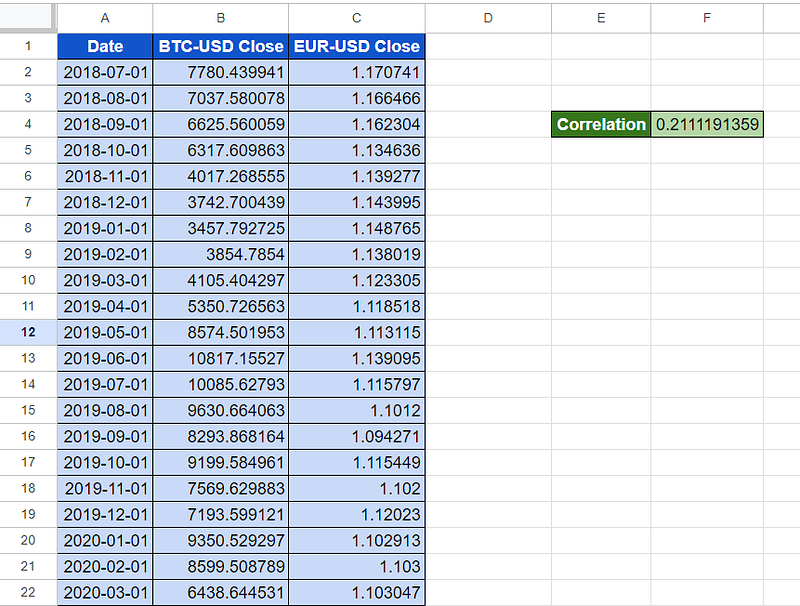
Here is the formula: “=CORREL(B:B,C:C)”. I’ve downloaded the data on Yahoo Finance and just pasted it here in Google Sheets.
We see that these two assets are positively correlated, but as the correlation is very low, we can consider them as uncorrelated.
Final Note
We’ve seen how important it is to diversify your portfolio for the most enjoyable investment experience possible, even when taking risks. Indeed, there’s nothing like a smooth equity curve (even if it’s not rising, at least you know it’s not random or volatile, and that there are things to correct), and that’s what good diversification achieves. Admittedly, it requires some effort, since you have to manage different investments and make some research, but it’s worth it.
To explore more of my stories, click here!
If you want to be notified every time I publish a new story, subscribe to me via email by clicking here!
If you’re not subscribed to Medium yet and wish to support me or get access to all my stories, you can use my link:
A Message from InsiderFinance

Thanks for being a part of our community! Before you go:
- 👏 Clap for the story and follow the author 👉
- 📰 View more content in the InsiderFinance Wire
- 📚 Take our FREE Masterclass
- 📈 Discover Powerful Trading Tools


