
How To Break Bad Habits Once And For All (Science-Based Approach)
Use the ‘habit loop’ to quickly get rid of unwanted habits and behaviors.

Let’s face it, we all have a few bad habits we’d like to get rid of.
Whether it’s excessive phone use, overeating, sleeping in, or procrastinating, we all have some bad habits holding us back in life.
That’s why, in this article, we’ll go over a science-based approach to get rid of bad habits once and for all.
Understand The Habit Loop
If you want to break a bad habit, it’s essential to understand what Charles Duhigg, author of The Power of Habit, calls the habit loop.
The habit loop consists of three main components:
- The trigger
- The routine
- The reward
The trigger activates a behavior, the routine is the behavior itself, and the reward reinforces the behavior.
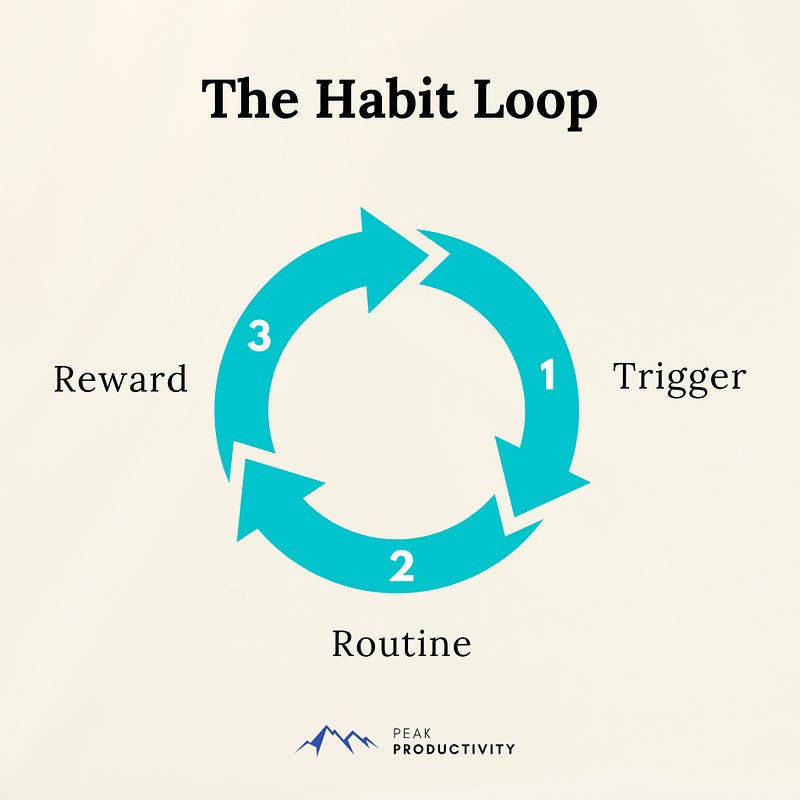
This loop becomes more entrenched with repetition, eventually leading to the formation of a habit.
The Trigger:
The trigger tells the brain to initiate the specific behavior.
Common habit triggers are feelings, locations, a time of day, or being around specific people.
For example:
- When you feel bored (trigger), you grab your smartphone and check social media (routine)
- Every time you see that bowl of cookies on the kitchen counter (trigger), you crave junk food (routine)
- When you’re around certain friends (trigger), you start drinking more alcohol (routine)
If you don’t know what triggers the habit, it’s going to be difficult to change your behavior.
The Routine:
This is the actual behavior that we want to change — whether it’s smoking, overeating, scrolling through social media, gaming, or procrastinating.
The Reward:
The reward is what the brain perceives as the main benefit of doing the routine, reinforcing the routine.
Rewards are often in the form of feelings (such as relaxation, alleviating stress/anxiety, entertainment) or fundamental human needs (social acceptance, safety, attention).
Without anticipation of a reward, there’d be no motivation to perform the behavior.
For example:
- When you feel stressed (trigger), you crave a cigarette (routine) because it temporarily alleviates stress (reward)
- When you’re around certain friends (trigger), you start drinking more alcohol (routine) because it makes you feel socially accepted (reward)
- When you feel bored (trigger), you grab your smartphone and check social media (routine) because it leads to a dopamine spike (reward)
Reduce Exposure To The Habit Trigger
First of all, we need to become aware of what triggers a bad habit, so we can reduce exposure to the trigger.
So, ask yourself, does this habit occur at a particular time of day, in specific emotional states, or in certain environments?
Sometimes, just becoming aware of the feelings, situations, or locations that trigger a habit can already be enough to change it.
But if that’s not the case, reduce exposure to the habit trigger.
For example, if certain friends keep triggering bad habits like gossiping, smoking, or excessive drinking, consider spending less time with them.
If you often get distracted by your smartphone while you’re trying to focus, don’t keep your phone right next to you but put it out of sight.
And if you find yourself snacking more junk food than you’d like, replace that bowl of cookies with a bowl of fruit, nuts, and other healthy snacks.
All in all, become aware of the people, emotions, locations, and situations that trigger a bad habit and, if possible, reduce exposure to these triggers.
Change The Routine With A Better Alternative
People often try to suppress the habits and behaviors they want to get rid of, but this usually leads to failure.
That’s because certain habit triggers are unavoidable.
So, when you do encounter these triggers, you’re still going to be tempted to relapse and fall back into the old routine.
So rather than suppressing a bad habit, try to replace the unwanted routine with a healthier or more productive one.
For example, let’s say this is your current habit loop:
- Trigger: Feel bored
- Routine: Check social media
- Reward: Entertainment
In this case, it’s hard to avoid the habit trigger (boredom) because it’s just part of life to be bored from time to time.
However, we can swap the unwanted routine (checking social media) with a more productive one to respond to boredom in a better way.
For example:
- Trigger: Feel bored
- Routine: Listen to inspiring podcast
- Reward: Entertainment
We’re simply replacing the unwanted routine (checking social media) with a more productive one (listening to an inspiring podcast) to respond to the same trigger (boredom) and satisfy the same needs (to be entertained).
Add Friction To The Routine
One of the laws of behavioral change is that the less effort required to perform a behavior, the more likely you are to do it.
Of course, the inverse is also true; the more effort required to perform a behavior, the less likely we are to do it.
So, if you want to get rid of a bad habit, simply make it more difficult. Add some friction to make unwanted behaviors less automatic.
For example, if eating junk food is a bad habit you want to get rid of, consider not keeping any junk food in the house to make this behavior more difficult.
At the bare minimum, place it somewhere hard to reach, so you can’t habitually grab a snack whenever you feel the craving.
If excessive smartphone- or social media use is the habit you want to break, consider downloading app blockers like Cold Turkey or App Block.
These blockers allow you to put a daily time limit on the most distracting apps and websites (or block you from using them entirely) making the unwanted habit much more difficult to perform.
Other examples of adding friction to undesired habits are:
- Unplug the television if watching TV is a habit you want to reduce
- Log out of your social media accounts so you can’t impulsively check Facebook, Instagram, etc.
- Unplug and hide the video game console if you spend too much time playing video games
- Put your alarm clock outside of your bedroom so you have to get out of bed instead of hitting snooze and sleeping in
The bottom line is to add friction to unwanted behaviors to make them less tempting and automatic.
If you don’t make bad habits more difficult to perform, you’re setting yourself up to fail.
Question If The Reward Justifies The Behavior
Another way to get rid of a bad habit is to question whether the reward justifies the behavior.
Let’s say this is your habit loop:
- Trigger: Being around certain friends
- Routine: Excessive alcohol consumption
- Reward: Social acceptance
In this case, we can question whether the reward (being socially accepted by these friends) is worth it in the first place.
Do we really need to be accepted by these specific people?
If we have to drink lots of alcohol to fit in, isn’t it time to look for more like-minded people?
It’s important to reflect on whether the reward justifies the behavior.
Sometimes, understanding that the reward isn’t worth it can be enough to get rid of a bad habit.
Obviously, changing some habits will be more difficult than others.
But the habit loop gives you a place to start.
Once you diagnose the trigger, the routine, and the reward associated with a bad habit, you’ll gain more power over it.


