
How to Boost Your Productivity with Benjamin Franklin’s Daily Schedule
A powerful strategy that will help you reach your goals

Let’s face it. It’s easy to set resolutions and draw up a list of goals, but it’s much more difficult putting in the hard work to achieve them.
At first, you might make significant progress towards your goals, but as the weeks pass, your schedule seems to become busier than you expected, your motivation begins to ebb, and those goals begin to look further and further out of reach.
How do you maintain that original interest and energy that motivated you during those initial stages? How do you ensure that you are working productively each day?
Here’s Benjamin Franklin’s solution to this problem.
Benjamin Franklin’s Method to Success
Benjamin Franklin was a master of the art of productivity. As a polymath, he wore many different hats during his lifetime: author, printer, entrepreneur, political theorist, politician, postmaster, scientist, inventor, and diplomat to name a few.
What was his secret to becoming so successful?
Undoubtedly, a lot of it was down to his own hard work and determination.
In his autobiography, however, he shares a technique that helped him stay focused on his goals: a daily schedule.
Below is a copy of this schedule from his autobiography.
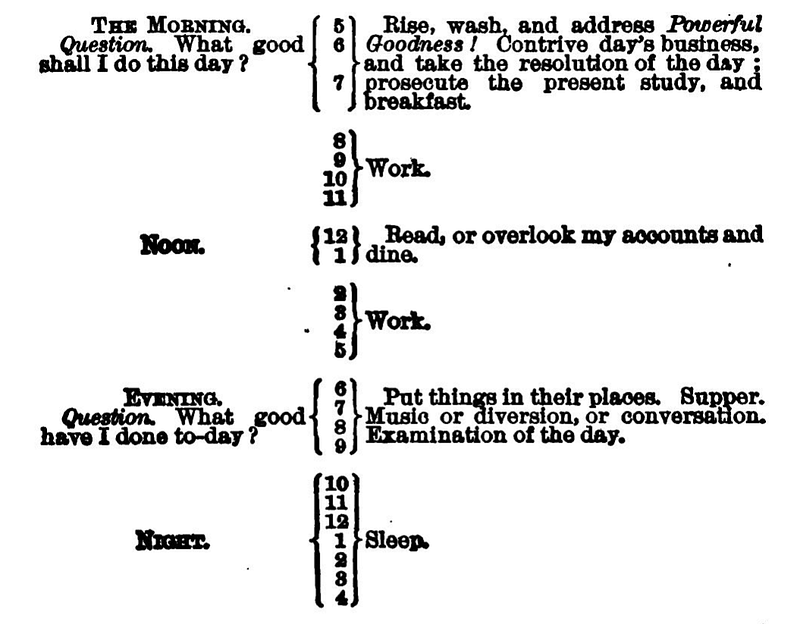
Drawing up a schedule like Franklin’s is a fantastic way to evaluate your day and figure out how you can take advantage of every available hour.
At first glance, Franklin’s schedule seems quite rigorous.
He woke at five in the morning and immediately began planning his day. By eight o’ clock he was busy at work on his different projects. He’d work for about four hours straight before allowing himself a pause for lunch or leisure time.
However, Franklin did admit the difficulties of following such a tight schedule. Sometimes his days didn’t always go as planned. He wrote,
“I found that, tho’ it might be practicable where a man’s business was such as to leave him the disposition of his time, that of a journeyman printer, for instance, it was not possible to be exactly observed by a master, who must mix with the world, and often receive people of business at their own hours.”
Obviously, it is important to be realistic when creating such a schedule for yourself. Often you will probably be unable to follow it to the letter. However, by having such a schedule in place, it will be much easier to develop daily habits, like a daily writing routine.
By working at the same time each day, Franklin trained himself to be ready to work during those hours. Whenever he had a day that was free of distractions and unexpected interruptions, he would be able to work as productively as possible.
But there’s one more element of Franklin’s schedule that makes it quite unique.
How Benjamin Franklin Took His Schedule to the Next Level
First thing each morning, Franklin decided on his goals for the day and determined what his most pressing priorities were.
At the top of the schedule, he printed:
“Morning Question, What good shall I do this day?”
Before he went to sleep at night, he would look over his list, examine his day, and ask,
“What good have I done today?”
This simple practice of evaluating his day every morning and evening helped Franklin put everything into perspective.
Even if he hadn’t accomplished everything that he wanted to, he was able to spend time celebrating his victories. He could also reevaluate his schedule and see what things he needed to keep working on.
Essentially, it was a way for him to measure his progress. If his method for achieving a goal wasn’t working, he could tweak it and attempt a different approach.
How to Make A Daily Schedule That Will Help You Reach Your Goals
First, you need to plan out your goals and upcoming projects. Consider whether a goal is too vague or if you have a clear idea of what success will look like. Make sure you write down your goal in the most specific terms as possible.
Next, break your long-term goal down into smaller short-term goals. This will allow you to easily measure your progress so you can celebrate weekly and monthly victories. Plan out what you should realistically be able to accomplish by the next month or even in the next few days.
You can make your short-term goals even more specific by setting deadlines. Give yourself a clear target to work towards.
Once you’ve done that, you’re ready to put together your schedule. Analyze how you can divide up your day so you’re working productively and taking advantage of the hours that are available to you.
In today’s Internet age, there are many fantastic apps that make it incredibly easy to create a daily schedule.
Currently, I write up mine on Evernote. Every night, I look over my schedule and tweak it depending on whether I have any appointments or other events that might interfere with my usual writing routine.
Todoist is another excellent app for writing up a daily schedule. I have recently signed-up for an account there and plan to start using it in addition to Evernote.
The Todoist app lets you create to-do lists with recurring dates and times. This is perfect for customizing a daily schedule. For example, you can schedule “writing every day at 8am” or you can create tasks that only recur on specific days, e.g., “research every Friday”. This allows you to create a custom schedule for every single day.
Take Time to Review Your Progress
Of course, it’s also important to review our schedules every morning and evening like Benjamin Franklin did. I’ve even taken this one step further.
Not only do I review my schedule every morning and evening, but also on the first of every month I write up an entry in my journal outlining the short-term goals for the month. I use an app called Day One that has a simple and elegant interface.
At the end of the month, I review these goals and evaluate my progress. I can see whether my goals were realistic, whether I met them successfully, and what I need to work on in the next month.
Ultimately, by monitoring your progress as often as you can, you help keep the momentum alive. Your brain is thinking about your goals constantly and becomes excited about achieving them. This helps you establish a daily habit of working towards them.
The Takeaway
Benjamin Franklin once observed,
“Lost time is never found again.”
By implementing a daily schedule like Franklin’s, you are able to evaluate whether you are using your time effectively, and you help guard yourself against slipping into the quagmire of procrastination.
At the end of the day, each box on your daily schedule might not be neatly checked off. And that’s fine.
However, the schedule will give you the motivation to continue pressing forward. As you look over the schedule, you will be able to see what times of the day you were most productive, and you will be able to tweak your schedule to best fit your life so you can successfully reach your goals.