
How To Believe In Yourself and Your Capabilities
It seems so simple, but how is it done? My 3 methods.
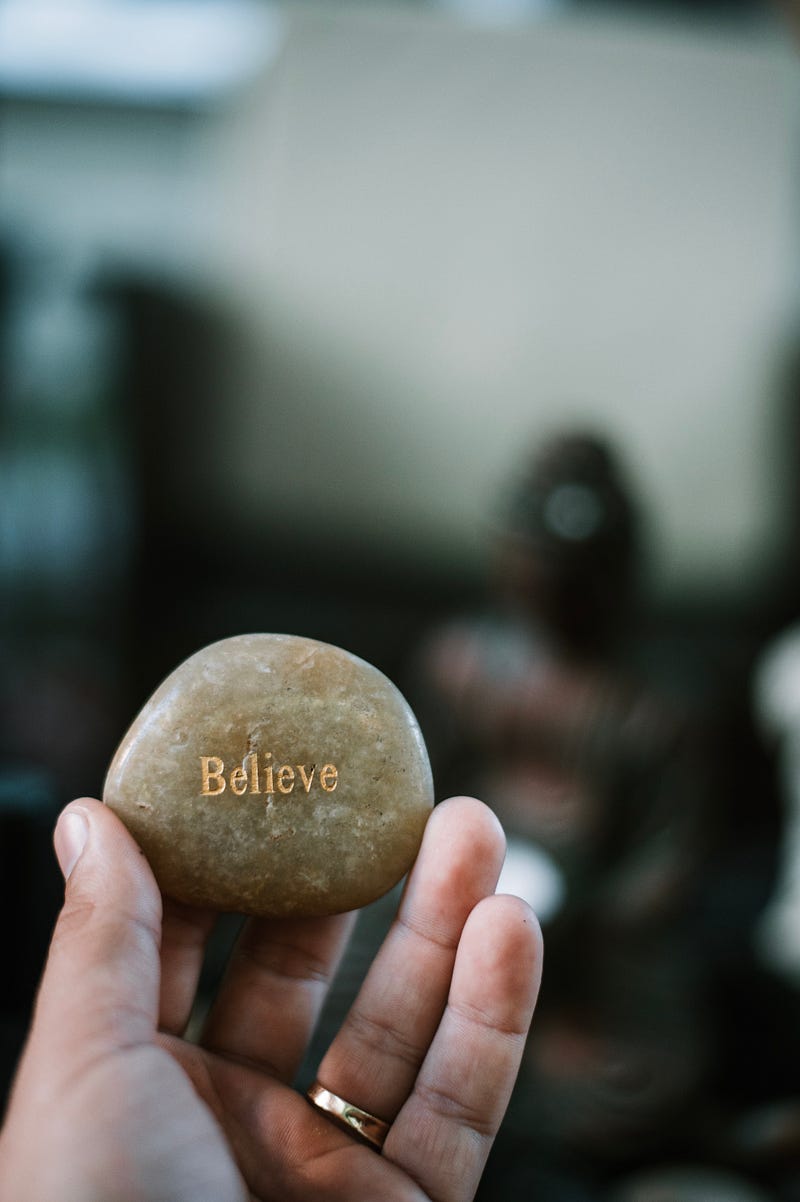
I have heard people say to me, “Just believe in yourself and everything will be ok”.
That may well be correct. But how do you actually do it? How do you get to the place where you actually believe?
And I am not just talking about believing in yourself, as enigmatic and imprecise as that sounds. Perhaps you have a big goal and you want to at least believe in the possibility of its completion, instead of just throwing your thought into the dust bin. Maybe you have an objective to lose weight, as I do. We must begin with at least the plausibility of the achievement being realized. If not, we won’t even start on the road to fulfillment of our objective.
Here are a few companion thoughts to help us answer the question of “how to believe in our capabilities”.
- What makes us doubt ourselves?
- What makes us think that we will fail?
- What causes our minds to disbelieve in ourselves?
- How were our failure beliefs formed?
- How were our paradigms of skepticism created?
I think that is a great set of questions. If we can answer those then we can answer the question of how to do the opposite. We can then figure out how to believe.
Let me tell you what Bob Proctor has to say about this…
“How is the paradigm formed, through the repetition of information.
How is the paradigm changed, thorough the repetition of information.”
— Bob Proctor
Stop, for just a moment, and think. If you have a pessimistic attitude or a gloomy view of a goal you just made, where does that mindset come from? Firstly, I think we have to agree that it comes from us. I also think that Proctor is onto something here. If we continually bump up against an idea or a situation, and we have a negative experience from that encounter, we are going to have a negative paradigm form after a certain amount of repetition.
Let’s say, for example, that when we were a kid we had trouble writing essays. Every time we went into an exam where an essay was required we failed. If we had enough repetition of that event we would have a strong negative paradigm set up in regards to writing essays. And perhaps not many repetitions were required if we had a really bad emotional experience tied to the event. That kind of paradigm might stick with us well into adulthood and perhaps might persist as a part of our self-perception until we die. So repetition is clearly responsible for our negative self-view. I can see also that the emotions we tie to the event play a part as well.
That leads us to at least one plausible solution to the problem we face. To form a new paradigm, and to break or rupture the old one, repetition and emotion are key.
I am not sure how you are going to tackle this age-old problem, but let me tell you what I am doing. I also want to let you know that I am doing this alongside a bunch of other things I am doing in my early morning routine. I won’t be repeating them again, but you can find my post on that here.
What I have added to my routine is another small affirmation. Here it is…
I believe.
Wow, seems so simple. And perhaps it is. But I say it as a part of my morning affirmation practice. I have another set of statements I use in my morning affirmations, but I won’t write them here. I am sorry, they are just too personal.
And I don’t believe that using someone else’s affirmations will help you anyway. As I discussed in my earlier post, if the affirmation does not belong to you, if you are not attached to it in an emotional way, it won’t work. I remember taking very seriously a set of affirmations that I repeated about 1000 times a day for 30 days. The exercise did nothing for me.
So when I say my affirmations, I try to do it with as much emotion and feeling as I can. To help me with the emotional connection I also try to use visualization as well. I also do one more thing. I am writing my affirmation as well. So I read, write, visualize, and try to get emotional involvement as I work on my affirmations. And as part of the emotional part of the affirmation, I attempt to really feel the emotion of my affirmation.
This is a short part of my morning routine, perhaps only about 7 minutes or so. This morning, for example, I wrote out, and repeated, my twenty-one-word affirmation eight times. That is one page in the journal I am using. So this is not an onerous task by any stretch of the imagination.
I feel I am making progress. Today my affirmation changed, as I have mentioned, and I added the words, “I believe”. Also, I have added two more words…
I awaken.
These are two powerful words for me, “I awaken”. I recall, when I was just newly married, a camping trip my wife and I took as a young couple. It involved sleeping on a beach for several nights in a tent, on the sand. Wow, is that romantic or what? I don’t think I will ever be able to forget that vacation. I was reading a book while I was there. My back was against a log that had washed up on the beach and my butt was resting comfortably in the white beach sand. I was looking out to the pacific ocean as I read. The book was called, Awaken The Gaint Within, written by Tony Robbins.
Unfortunately, I lost the book and have not replaced it since, but the word, awaken, really does strike a special chord in my heart. So, in my affirmation, I make use of that strong positive feeling I have attached to that word, and have since added the word, awaken, to my affirmation statements. Again, I feel I am making progress, but it is too early for me to tell.
Conclusion
I think it is possible to change our paradigms and I am using Bob Proctor’s method to do so. I am using the three pillars of his system, adapted for my own use, which involve:
- Affirmations (written and spoken)
- Visualization (seeing pictures in my mind’s eye)
- Feeling with Emotion (attached to the visualization)
I spend about 7 minutes a day on this exercise as I write, speak, visualize, and feel with emotion my affirmation statement.
So far, I can say I am feeling a difference in my attitude and mental state, but I can not say that anything materially significant has happened to me yet. I will keep you posted.
But the very fact that my mental state has improved is a testament to the fact that the affirmation system I am following is working.
All the best… Max


