
How To Become More Organised Than 99% Of People
Rise Above The Chaos

We all want to make the best of the time we have available.
We spend hours meticulously crafting our To-Do lists, hoping that they will steer our productivity journey.
However, the issue lies in the simplicity of To-Do lists — they are merely a compilation of tasks to be accomplished.
We cruise through life on autopilot, crossing our fingers that the tasks we’ve set for ourselves will magically check themselves off the list.
This probably sounds familiar:
You wake up with enthusiasm, ready to tackle the day’s tasks. You have a general plan in mind, but nothing is firmly scheduled.
You tell yourself, ‘I know what needs to be done; I’ll start in a few hours on whichever task feels right.’
Yet, repeatedly, the same pattern unfolds.
Your time slips away.
It vanishes, lost in the abyss of social media scrolls and email replies.
What we’re missing is a comprehensive framework for structuring our days and genuinely accomplishing the work at hand.
This year, life became infinitely busier for me.
- I started a new job, and the demands on my time are substantial
- I am trying to build a side hustle
- I am working on my health goals
- I’m finishing a Masters degree part-time
- I am trying to spend as much time with my wife and newborn child as possible
I very quickly became overwhelmed and found that as I finished each day, I was becoming more and more stressed.
But here’s the thing.
Despite this increase in stress, I wasn’t actually accomplishing anything.
Out of complete necessity, I sought out solutions.
Enter Time Block Planning.
What is Time Block Planning?
If you’ve never heard of it, Time Block planning is a concept popularised by Cal Newport in his book, Deep Work.
The concept is simple:
You divide your entire day into blocks of time. Within each block, you allocate a specific task or group of tasks to each block.
Now here comes the most crucial step:
While working through each block, you focus 100% of your attention on the task at hand. You remove your phone from view, you shut down any unnecessary tabs.
How to Time Block Your Day
Time Block planning may seem deceptively simple at first, almost to the point of appearing inconsequential.
There’s no fancy app needed. All that is required, is a simple pen and paper (or try Cal’s Time Block Planner if you wish).
Here are the steps to Time block your day.
#1. Calendar
Open your calendar for the day and block off any meetings in your plan. These are mandatory non-urgent items that need to occur.
#2. Decide what you want to achieve
Figure out what it is you need/want to get done today.
Prioritize your most important tasks and estimate the length of time it would take to complete each task.
#3. Batch Similar Tasks together
Switching between different types of tasks each day is what Cal explains as ‘context shifting’. It can be exhausting to move back and forth between different task types.
An alternative is to group similar task types together and complete them in one burst.
For example, responding to and checking your email. Ideally, you would do this at predefined times throughout the day. While you are checking and responding to emails, just do that.
Any tasks that arise from your emails, set aside and allocate them to a block later that day or week. Just focus on clearing your emails.
#4. Set up Deep Work Blocks
Deep Work blocks are defined as 60–90 minute blocks of concentration on cognitively demanding tasks. There can be no distractions.
Your phone is off or in another room. The tabs on your computer are closed.
It’s just you and whatever you need to get done for that 90-minute period.
No email or phone calls.
Assign your most important tasks earlier in the day when you are most alert.
It’s currently 5.10 am as I write this article. I came downstairs this morning, completed my morning journaling and jumped into my Notion to write this article.
My phone is on aeroplane mode and I can work fully focused on the task at hand.
The more Deep Work blocks you can incorporate into your day, the higher the quality of your work and the more you will achieve in the day.
#5. Adapt your plan
Inevitably your plan will go awry.
This happens to me almost every day:
- A task takes longer than I estimated
- I get interrupted and a Deep Work block is cut short
- An urgent task appears out of nowhere that throws my whole day off course.
Unfortunately, this is life.
But adapting your time block plan is easy.
Simply cross out the plan on the left-hand side, move to the centre of the page and redraft it for the remainder of the day.
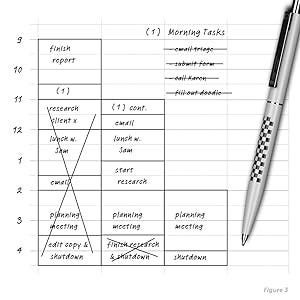
Embracing Time Block planning has not only significantly boosted my productivity but has also become a game-changer in reducing my stress levels.
The beauty of this method lies not just in producing more work efficiently but in reclaiming control over your time.
If you haven’t given it a try yet, I highly encourage you to incorporate Time Block planning into your routine.
Share your experiences and thoughts in the comments below — I’m eager to hear how this strategy transforms your approach to daily tasks.
About the Author
My name is Dave 👋
I’m always on the hunt for strategies to unlock high performance and dedicated to assisting others in their journey towards self-improvement.
If you enjoyed this article, please consider following me and subscribing to receive my articles directly to your inbox.
Note: This article contains affiliate links, which means I may earn a commission if you make a purchase through these links. There is no extra cost to you, and I only recommend products and services that I believe in.


