
How to be a good consultant-Principle 3 of 7
7 principles of Professional Services
Being a Consultant is not an easy job and there is a reason why Consultants are handsomely paid.
When a team hires an external Consultant, they expect that they provide more value than their own team members. A consultant carries this burden of high expectations on his shoulders throughout the time of their engagement.
Anyone who wants to become a Consultant must read “The Seven Principles of Professional Services” by Shane Anastasi. I was lucky that I got referred to this book by one of my colleagues.
These 7 principles now act as a constant reminder to help me become more valuable with my services.
I would highly recommend buying this book and reading it multiple times. (Please note that I am not affiliated with this book. These are my personal opinions)
In this story, I have noted down key takeaways for the 3rd Principle from the book which says “Manage Expectations”. This in no way covers all the important points mentioned in the book. I have only noted down the ones that are most relevant from my point of view.

Principle 3: Manage Expectations
Focus Area: Delivering engagements successfully
The customer has hired you to help them in achieving their business outcomes. If low expectations are set, the customer will not see any value in engaging you or your firm whereas if you set high expectations, you may not be able to deliver with good quality.
The engagement kick-off session is one of the most important meetings you will have with the customer. Use this meeting to understand the customer’s expectations. If there is a misalignment of expectations, raise it immediately and take every action to get the alignment.
The Law of Triple Constraint
The contract for the engagement will define the scope, the effort/cost required to achieve the required scope within an expected time.
These 3 constraints are bound by a relationship called the “Law of Triple Constraint”.
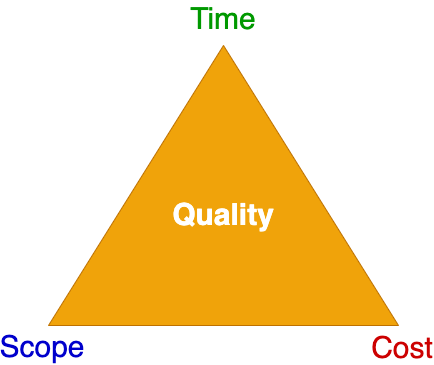
The law states that efforts/cost, scope, and time together create the overall quality of the service delivered through the contract. If any one of these elements shifts, the other elements should also shift proportionally if the quality has to be retained. If the other elements don't shift, there will be a negative impact on the overall quality.
Read about the next principle here:


