
How to Become a Freelance Data Analyst in 2024
Here’s how to stand out from the competition, get your first client, and actually start making money.

Have you ever wondered what it would be like — sipping martinis on a beach in Bali while working on a $10,000 client project?
Never having to step into an office and face the 7am rush-hour traffic again?
And never having to hear the sound of a Microsoft Teams notification when you’re just trying to enjoy a peaceful lunch while watching Netflix?
Welcome to the life of a freelance data analyst!
Okay, that might have been an exaggeration.
However, as someone who has worked as a freelance data analyst, there are many advantages of becoming one:
- The pay is great.
- You get to work on interesting projects on your own terms.
- It’s the introvert’s dream job — the work is remote and peaceful.
In this article, I will break down what a freelance data analyst is, how you can become one, and share my own experiences in the field.
For a video version, click here.
How to become a freelance data analyst
“Data analyst” is a broad term.
I use a lot of Python and SQL, and was surprised when interviewing at a company where the job solely entailed working in Excel.
I know a data analyst whose sole focus is on creating dashboards and doing BI work.
Since the field is so broad, you first need to figure out what type of data analyst you are.
Step 1 is to identify:
- What tools and languages you specialize in
- What problems you can help companies solve
I have an entire video outlining how you can become a data analyst, and the different types of analysts out there. You can watch it if you’re unsure how to start.
Once you’ve found your niche — which includes the tools and skills to specialize in — try to get as good at it as you possibly can.
There is a sea of resources on the internet to help you do this, including online courses, code-along projects, and certifications.
Step 2 is to register onto two platforms:
Upwork and Fiverr.
These are freelance platforms that contain a myriad of jobs you can apply to.
You essentially “bid” for roles, providing a description of your skill set and giving them a quote.
For instance, if a job is listed for $200, you might want to bid at a slightly lower rate (such as $100 or $150), to improve your chances of getting hired.
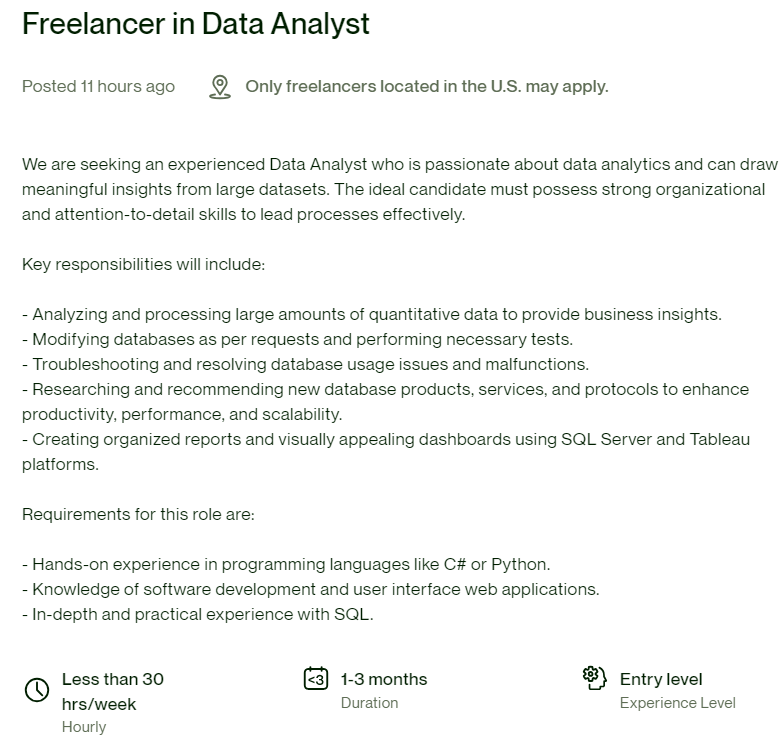
Here is an example of a data analyst job listing on Upwork:
And that’s it! That’s the 3-step process.
All you need to do is:
- Identify your niche
- Learn the skills required to become a data analyst
- Apply to jobs on Upwork and Fiverr, land an interview, and get hired.
Sounds easy, right?
Unfortunately, it isn’t that simple.
Freelancing is competitive.
I’m not going to lie to you.
It is difficult to become a freelancer in 2024. And not just in the data industry, but in almost every field.
The competition is tough, since everyone wants the luxury of working remotely on their own terms.
Furthermore, you’re facing a chicken and egg problem on freelance platforms like Upwork and Fiverr.
It goes like this:
- Nobody will give you a job because you are just starting out. You have no work experience, no reviews, and aren’t a highly rated freelancer.
- The only way to get reviews or become a highly rated freelancer is to get a job in the first place.
I’ve been in this situation before. It’s frustrating.
After having completed a couple of certifications in programming and SQL, I tried to get jobs on freelance platforms.
I bid for roles on Upwork and set my rates extremely low, simply because I wanted someone to give me an opportunity.
But all I got in response was radio silence.
And while the knee-jerk reaction is to blame employers for not giving you a chance, look at it from their point of view.
Wouldn’t you want to hire someone who you already know is trustworthy?
Someone who already has referrals and credibility — who you know can get the job done?
Having been in a position where I’ve helped review resumes and shortlist candidates for jobs, I’ve realized that the hiring process is time-consuming and expensive.
Employers tend to gravitate towards the most promising candidates — candidates who have a proven track record of success.
How to become a freelance data analyst in 2024
We now know that to get a freelance gig as a data analyst, you must have credibility. People need to trust that you can get the job done.
But how do you establish credibility when you have no prior work experience, no references, and no strong educational background?
The answer — an online presence.
When I was just getting into the data industry, I had a ton of self-doubt. I didn’t know how I was going to learn the skills necessary to get my first few gigs and start making money.
I didn’t have access to mentors or role-models around me.
My peers were on a completely different career path, and my university’s resources were specific to helping students land full-time roles.
That’s when I turned to the Internet for advice.
I started to closely emulate the decisions of people who had the life and career path I desired.
Daniel Bourke is one such person.
Daniel used to work as a part-time Uber driver while teaching himself data science and machine-learning.
He would document his learning path through blog posts and YouTube videos. He used his spare time to create machine learning projects.
This man had no technical degree and no corporate experience.
He just knew that he didn’t want to continue driving Uber for the rest of his life.
One day, a friend of his came across Daniel’s machine learning articles and referred him to an employer.
He got an internship as a machine learning engineer.
When I was trying to emulate his career path 3 years ago, Daniel was doing freelance work for reputable companies like Datacamp.
He was making around $10,000/month at that time, from passive income and freelance gigs alone.
And that was then.
Daniel went on to get more freelance opportunities. He now has multiple online courses on Udemy, where he breaks down difficult concepts in a way that is fun and easy to understand.
I’ve purchased one of his courses on Tensorflow when I was teaching myself deep learning.
To reiterate, Daniel is one of those people who would have been ignored indefinitely on freelance platforms, had he just applied to jobs when starting out.
He is now making more money than the top freelancers on these platforms.
Daniel’s large breakthrough came from through things:
- Side projects
- An online presence
He created machine learning projects and showcased them on social media. He made various YouTube videos documenting his learning journey.
From there, the opportunities came flooding in.
So… How can you do what Daniel did?
Step 1
Firstly, build personal projects.
If you don’t have any work experience or a technical background, the best way to showcase what you can do is through personal projects.
For instance, if you’ve just taken a Tableau course, create a dashboard related to something you have genuine interest in.
Build things that tell a story.
For example, I’ve always been interested in solving social issues with data, so my first project was a dashboard showcasing gender disparity in Hollywood.
Daniel took a course on bioinformatics on Coursera.
Because his friend’s son was born deaf, he created a project designed to understand genetic causes of hearing loss.
He then shared all his code publicly and made a video explaining what he’d done.
Daniel combined the knowledge that he had gained with a topic and person he was passionate about. And created a project that told a story.
People love stories.
I watched the video on Daniel’s project 3 years ago.
I still remember it.
Step 2
Promote your work.
How will people know what you’re capable of if you don’t show them?
After creating projects, promote them everywhere — on LinkedIn, Medium, and Substack.
You can also make videos about them, just like Daniel did.
This article on a data analysis project got me a client I’ve been working with for almost 3 years now. And this article got me my first ever freelance client.
Keep in mind that my own network was devoid of opportunities.
So I had to get creative.
My freelance clients were people who lived in different parts of the world — individuals whom I never would have met or interacted with, if not for my projects.
These people found me because I spent so much time promoting my work.
I optimized my website, posted frequently on LinkedIn, and wrote articles about all my projects.
Step 3
Be consistent.
Back in 2020, I created my very first data analytics project on gender disparity in Hollywood.
I wrote about it.
And…nothing happened.
I got a total of 10 reads, and one person liked my article. That one person was my own dad.
It took at least 5 projects, 20 failed attempts, and 50 social media posts to even start getting noticed by hiring managers.
But everything became much easier once I got my first freelance job.
My employer wrote me a recommendation.
I started getting positive ratings on Upwork which pushed my profile to the top of the platform and increased my visibility.
I stopped applying to gigs, and let employers reach out to me instead.
I was able to be picky about jobs and rates.
Now, although I’m slowly moving away from freelancing, I still get invites on Upwork to interview for data-related jobs.
And that is because I have a profile that is being shown to employers, and previous work that people are finding on the Internet because I decided to put it out there 3 years ago.
I’m giving you homework.
If you’re anything like I used to be, you’re probably the type to watch YouTube videos and read an endless number of Medium articles, but fall short when it comes to implementing any of the advice yourself.
And that’s not your fault.
It is always easier to talk and think about doing things than it is to actually do them.
Motivation is fleeting. It is a temporary feeling.
However, since you’ve clicked on this article and read this far, you clearly are dedicated to upskilling, making more money, and getting ahead in 2024.
I’m going to hold you accountable to that.
Here are 3 things you are going to do after reading this article:
1. You’re going to write down your goals for 2024.
Whether it’s getting a full-time job in the data industry, or landing 10 freelance clients, you are going to write down all your goals for the year.
2. Break your goals down into smaller goals.
For example, if your larger goal is to become a freelance data analyst, your smaller goals can be:
- Creating two projects and post about them on LinkedIn
- Upskilling by completing an online course on data analytics
- Getting certified
The process of breaking your goals down is called chunking. This makes your goals less overwhelming and more attainable — helping you take smaller steps towards achieving it everyday.
3. Do one thing today that brings you closer to your goal.
It doesn’t have to be a big step.
For example, if your goal is to become a data analyst, simply sign up to Coursera, and find a course that aligns with what you need to learn.
You don’t even have to buy it.
Or go onto LinkedIn or Instagram and follow 10 people who have the career you want.
My personal favorites are Daniel Bourke and Alex the Analyst.
When you open your phone and see their posts every day, that will inspire you to work towards your goal.
And that is all for this article!
I hope that you’ve gained some insight into how you can become a freelance data analyst in 2024.
Or at the very least, hopefully I’ve motivated you to take the next step in your data career, whatever that might be.
Thanks for reading!
Note: This article contains affiliate links.


