
Satire
How to Be Supremely Confident and Gulliblise People
A concise guide to being confident so that other people will want to be influenced by you

Have you seen how successful confident people are? Don’t you get pissed off at how everyone just ends up getting influenced by confident people (instead of you)?
In this article, I am going to show you how to be confident. You may notice that I said ‘be’ confident, not look confident. Yes, that’s right! I am talking about actually being confident, not appearing confident; not trying to be confident; not learning how to be confident; not fake until you make it type of confidence. I am going to share with you the secret to actually BE supremely confident.
But first, let’s have a quick look at the role of confidence in your writing.
Role of confidence in writing
I touched upon the subject of confidence in my previous article in the context of personal essays. i.e. showing too much confidence in an oversharing scenario is not advisable. But on the other hand, if you are writing something telling people how to live their lives, how to do XYZ better, etc. you absolutely need to demonstrate oodles of confidence. Because what you are doing there is selling something. It could be advice, hope or plain bullshit. You are trying to get other people to buy it.
Let’s take an example from a typical sales scenario. Say you are at a car dealership looking at a car you like. A sales guy approaches beaming with a Chicken Run smile saying “Great car mate! You can’t go wrong with this beauty.” His confidence in the car will rub on you, right? Now imagine a different salesperson who leads with something like this: “I think it’s a good car. Er… I mean this model has had only about 24% new car recalls in the last year, which is slightly better than most other models in the same category.” Who would you buy the car from?
The role of confidence is the same whether you are selling cars in a yard or selling snake oil online. If you don’t look and sound confident, nobody is going to buy your shit.
Where does confidence come from — some science
I am going to back my arguments in this article with some solid scientific facts, instead of just relying on pseudoscience like I would usually do. The theory I am going to introduce you to comes from the field of social psychology. It’s called the Dunning-Kruger effect.
David Dunning and Justin Kruger, both professors in social psychology came up with this theory that can be summarised in the diagram below:
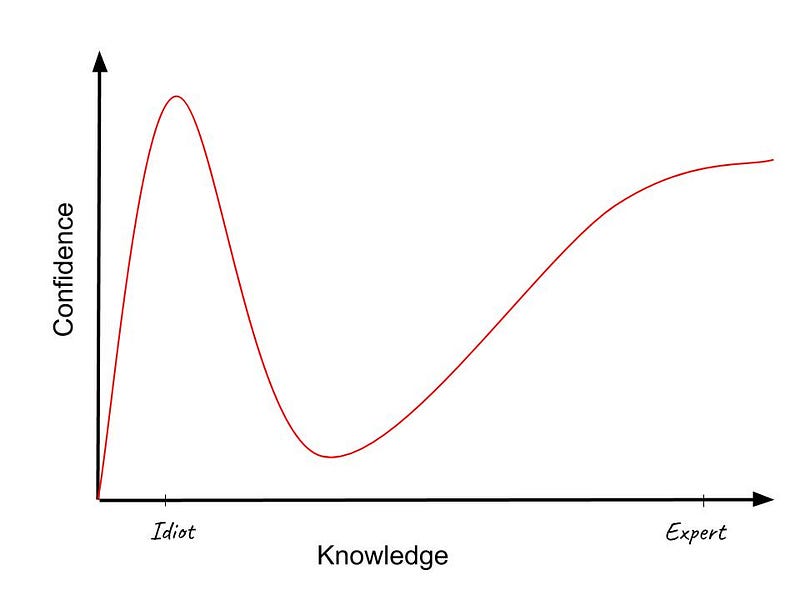
For any (almost) given topic, the level of confidence someone demonstrates is higher the less they really know about it. Of course, if you have zero knowledge you don’t even know the topic exists, so your confidence on the topic is zero too. But once you know a little about it, your confidence on the topic will skyrocket. Then when or if you actually start gaining more knowledge beyond a certain point, the confidence nose dives with the realization that there is a lot more shit you don’t know than you do know.
You may consider the right-hand half of the graph is a bit redundant. It shows that eventually, after a long long time, your confidence will grow as/if you become an expert on the topic. But that is after years of learning and gaining hands-on experience, so most likely it is going to be irrelevant to you and me.
Applying the Dunning-Kruger effect to your everyday life
Like with anything else, people can take the Dunning-Kruger effect in different ways. Some put a negative spin on it to put down other people, but let’s not languish on the negativity. I invite you to see the positives in this. At the start of this article, I promised you the real secret to immeasurable confidence. The answer is right there — see it?
The secret to being supremely confident about anything is knowing as little as possible about it!
Going back to our example of two car salesmen, which salesman do you think suffered from knowing too much about cars? And which salesman do you think earns more commission at the end of the day? It is not what you have to say or how valid what you have to say is, it’s how you say it that matters, even if it is total baloney. Now I pointed it out, I’m sure you can think of many examples yourself, e.g. think of overconfident politicians and guess how much they really know about running a country.
To prove this point I only read the Wikipedia page on Dunning-Kruger effect and watched only the single video linked at the end of this article, in which John Cleese introduces Dunning-Kruger effect. I resisted the temptation to read up more about it. By limiting my research to a maximum of ten minutes I ensured that I can write about this with so much confidence that you can see the confidence oozing through these words. Had I read more about it, I may even have learned that I am misrepresenting the Dunning-Kruger research.
Now go put this theory into practice. Go read about something you had no freaking idea about for no more than ten minutes and write an awesome blog post. Readers will flock to it like flies. Trust me.
Okay, I gotta go now. I still haven’t figured out this Haiku business. What’s the deal with three lines? Three, not four? Odd number? Say you start writing a four-line stanza and get stuck unable to come up with the last line, (which is supposed to be the punch line), can you give up half-assedly and call it a haiku? I should Google about it.
You may also like my other dodgy blogging advice:
Author’s notes:
* Gulliblise is a totally legit word. You should add it to your vocabulary too.
* References: https://www.google.com/search?q=dunning+kruger+effect
* The video mentioned earlier:


